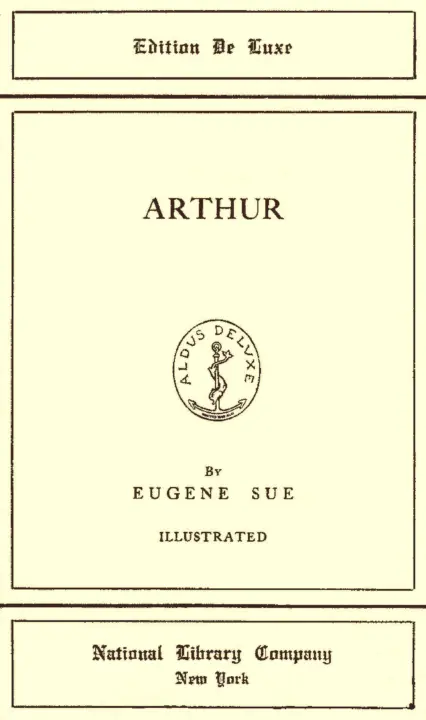
Arthur
Eugène Sue
THE CLASSIC COLLECTION · 1892
"A Cardinal Sin" by Eugène Sue is a novel written in the late 19th century. The story revolves around Mariette, a young girl facing poverty and hardship as she tries to care for her ailing godmother while dreaming of a life filled with love and happiness. The narrative highlights themes of love, sacrifice, and the struggles of the lower class in society. The opening portion introduces Mariette as she visits a public scribe to have a letter written to her beloved, Louis. Through their interaction, we learn of her life’s burdens, including her responsibilities towards her sick godmother and her longing for a better future. As Mariette dictates her heartfelt letter, she reveals her devotion and emotional turmoil, setting the stage for the complex interplay of love, social struggles, and sacrifice that will likely unfold in the novel. A parallel story emerges through the scribe’s furtive glances and apprehensions, hinting at deeper connections and potential conflicts as Mariette's love story develops amidst societal challenges.
Introduction adapted from the source catalogue; source summaries may be automatically generated.
Free to read · English · 43,164 words · No account needed
MAKE TIME FOR A GOOD BOOK
On by default. Untick to stop anonymous reading totals. Each page counts after 10 seconds in view. How this works.
Anonymous counting is on unless you have switched it off.
Louis understood it all, however, from the chance meeting of Mariette with his father, to the stratagem of the latter to deceive them both. This abuse of confidence overwhelmed him with such grief and shame, that he dared not admit the tie of relationship existing between himself and the public scribe, but sought another plausible explanation of this deceit and treachery.
"Notwithstanding his apparent good nature and benevolence, this old rascal must have been trying to amuse himself at your expense, my poor Mariette," said the young man. "He read you just the contrary of what I had written."
"Oh! how could he be so cruel!" cried the girl, clasping her two hands together. "He appeared so good, and expressed his sympathy so kindly for poor creatures like me, who can neither read nor write."
"One thing is evident, my dear Mariette, he certainly deceived you."
"But did you receive my letter at Dreux?"
"It must have reached that city after I had left it," he said, unwilling to admit that it had been addressed to Paris. "But never mind it now," he added, anxious to drop a conversation which pained him so deeply; "we are happy and--"
"Yes, you are happy enough," put in Mme. Lacombe, "but what about me?"
"What do you mean, godmother?" asked Mariette.
"I mean that I will never consent to such a marriage," she said harshly.
"But my dear madame--" began Louis.
"Tut, tut, tut, soft words won't blind me, young man;" she interrupted roughly. "If you are the son of a public writer, you are as penniless as Mariette; and two miseries united in marriage are worth three single ones. My goddaughter has enough of me to support, without a troop of famished children."
"But, my dear godmother--" protested the girl.
"Don't bother me!" she retorted angrily. "I know your plans; you simply want to rid yourself of me and leave me in the gutter to starve."
"How can you believe such a thing!" cried Mariette, reproachfully, her
eyes full of tears.
"Your fears are groundless, I assure you," Louis hastened to say. "I have just discovered that my father is immensely wealthy, but for reasons of his own, he has kept the matter a secret until now."
Mariette gazed at Louis with an air of mingled astonishment and delight at this unexpected information. Then she smiled through her tears and said, with a shade of defiance in her gentle voice: "You see, godmother, that the picture is not as dark as you painted it, we are quite able to take care of you as well as ourselves."
Your reading position is saved on this browser. Take it to another device with a library code. Reading pages adapt to text, rather than matching a printed edition.
Eugène Sue
Eugène Sue
Eugène Sue
Eugène Sue
BEHIND THE BOOK
This eBook is for the use of anyone anywhere in the United States and most other parts of the world at no cost and with almost no restrictions whatsoever. You may copy it, give it away or re-use it under the terms of the Project Gutenberg License included with this eBook or online at www.gutenberg.org. If you are not located in the United States, you will have to check the laws of the country where you are located before using this eBook. Read the source licence.
The original source file, including credits and licence, is retained by this library. Request an original-format copy at no charge. Please include the book title and Project Gutenberg identifier #18832.
KEEP YOUR CURIOSITY GOING
Coulson Kernahan

Maurice Baring
Frances Wright
Cécile Tormay

Frederic Jesup Stimson

W. H. P. (William Henry Pope) Jarvis