THE CLASSIC COLLECTION✦The Danube from the Black Forest to the Black SeaCLASSIC FREE BOOKS
The Danube from the Black Forest to the Black Sea
Francis Davis Millet
THE CLASSIC COLLECTION · 1892
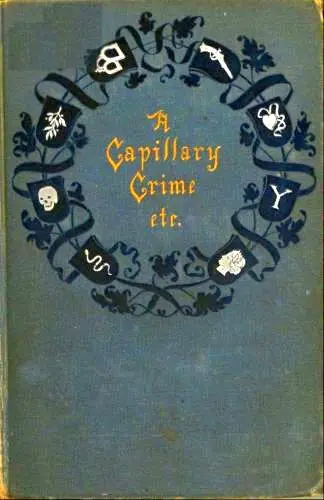
"A Capillary Crime and Other Stories" by Francis Davis Millet is a collection of short stories written in the late 19th century. The stories explore various themes driven by intrigue, human emotions, and unexpected occurrences, with the titular tale "A Capillary Crime" centering on the mysterious murder of an artist in Paris and the investigation that follows. At the start of "A Capillary Crime," the narrative unfolds in a quiet street in Montmartre, Paris, which reflects a juxtaposition of the bustling city life nearby. The scene sets a foreboding tone as it introduces the sudden death of artist Charles Mandel, whose lifeless body is discovered in his studio under mysterious circumstances. A young woman, familiar with the locality, emerges anxious and flustered, hinting at her connection to the artist, while police officers begin their examinations amid a gathering crowd. As the investigation commences, the tragic incident reveals layers of complex relationships and motivations, capturing the reader's interest in uncovering the truth behind the unsettling events.
Introduction adapted from the source catalogue; source summaries may be automatically generated.
Free to read · English · 48,949 words · No account needed
MAKE TIME FOR A GOOD BOOK
On by default. Untick to stop anonymous reading totals. Each page counts after 10 seconds in view. How this works.
Anonymous counting is on unless you have switched it off.
“MONSIEUR,--En fait de renseignements sur la dilatation du bois je ne connais que ceux donnés par M. Reynaud dans son traité d’architecture, vol. i., pages 84 à 87 de la 2ᵉ êdition.
“Il en résulte que:
“1. Les bois verts se dilatent beaucoup plus que ceux purgés de
sève.
“2. Que le chêne se dilate tantôt plus tantôt moins que le sapin, mais plus que le noyer.
“3. Que dans les conditions ordinaires, c’est à dire, avec les variations hygrométriques de l’air seulement, le coefficient de dilatation atteint au plus 0.018, d’où résulte qu’une planche de 0.20 deviendrait 0.2036.
“4. Qu’en plongeant dans l’eau pendant longtemps une planche primitivement très sèche, le coefficient de dilatation peut atteindre 0.0375, ce que donnerait pour la planche de 0.20, 0.2075.
“Peut-être vous trouverez d’autres renseignements dans le traité de charpente du Colonel Emy, ou dans celui de menuiserie de Roubo.
“Recevez, Monsieur, l’assurance de mes sentiments distingués.
A few days later there was gathered in a small room in the prefecture quite a knot of advocates and police officers. They were soon joined by Benner himself, accompanied by a short, stout gentleman with eye-glasses. Besides the ordinary furniture of the room, there was a wash-tub, a pail of water, a manikin, and the drawing-board with the mechanism on it. The entrance of the judge put a stop to the buzz of conversation, and when he took a seat on the low platform the rest of the company placed themselves on the benches in front. The judge, after a few preliminary remarks on the subject of the mystery of Montmartre, said that there had lately been developed such a new and surprising theory to account for the death of the artist that he had consented to give a hearing to the explanation of the theory. Benner then arose and made the following statement: “In the Café du Rat Mort, a few days ago, I noticed a peculiar movement in a broken match as it lay on the table before me. At first my curiosity was excited only to a moderate degree, but shortly this inexplicable motion interested me so that I experimented until I found the cause of it. At the same moment there flashed into my mind what I had learned long ago at school about capillary force, and the solution of the mystery of my friend’s death was at once plain to me. Hurrying to my studio, I cut off the hand of my manikin, and carried it to the Academy of Fine Arts to show it to Professor Brunin, of the Architectural Department, and ask his assistance. Finding him neither there nor at his house, I wrote him a note and left it for him. All that night I worked constructing a working model of a manikin’s finger, and the next morning I received a letter from Professor Brunin which gave me the data I was in search of--the facts in regard to the expansion of wood when moistened. I should read that letter here, but Professor Brunin is present, and will explain the phenomenon. My theory is very simple. My friend Charles Mandel was shot by his own manikin. There are witnesses enough to prove that the pistol had been loaded for a long time, and that Mandel had often tried in vain to draw the charge. It is also well known that the pistol was cocked when it was in the manikin’s belt, for on the half-completed picture it was so painted by Mandel on the last day of his life. Furthermore, the position of the right index finger of the manikin can also be plainly seen in the picture; for the artist, not having a model to hold the weapon, had roughly rubbed in the angular fingers of the lay figure, preparatory to finishing the hand from life. The pistol then, being loaded and cocked, needed but the pressure of the finger to discharge it. That pressure was given by the rain on the night of the death of my friend. The lieutenant will find, on reference to his note-book, that on the morning when he examined the studio there had been quite a serious leak in the ceiling, and that the water had fallen directly on the manikin. He will find also in his notes the exact position of the manikin in reference to the divan on which the corpse lay. Now, it is clear that when the wrist of the manikin was bent, and the index finger was placed on the trigger of the pistol, only a very slight motion of the whole was necessary to give the pressure required to fire a pistol. The weapon was braced against the inside of the thumb of the hand, and thus held firmly there as it stuck in the belt ready to be drawn and fired. When the water first fell from the ceiling, it soaked the covering of the wrist and hand, and swelled the wrist joint so that it became absolutely immovable. Next the moisture extended to the tip of the fingers, the hand being held somewhat downward. In the manikin we have here, the exact construction of the fingers and the movement of the joints of the hand and wrist can be plainly seen. In my working model I have imitated the mechanism of one finger, so arranging it that the least deflection of the finger from the straight line will be measured on a scale of millimetres. The joints are so constructed that any elongation of the pieces of wood will curve the line of joints away from the straight line which I have drawn on the board. I propose to experiment with this model so as to make it perfectly plain that my friend’s death was accidental. If the experiment were tried on the manikin, and with a flint-lock pistol, it would doubtless fail ninety-nine cases out of a hundred. In the accident which caused my friend’s death everything happened to be perfectly adjusted. If my model works, of course the manikin might have worked in exactly the same way.”
Your reading position is saved on this browser. Take it to another device with a library code. Reading pages adapt to text, rather than matching a printed edition.
Francis Davis Millet

Francis Davis Millet & W. Hamilton (William Hamilton) Gibson & Will H. (Will Hicok) Low & John Ames Mitchell & Francis Hopkinson Smith
BEHIND THE BOOK
This eBook is for the use of anyone anywhere in the United States and most other parts of the world at no cost and with almost no restrictions whatsoever. You may copy it, give it away or re-use it under the terms of the Project Gutenberg License included with this eBook or online at www.gutenberg.org. If you are not located in the United States, you will have to check the laws of the country where you are located before using this eBook. Read the source licence.
The original source file, including credits and licence, is retained by this library. Request an original-format copy at no charge. Please include the book title and Project Gutenberg identifier #62030.
KEEP YOUR CURIOSITY GOING
Coulson Kernahan

Maurice Baring
Frances Wright
Cécile Tormay

Frederic Jesup Stimson

W. H. P. (William Henry Pope) Jarvis