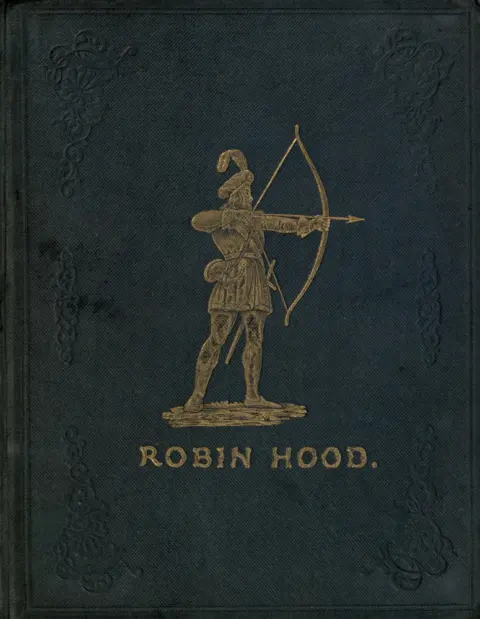
Robin Hood and His Merry Foresters
Joseph Cundall
THE CLASSIC COLLECTION · 1895
"A Brief History of Wood-Engraving From Its Invention" by Joseph Cundall is a historical account, likely written in the late 19th century. This work explores the evolution of wood-engraving from its origins, providing insights into its significance across various European countries, particularly during the formative years of the art in the 15th and 16th centuries. The opening of the text introduces the reader to the history of wood-engraving, beginning with early forms of the art found in religious prints, particularly images of saints. Cundall mentions the first known woodcuts and the context in which they were created, highlighting the technical aspects and the craftsmanship involved. He illustrates the types of subjects within early wood-engraving, emphasizing devotional images and their significance in monasteries and public veneration. The author also references various notable pieces, noting a colored print of the Virgin with the Holy Child as an example, and discusses the debates surrounding early wood engravings to set the stage for a more comprehensive exploration of the medium's development in subsequent chapters.
Introduction adapted from the source catalogue; source summaries may be automatically generated.
Free to read · English · 28,162 words · No account needed
MAKE TIME FOR A GOOD BOOK
On by default. Untick to stop anonymous reading totals. Each page counts after 10 seconds in view. How this works.
Anonymous counting is on unless you have switched it off.
In order to assist our readers in reading the text printed with the early woodcuts, we give them a key to the most usual abbreviations of Monkish Latin.
************************************************************************* ** Transcriber's note: In paragraph 1. [-e] denotes a letter with a ** ** straight line over (or through the riser), [~e] the same with a ** ** tilde-like curve. ** *************************************************************************
1. A right line, thus (-), and a curve, thus (~), placed horizontally over a letter, denote: (-) 1st, over a vowel in the middle or end of a word, that one letter is wanting, e.g. v[-e]d[-a]t=vendant, bon[-u]=bonum, terr[-a]=terram. (~) 2nd, above or through a letter=the omission of more than one letter, e.g. a[~i]a=anima, a[~l]r=aliter, a[~l]ia=animalia, abla[~c]o=ablatio, Winto[~n]=Wintonia, no[~b]=nobis, &c. A straight line through a consonant also denotes the omission of one or more letters, e.g. vo[-b]=vobis, q[-d]=quod, &c.
************************************************************************* ** Transcriber's note: In paragraph 2. ? denotes a backward curl ** ** attached to the top of a letter. ** *************************************************************************
2. [?]=er, or re, as the sense requires, e.g. [?t]ra=terra, [?p]dictus=predictus, i.e. prædictus.
************************************************************************* ** Transcriber's note: In paragraph 3. the first [?e] has an oblique ** ** line attached below the letter, the second a lightning bolt. ** *************************************************************************
3. The diphthong is sometimes represented thus, terr[?e] or
terr[?e]=terræ.
************************************************************************* ** Transcriber's note: In paragraph 4. the first [-p] has a straight ** ** line & the second a wavy one (like a tilde) through the ** * descender. In the third a line continues the bottom of the loop ** ** and bends down to cut the descender. ** *************************************************************************
4. A straight or curved line through the letter p, thus, [-p] [-p]=per, por, and par. A curved line, thus [-p]=pro.
************************************************************************* ** Transcriber's note: In paragraph 5. the sign [3] resembles the ** ** type of 3 with an angled top, or a drachm sign. ** *************************************************************************
5. The character [3] at the end of a word=us, omnib[3]=omnibus, also et, deb[3]=debet. {19}
************************************************************************* ** Transcriber's note: In paragraph 6. the sign [zs] resembles a z ** ** with a reversed s drawn through the bottom stroke. ** *************************************************************************
6. The figure [zs] at the end of a word=rum, ras, res, ris, and ram; eo[zs]=eorum, lib[zs]=libras or libris, Windeso[zs]=Windesores, Alieno[zs]=Alienoram, &c.
************************************************************************* ** Transcriber's note: In paragraph 7. the sign [-&] is an ampersand ** ** with a straight line over; [q3] a q with a mark like a small 3 ** ** on the right; [9] a raised spiral rather like a 9, [c)] has a ** ** long bracket-shaped mark descending below the baseline. ** *************************************************************************
Your reading position is saved on this browser. Take it to another device with a library code. Reading pages adapt to text, rather than matching a printed edition.
Joseph Cundall
BEHIND THE BOOK
This eBook is for the use of anyone anywhere in the United States and most other parts of the world at no cost and with almost no restrictions whatsoever. You may copy it, give it away or re-use it under the terms of the Project Gutenberg License included with this eBook or online at www.gutenberg.org. If you are not located in the United States, you will have to check the laws of the country where you are located before using this eBook. Read the source licence.
The original source file, including credits and licence, is retained by this library. Request an original-format copy at no charge. Please include the book title and Project Gutenberg identifier #40589.
KEEP YOUR CURIOSITY GOING
Cécile Tormay

Moritz Busch
John L. Ransom
Frances Wright
Cécile Tormay

Mabel Potter Daggett