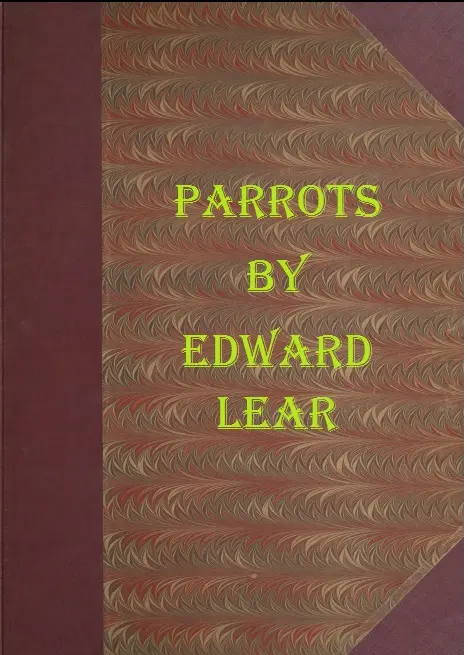
Illustrations of the Family of Psittacidæ, or Parrots The greater part of them species hitherto unfigured, containing forty-two lithographic plates, drawings from life, and on stone
Edward Lear
THE CLASSIC COLLECTION · 1846
"A Book of Nonsense" by Edward Lear is a whimsical collection of children's poetry created in the 19th century. This book belongs to the genre of children's literature and is notably recognized for its playful use of nonsense verse and rhyme. Lear's work is emblematic of the Victorian era, showcasing an imaginative landscape where absurdity and humor reign. It engages young readers with its delightful characters and humorous situations, inviting them into a world of silliness. The book features a series of amusing limericks, each centered around eccentric characters, mainly "Old Men" and "Young Ladies," who find themselves in ludicrous and entertaining predicaments. Each poem encapsulates a brief narrative filled with quirky scenarios, from cats being mistaken for objects to the peculiar habits of oddly behaving individuals. The vibrant illustrations that accompany the verses further enhance the joviality of Lear's creations. Through its playful language and silly stories, "A Book of Nonsense" delights readers of all ages and invites them to appreciate the joy of imagination and laughter.
Introduction adapted from the source catalogue; source summaries may be automatically generated.
Free to read · English · 3,669 words · No account needed
MAKE TIME FOR A GOOD BOOK
On by default. Untick to stop anonymous reading totals. Each page counts after 10 seconds in view. How this works.
Anonymous counting is on unless you have switched it off.
There was a Young Lady of Welling,
Whose praise all the world was a-telling;
She played on the harp, and caught several Carp,
That accomplished Young Lady of Welling.
There was an Old Person of Tartary,
Who divided his jugular artery;
But he screeched to his Wife, and she said, "Oh, my life!
Your death will be felt by all Tartary!"
There was an Old Man of Whitehaven,
Who danced a quadrille with a Raven;
But they said, "It's absurd to encourage this bird!"
So they smashed that Old Man of Whitehaven.
There was a Young Lady of Sweden,
Who went by the slow train to Weedon;
When they cried, "Weedon Station!" she made no observation,
But thought she should go back to Sweden.
There was an Old Person of Chester,
Whom several small children did pester;
They threw some large stones, which broke most of his bones,
And displeased that Old Person of Chester.
There was an Old Man of the Cape,
Who possessed a large Barbary Ape;
Till the Ape, one dark night, set the house all alight,
Which burned that Old Man of the Cape.
There was an Old Person of Burton,
Whose answers were rather uncertain;
When they said, "How d' ye do?" he replied, "Who are you?"
That distressing Old Person of Burton.
There was an Old Person of Ems
Who casually fell in the Thames;
And when he was found, they said he was drowned,
That unlucky Old Person of Ems.
There was a Young Girl of Majorca,
Whose Aunt was a very fast walker;
She walked seventy miles, and leaped fifteen stiles,
Which astonished that Girl of Majorca.
There was a Young Lady of Poole,
Whose soup was excessively cool;
So she put it to boil by the aid of some oil,
That ingenious Young Lady of Poole.
There was an Old Lady of Prague,
Whose language was horribly vague;
When they said, "Are these caps?" she answered, "Perhaps!"
That oracular Lady of Prague.
There was a Young Lady of Parma,
Whose conduct grew calmer and calmer:
When they said, "Are you dumb?" she merely said, "Hum!"
That provoking Young Lady of Parma.
There was an Old Person of Sparta,
Who had twenty-five sons and one "darter;"
He fed them on Snails, and weighed them in scales,
That wonderful Person of Sparta.
There was an Old Man on whose nose
Most birds of the air could repose;
But they all flew away at the closing of day,
Which relieved that Old Man and his nose.
Your reading position is saved on this browser. Take it to another device with a library code. Reading pages adapt to text, rather than matching a printed edition.
Edward Lear
Edward Lear
Edward Lear
Edward Lear
BEHIND THE BOOK
This eBook is for the use of anyone anywhere in the United States and most other parts of the world at no cost and with almost no restrictions whatsoever. You may copy it, give it away or re-use it under the terms of the Project Gutenberg License included with this eBook or online at www.gutenberg.org. If you are not located in the United States, you will have to check the laws of the country where you are located before using this eBook. Read the source licence.
The original source file, including credits and licence, is retained by this library. Request an original-format copy at no charge. Please include the book title and Project Gutenberg identifier #13646.
KEEP YOUR CURIOSITY GOING

Eric Mackay

Abby Morton Diaz
Helen Hunt Jackson
Edmund Gosse
Sophia Margaretta Hensley
Mary Frances Blaisdell