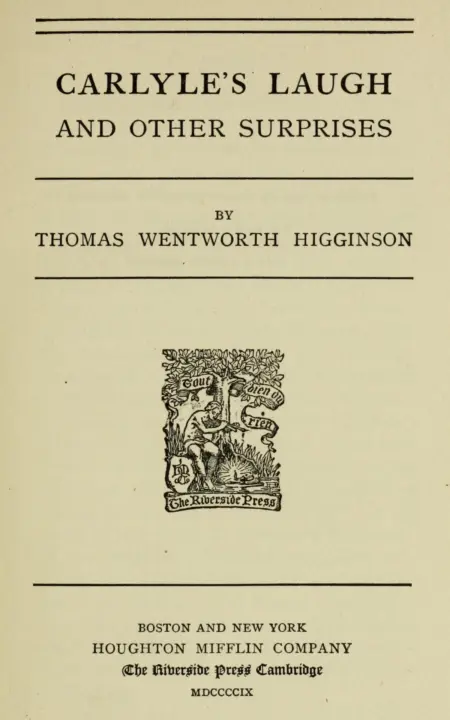
Carlyle’s laugh, and other surprises
Thomas Wentworth Higginson
THE CLASSIC COLLECTION · 1877
"A Book of American Explorers" by Thomas Wentworth Higginson is a historical account written in the late 19th century. This work offers a compilation of narratives and extracts from the stories of early explorers of America, showcasing the adventures and discoveries of figures from various nations, including Norsemen, Italians, and Spaniards. Through these accounts, readers are given a glimpse into the captivating journeys that shaped the early exploration of the American continent. At the start of the book, Higginson expresses admiration for the narratives of early American explorers, comparing them to well-known tales like "Robinson Crusoe." He outlines his intention to compile and present these stories with minimal alteration to preserve their original charm and language. The opening section introduces readers to the legends of the Northmen, detailing stories of significant figures like Leif the Lucky, who embarked on voyages to discover lands that would eventually become part of America. The narrative sets the stage for the rich tales of exploration that follow, inviting readers to delve deeper into the adventures of courage and discovery that defined an era.
Introduction adapted from the source catalogue; source summaries may be automatically generated.
Free to read · English · 92,870 words · No account needed
MAKE TIME FOR A GOOD BOOK
On by default. Untick to stop anonymous reading totals. Each page counts after 10 seconds in view. How this works.
Anonymous counting is on unless you have switched it off.
417 – A flint-lock musket, then rare.
418 – Advantage.
419 – These were the Nauset Indians.
420 – Tide.
421 – Clark’s Island. It was named after the mate of the
“Mayflower,” who is said to have been the first to land
there.
422 – This was the “landing of the Pilgrims.” Allowing for the change in the calendar, called “New Style,” it corresponds to the 21st of December, though it was long considered to correspond to the 22d. “New Style” means the modern or Gregorian mode of reckoning time, which was proposed by Pope Gregory XIII. in 1582, but not adopted in England till September, 1752.
423 – Appoint, or propose.
424 – Guard-house.
425 – Split.
426 – Surrounded by palings.
427 – Requiring.
428 – It is still called Billington Sea.
429 – Town Brook.
430 – These houses were built on each side of Leyden Street, which now extends from the First Church to the harbor.
431 – It was, however, an unusually mild winter.
432 – Beware of.
433 – Monhegan, an island on the coast of Maine.
434 – Ardent spirits.
435 – Mallard-duck.
436 – Massasoit was the name of a sachem; but they mistook it for
the name of a tribe.
437 – By.
438 – The fight took place at Martha’s Vineyard, July 1, 1620.
439 – This Captain Hunt had kidnapped Indians, and carried them to Spain as slaves. The monks of Malaga set them at liberty.
440 – Trade.
441 – Clowns.
442 – Smoked.
443 – Maladies.
444 – These may have been buttercups washed from the shore. It has also been supposed that they might be actiniæ, or sea-anemones, torn from the rocks.
445 – i.e., signs of fertility, seen in advance.
446 – Gloucester harbor.
447 – Ten-Pound Island.
448 – Afterwards Salem.
449 – John Endicott, who had arrived in September, 1628.
450 – Massachusetts.
451 – Probably the moose. The lions were imaginary.
452 – The flying-squirrel, which has a membrane connecting the fore and hind paws on each side.
453 – Inconveniences.
454 – i.e., assigned to a certain place in the ship.
455 – To protect the sides of the vessel.
456 – Lady Arbella Johnson, daughter of the Earl of Lincoln, and wife of Isaac Johnson, to whom the settlement of Boston was chiefly due. She died soon after her arrival.
457 – A part of Medford, Mass. The farm still retains the name which he gave it,――“Ten-Hills Farm.”
458 – Gun.
459 – This chief is described by Governor Dudley as “a handsome young man, conversant with us, affecting English apparel and houses, and speaking well of our God.”
460 – Oct. 11, 1631.
Page 1:
Sentence starting: These extracts are taken from....
– ‘Randa’ replaced with ‘Rauda’
(works called Tháttr Eireks Rauda)
Page 11:
Sentence starting: Thorvald said then, “We....
– ‘Throvald’ replaced with ‘Thorvald’
(Thorvald said then,)
Page 82:
Sentence starting: We sounded, and found....
– ‘ouselves’ replaced with ‘ourselves’
(and found ourselves in seven)
Page 95:
Sentence starting: Notwithstanding all this....
– ‘Nowithstanding’ replaced with ‘Notwithstanding’
(Notwithstanding all this)
Page 115:
Sentence starting: After he had with certain signs....
– ‘rubing’ replaced with ‘rubbing’
(rubbing them with his own hands)
Your reading position is saved on this browser. Take it to another device with a library code. Reading pages adapt to text, rather than matching a printed edition.
Thomas Wentworth Higginson
Thomas Wentworth Higginson
Thomas Wentworth Higginson
Thomas Wentworth Higginson
BEHIND THE BOOK
This eBook is for the use of anyone anywhere in the United States and most other parts of the world at no cost and with almost no restrictions whatsoever. You may copy it, give it away or re-use it under the terms of the Project Gutenberg License included with this eBook or online at www.gutenberg.org. If you are not located in the United States, you will have to check the laws of the country where you are located before using this eBook. Read the source licence.
The original source file, including credits and licence, is retained by this library. Request an original-format copy at no charge. Please include the book title and Project Gutenberg identifier #56346.
KEEP YOUR CURIOSITY GOING
Wilfrid Scawen Blunt
Wilfrid Scawen Blunt

E. W. (Edgar Watson) Howe
Cécile Tormay

Moritz Busch
John L. Ransom