
The Diary of a Saint
Arlo Bates
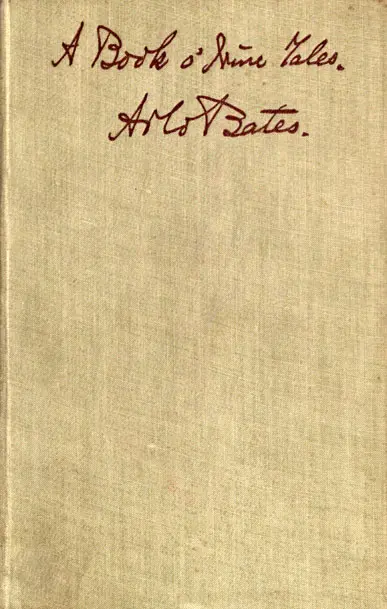
THE CLASSIC COLLECTION · 1891
"A Book o' Nine Tales" by Arlo Bates is a collection of short stories written in the late 19th century. The book opens with a tale about a mysterious wounded man found on the shore after a shipwreck, who struggles with amnesia regarding his identity. The narrative explores themes of memory, love, and the mystery of personal history through the eyes of Columbine Dysart, the young woman caring for him, as well as the stranger's perplexing past. At the start of the book, the reader meets a sick and delirious man lying in bed, unable to remember anything about himself, while a kind young nurse named Columbine tends to him. Their interactions reveal the girl's curiosity about his identity, which she weaves into her imagination as a romantic fantasy. As the man begins to regain consciousness and the light of reason in his eyes, he expresses confusion about his very existence, asking who he is. The opening sets the stage for an exploration of the characters’ evolving relationship, the poignant search for belonging, and the layers of mystery surrounding the stranger’s life.
Introduction adapted from the source catalogue; source summaries may be automatically generated.
Free to read · English · 60,213 words · No account needed
MAKE TIME FOR A GOOD BOOK
On by default. Untick to stop anonymous reading totals. Each page counts after 10 seconds in view. How this works.
Anonymous counting is on unless you have switched it off.
She. But men are such selfish creatures!
He. You are amazingly pretty when you toss your head that way. It is worth coming from New York to see.
She. It is well you think so; otherwise you might consider your voyage
a waste of time.
He. What, with the certainty of your consenting to marry me?
She. I like your assurance! Why should I marry you?
He. I supposed that with your sex the fact of my amazing attachment would be a sufficient reason.
She. Your knowledge of our sex is then remarkably limited. Apparently, whether I happen to love you is of no particular consequence.
He. Oh, love is said to beget love.
She. But you love me, you say, because I amuse you. Now you don't amuse me in the least, and as I do not know just how to cultivate a passion simply on the rather doubtful ground of your affection, especially with the chance of its being transient, there really seems to be very little chance of reciprocity.
He. Do you know what a tremendously hot day it is?
She. I don't see the connection, and I am sure I am cool enough.
He. But you make it very hot for me! How picturesque that ragged fellow over there looks, riding on the top of his high saddle.
She. With a string of mules tied to his horse's tail. I am fond of the mules, their bells are so musical.
He. And their bray.
She. And the muleteers sing such weird songs. I hear them going by about four o'clock in the morning, on their way to the Havana market, and the effect is most fascinating.
He. I should have expected you to be fond of the mules.
She. Why?
He. A fellow feeling is said to have a softening effect, and the mule's strongest characteristic is--
She. Consistency!
He. And as I was about to remark, we are apt to value others most for the virtues we do not ourselves possess.
She. You are sufficiently rude.
He. There is always danger that honesty will be thought rude.
She. Really, you begin to amuse me. Please go on; I would like to try falling in love on the amusement plan; it must be very droll.
He. Oh, bother the amusement! Like the young ladies in novels, I would be loved for myself alone.
She. I fear that would be more difficult than the other way. What have you ever done to make me admire you?
He. Perhaps nothing. Admiration presupposes the capability of
appreciation.
She. Ah! What have you done, then, worthy of admiration?
Your reading position is saved on this browser. Take it to another device with a library code. Reading pages adapt to text, rather than matching a printed edition.
Arlo Bates

Arlo Bates

Arlo Bates

Arlo Bates
BEHIND THE BOOK
This eBook is for the use of anyone anywhere in the United States and most other parts of the world at no cost and with almost no restrictions whatsoever. You may copy it, give it away or re-use it under the terms of the Project Gutenberg License included with this eBook or online at www.gutenberg.org. If you are not located in the United States, you will have to check the laws of the country where you are located before using this eBook. Read the source licence.
The original source file, including credits and licence, is retained by this library. Request an original-format copy at no charge. Please include the book title and Project Gutenberg identifier #41189.
KEEP YOUR CURIOSITY GOING
Coulson Kernahan

Maurice Baring
Frances Wright
Cécile Tormay

Frederic Jesup Stimson

W. H. P. (William Henry Pope) Jarvis