
List, Ye Landsmen! A Romance of Incident
William Clark Russell
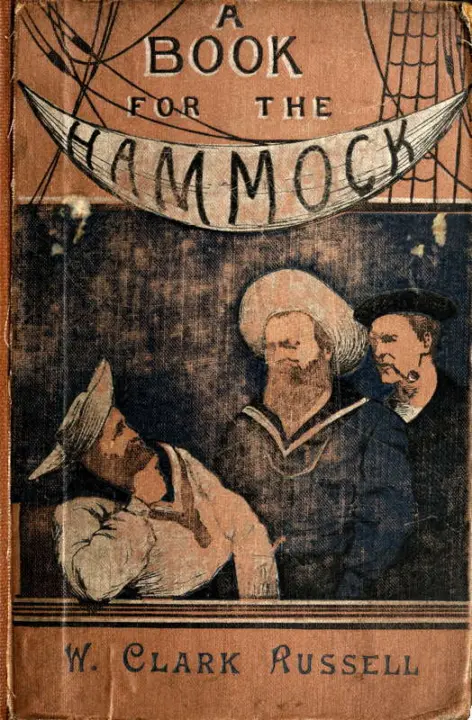
THE CLASSIC COLLECTION · 1887
"A Book for the Hammock" by William Clark Russell is a collection of nautical essays written in the late 19th century. The work reflects on the romanticism of sea life, contrasting past maritime adventures with the mechanized, prosaic realities of modern naval experiences. The essays explore themes of nostalgia for traditional seamanship, the loss of poetic engagement with the ocean, and the whimsical culture of sailors, including superstitions and life at sea. The opening of the book introduces readers to Russell's reflections on the decline of the "old romance of the sea" amid the advancements of steam-powered travel. He paints a vivid picture of a modern sailor's experience aboard a ship, pondering the beauty and mystery once associated with ocean voyages that seems lost in the face of progress. Russell laments the absence of wonder in contemporary maritime life, as sailors now rush through journeys stripped of the exploratory spirit that once characterized their trade. Through his contemplative prose, he creates a sense of longing for a bygone era filled with adventure and folklore, suggesting that the magic of the ocean has faded alongside the traditional ways of seafaring.
Introduction adapted from the source catalogue; source summaries may be automatically generated.
Free to read · English · 93,636 words · No account needed
MAKE TIME FOR A GOOD BOOK
On by default. Untick to stop anonymous reading totals. Each page counts after 10 seconds in view. How this works.
Anonymous counting is on unless you have switched it off.
“Whoever were the inventors,” writes Sir Walter Raleigh in “A Discourse of Shipping,” included in his Genuine Remains, “we find that every age hath added somewhat to ships, and to all things else; and in mine own time the shape of our English ships hath been greatly bettered. It is not long since the striking of the Top-mast (a wonderful ease to great Ships both at Sea and in Harbour) hath been devised, together with the Chain Pump, which takes up twice as much water as the ordinary did. We have lately added the Bonnet and the Drabler. To the Courses, we have devised Studding Sails, topgallant Sails, Sprit-sails, Topsails. The Weighing of Anchors by the Capstone is also new. We have fallen into consideration of the length of Cables, and by it we resist the malice of the greatest Winds that can blow.”
Although this passage has reference to improvements made in the fabrics of ships during the closing years of the reign of Queen Elizabeth and of the opening of that of James I., it is curious, as illustrative of the conservatism of the sailor, that by omitting the “sprit-sail” these words of Raleigh might stand for the ships of to-day. No sailor unacquainted with the archæology of his own calling would believe that the studding-sail, the bonnet, the drabbler, the chain-pump, the topgallant-sail, and even the sprit-sail (a sail that was in use down to so late a period as the close of the first quarter of the present century) were as old as Raleigh’s hey-day. Certainly the terms given by Sir Walter would furnish us with a clue to the paternity of these cloths. “Studding-sail,” for example. Falconer derives it from scud, stead, or steady. I am inclined to think it is derived from the verb “to stud”—to adorn, to cover, but not necessarily, as Johnson says, “with studs or shining knobs.” It is quite conceivable to think of a forked-beard lifted over a ruff in admiration of canvas that raises the cry, “By’r Lady, but she is now studded with sail!” Assuredly we moderns would not regard a studding-sail as a steadying sail in any sense of the word. The “bonnet” mentioned by Raleigh is an additional piece of canvas made to lace on to the foot of a sail. The term bonnet applied to a thing worn at the foot advises us of an ironical derivative. But of “drabbler” the etymology is obvious. To drabble is to wet, to befoul. Now the drabbler is an additional piece of canvas laced to the bonnet, and necessarily coming very low, unquestionably takes its name from “drabbling”—getting wet. The sprit-sail and sprit-top-sail are among the vanished details; so indeed is the sprit-sail-yard, which may be said to have been conquered, like a cold young virgin, by the invention of “whiskers”—small booms or irons, one on each side the bowsprit, and formerly projecting from the cat-heads, whence possibly the term. Of many sea-expressions the origin is sufficiently transparent. I offer a few examples. “Bilge” is the part of a vessel’s bottom which begins to round upwards. The word is corrupted from the old “bulge, the outermost and lowest part of a ship, that which she bears upon when she lies on the ground.” “Butt” is the joining of two planks endways. “To start a butt” is to loosen the end of a plank where it unites with another. This word is got from “abut.” “Chock-a-block,” said when anything is hoisted by a tackle as high as the block will let it go. Chock here means choke, and in that sense is implied in such expressions as “chock-aft,” “chock-home,” etc. Formerly “jib” was spelt “gyb.” A vessel in running is said to “gybe” or “jibe” when the wind gets on the lee side of her fore and aft sails and blows them over. As this in the old days of square rigs and “mizon yards” would be peculiar to the “gyb” or “jib,” the expression is sufficiently accounted for. “To stay” is to tack; a ship “in stays” is a ship in the act of tacking. I interpret “to stay” by the verb “to stop;” “she is staying”—she is stopping; “in stays”—in the act of stopping.[38] “Tack” is the weather lower corner of a square-course when set. “To tack” may be accepted as metaphorically expressing the action of rounding into the wind in the direction of the tacks. “topgallant,” says Johnson, “is proverbially applied to anything elevated or splendid,” and quotes from L’Estrange: “I dare appeal to the consciences of topgallant sparks.” Prior to the introduction of topgallant sails, there was nothing higher than the topsails. Taking “topgallant” as of proverbial application to whatever is elevated, if not splendid, one easily sees how the topgallant fabric of a ship—its sail, mast, and gear—obtained the name it is known by. “To luff” is to put the helm down, so as to bring the vessel closer to the wind. This word is manifestly taken from “loof,” which in olden times was the term applied to the after-part of the bows of a ship. “Quick-work” was the name given to that part of a ship’s sides which is above the channel-wales. “’Tis commonly perform’d with Firdeal,” says an old writer, “which don’t require the fastening nor the Time to work it, as the other parts, but is Quicker done.” The ancient spelling gives us “halyards” for “halliards”—ropes and tackles for hoisting sails and yards. To hale is to haul; so that “halyards,” “halliards,” is ben trovato.[39]
Your reading position is saved on this browser. Take it to another device with a library code. Reading pages adapt to text, rather than matching a printed edition.
William Clark Russell

William Clark Russell
William Clark Russell

William Clark Russell
BEHIND THE BOOK
This eBook is for the use of anyone anywhere in the United States and most other parts of the world at no cost and with almost no restrictions whatsoever. You may copy it, give it away or re-use it under the terms of the Project Gutenberg License included with this eBook or online at www.gutenberg.org. If you are not located in the United States, you will have to check the laws of the country where you are located before using this eBook. Read the source licence.
The original source file, including credits and licence, is retained by this library. Request an original-format copy at no charge. Please include the book title and Project Gutenberg identifier #61207.
KEEP YOUR CURIOSITY GOING
Wilfrid Scawen Blunt
Wilfrid Scawen Blunt

E. W. (Edgar Watson) Howe

David Patterson (Spirit) Hatch

David Patterson (Spirit) Hatch

David Patterson (Spirit) Hatch