
List, Ye Landsmen! A Romance of Incident
William Clark Russell
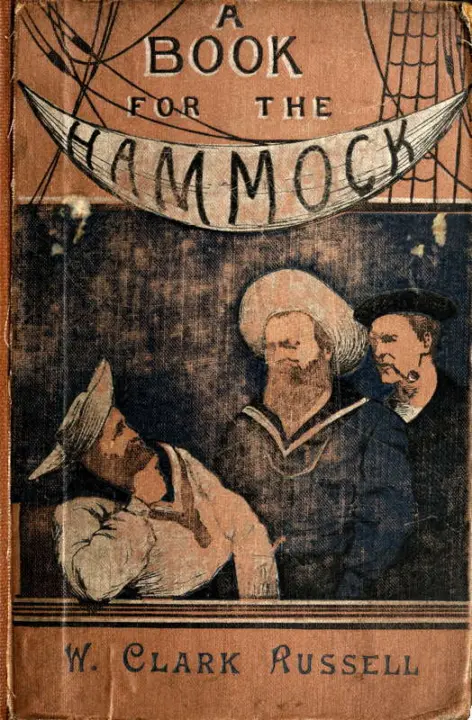
THE CLASSIC COLLECTION · 1887
"A Book for the Hammock" by William Clark Russell is a collection of nautical essays written in the late 19th century. The work reflects on the romanticism of sea life, contrasting past maritime adventures with the mechanized, prosaic realities of modern naval experiences. The essays explore themes of nostalgia for traditional seamanship, the loss of poetic engagement with the ocean, and the whimsical culture of sailors, including superstitions and life at sea. The opening of the book introduces readers to Russell's reflections on the decline of the "old romance of the sea" amid the advancements of steam-powered travel. He paints a vivid picture of a modern sailor's experience aboard a ship, pondering the beauty and mystery once associated with ocean voyages that seems lost in the face of progress. Russell laments the absence of wonder in contemporary maritime life, as sailors now rush through journeys stripped of the exploratory spirit that once characterized their trade. Through his contemplative prose, he creates a sense of longing for a bygone era filled with adventure and folklore, suggesting that the magic of the ocean has faded alongside the traditional ways of seafaring.
Introduction adapted from the source catalogue; source summaries may be automatically generated.
Free to read · English · 93,636 words · No account needed
MAKE TIME FOR A GOOD BOOK
On by default. Untick to stop anonymous reading totals. Each page counts after 10 seconds in view. How this works.
Anonymous counting is on unless you have switched it off.
The calibre and character of other old guns are fully understood. There was the “whole cannon,” which carried a 60 lb. ball; there was the demi-cannon, with a 31 lb. ball; also the cannon petro, 31 lb.; whole culverine, 11 lb.; and demi-culverine, 9 lb. The cannon royal rose sometimes to a 63 lb. ball. Then there was a gun called the French cannon, 43 lb.; the Saker, 5 lb.; the Minion, 4 lb.; and the Faulcon, or Falcon, 2 lb.[15]
Footnote 15:
Some of these terms seem to have been supplied by the language of the falconer. Among the names mentioned by Strutt as given to different species of hawks, I find, the faulcon, the bastard, the sacre, and the musket. To this may be added the following from Camden’s “Remaines,” p. 208: “This being begun by him” (i.e. Berthold Swarte, whom he considers the inventor of gunpowder and cannons) “by skill and time is now come to that perfection, not onely in great yron and brass pieces, but also in small, that all admire it; having names given them, some from serpents or ravenous birds, as Culverines, or Colubrines, Serpentines, Basiliques, Faulcons, Sacres; others in other respects, as Canons, Demicanons, Chambers, Slinges, Arquebuze, Caliver, Handgun, Muskets, Petronils, Pistoll, Dagge, etc., and Petarras of the same brood lately invented.” From the edition of 1657.
These pieces were in use in the sixteenth and seventeenth centuries, but by degrees other names were given, so that the titles applied to cannon from, let me say, the days of Henry VIII. down to the close of the last century, should furnish out an inventory long enough to fill many pages.
To the above list, given by Ralph Willett in a paper on British naval architecture, other examples may be added from the researches of James. He speaks of the cannon-serpentine and bastard-cannon as corresponding with the 42-pounder. The carronade dates as late as 1779, and takes its name from the Scotch town where it was invented. Another comparatively recent gun he speaks of as Gover’s, or Congreve’s, the Americans naming a similar weapon a Columbiad. Other guns are not mentioned by the historian, though of all our marine artillery they played, as small weapons, the largest part in our wars last century. The swivel cannon carried a shot of half a pound; it was fixed in a socket on the ship’s side, or stern, or bow, and in her tops. The socket that supported it was bored in a piece of oak, hooped with iron, to enable it to sustain the recoil. It was, indeed, a modernized form of the old pettararoe, and was turned about at will by an iron handle affixed to its cascabel; when worked in the tops it was charged with musket-balls, and fired down at the enemy’s decks. The coehorn was a small mortar, also fixed on a swivel, and chiefly used for firing grenadoes, as they were called, or bullets from merchantmen’s close quarters when they were boarded. For yard-arm fighting there was the “powder-flask”—a flask charged with gunpowder, and fitted with a fuse; it was hurled into the enemy’s deck immediately before the assault. Another device was the “stink-pot,” still in vogue with John Chinaman, an earthen shell suspended from the yard-arm or end of the bowsprit. This machine was charged with powder mixed with materials which threw up a disgusting, suffocating smoke and smell. The notion of these apparatuses was to create confusion, in the midst of which and under cover of the thick vapour the detachment rushed aboard, cutlass, and sword, and pistol in hand. Another contrivance was the “organ,” the grandfather of the Mitrailleuse—a machine formed of six or seven musket-barrels fixed upon one stock so as to be fired at once. There was also the fire-arrow, a small iron dart, furnished with springs and bars, and a match saturated with powder and sulphur, wound round the shaft. It was usually fired from a swivel, at the enemy’s sails. The match was ignited by the explosion, and the dart, penetrating the sail, set the cloths on fire. The springs and bars prevented the arrow from passing through the canvas. The musquetoon was a sort of carbine, with a barrel spirally rifled from the breech; the explosion lengthened the ball to about the breadth of a finger. The old fire-pike possessed something of the character of the fire-arrow. Another weapon of the fusil pattern is indicated in Sir William Monson’s “Building of Ships:” “As I have said, such a ship that has neither forecastle, copperidge head, nor any other manner of defence, but with her men only; that hath no fowlers, which are pieces of great importance, after a ship is boarded and entred, or lieth board and board; for the ordnance stands her in little stead, and is as apt to endanger themselves as their enemy; for in giving fire, it may take hold of pitch, tar, oakum, or powder, and burn them both for company; but a murderer or fowler, being shot out of their own ship, laden with dice shot, will scour the deck of the enemy, and not suffer the head of a man to appear.” It is evident that the “murderer” or “fowler” was a sort of fusil.[16]
Your reading position is saved on this browser. Take it to another device with a library code. Reading pages adapt to text, rather than matching a printed edition.
William Clark Russell

William Clark Russell
William Clark Russell

William Clark Russell
BEHIND THE BOOK
This eBook is for the use of anyone anywhere in the United States and most other parts of the world at no cost and with almost no restrictions whatsoever. You may copy it, give it away or re-use it under the terms of the Project Gutenberg License included with this eBook or online at www.gutenberg.org. If you are not located in the United States, you will have to check the laws of the country where you are located before using this eBook. Read the source licence.
The original source file, including credits and licence, is retained by this library. Request an original-format copy at no charge. Please include the book title and Project Gutenberg identifier #61207.
KEEP YOUR CURIOSITY GOING
Wilfrid Scawen Blunt
Wilfrid Scawen Blunt

E. W. (Edgar Watson) Howe

David Patterson (Spirit) Hatch

David Patterson (Spirit) Hatch

David Patterson (Spirit) Hatch