
List, Ye Landsmen! A Romance of Incident
William Clark Russell
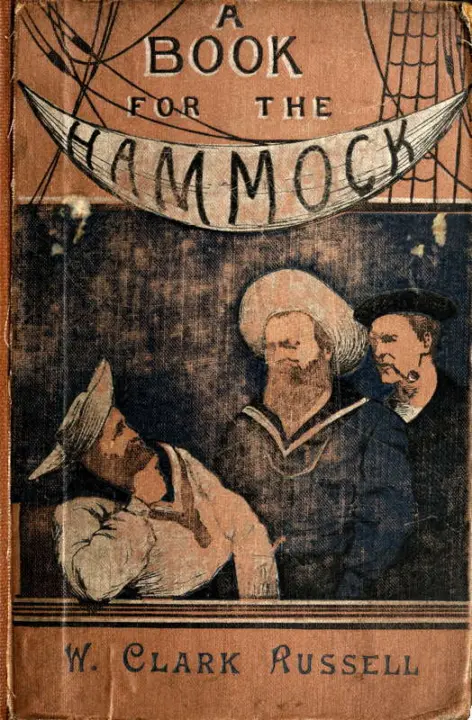
THE CLASSIC COLLECTION · 1887
"A Book for the Hammock" by William Clark Russell is a collection of nautical essays written in the late 19th century. The work reflects on the romanticism of sea life, contrasting past maritime adventures with the mechanized, prosaic realities of modern naval experiences. The essays explore themes of nostalgia for traditional seamanship, the loss of poetic engagement with the ocean, and the whimsical culture of sailors, including superstitions and life at sea. The opening of the book introduces readers to Russell's reflections on the decline of the "old romance of the sea" amid the advancements of steam-powered travel. He paints a vivid picture of a modern sailor's experience aboard a ship, pondering the beauty and mystery once associated with ocean voyages that seems lost in the face of progress. Russell laments the absence of wonder in contemporary maritime life, as sailors now rush through journeys stripped of the exploratory spirit that once characterized their trade. Through his contemplative prose, he creates a sense of longing for a bygone era filled with adventure and folklore, suggesting that the magic of the ocean has faded alongside the traditional ways of seafaring.
Introduction adapted from the source catalogue; source summaries may be automatically generated.
Free to read · English · 93,636 words · No account needed
MAKE TIME FOR A GOOD BOOK
On by default. Untick to stop anonymous reading totals. Each page counts after 10 seconds in view. How this works.
Anonymous counting is on unless you have switched it off.
In the “Pasha of Many Tales,” Captain Marryat exaggerates the proverbial “twister” of the marine. But how many experiences have sailors suffered incomparably more surprising than the most ingenious of the fictions in Marryat’s book; and more miraculous in the machinery of fortuitous escape than could ever occur to the most daring among the old Arabian inventors? There are instances of disasters so complicated by misfortune as to become sheer eccentricities of peril. I remember being much struck with a paragraph I came across in a newspaper of the last century: “Captain Lamire, commander of the Heureux, on April 26, being in the lat. of one deg. 2 min., and 21 deg. 28 min. long. W., reckoning from Teneriff, several of his crew, and a great number of negros on board, were seized with a disorder of their eyes, many of whom were blind for ten or twelve days; nine lost their sight entirely, and seven or eight the sight of one eye. Accidents of this kind, it is said, are not unprecedented in latitudes so near the line, but the great number affected at the same time exceeds anything that was ever heard of before.” Had that old ship carried such slender companies as vessels now go manned with, who shall say, in the face of the numbers who were blinded, that all hands would not have lost their sight? What object could the imagination fasten upon more dreadful and tragical than a ship in charge of a blind crew? What possibilities of harrowing description would such a subject offer to the romancer!
There is preserved a curious account of the Hon. John O’Brien, a brother or near relative to the Earl of Inchiquin. He was so incessantly in jeopardy from one cause or another that his career expresses in perfection the eccentricity of disaster. A few examples will hint at his story. He was a lieutenant in the Navy in 1747, and his first mishap befel him off the coast of India, where his ship was wrecked, all hands perishing with the exception of O’Brien and four sailors. He embarked in a vessel to return to Europe, but was cast away near the Cape of Good Hope, and was the only one of a great number who contrived to escape with his life. The Dutch Governor, discovering him to be a “person of honour,” supplied him with every necessary for continuing the voyage, and gave him a cabin in one of the homeward bound East Indiamen. The Governor of another settlement, who was going home in the same ship, finding himself rather straitened for room on account of the number of his own family, begged for the exclusive use of the vessel for his suite and baggage. The Governor of the Cape complied, and procured accommodation for O’Brien in another vessel that was to sail on the same day. Shortly afterwards the ships put to sea, and it is recorded as an absolute and well assured fact that, within twenty-four hours of their leaving the Cape, O’Brien saw the ship he had quitted founder in a gale of wind, taking down with her every creature on board! A few years later this fortune-hunted gentleman was stationed on board the Dartmouth of fifty guns. She fell in with the Glorioso, a Spanish man-of-war, and engaged her for some hours. O’Brien was at his station between decks, when the gunner ran up to him, and, with wildness and despair in his look, cried out, “Oh, sir! the powder-room!” Lieutenant O’Brien heard no more, for the ship instantly blew up! Such a catastrophe as this, you would conjecture, must effectually put an end to O’Brien. In fact, if I were to write his life I should skip this little disaster for fear that it should destroy the reader’s faith in the other parts of the story. It is true, nevertheless, that O’Brien, instead of perishing, was found floating about on the carriage of a gun. It was supposed that he had been blown through a porthole with one of the guns. He was picked up by a privateer named the Duke, and as a proof that the natural sprightliness and gaiety of his character was superior to so slight an accident as that of being blown up in a man-of-war, he is recorded to have said to the captain of the Duke, speaking with great gravity, “You will excuse me, sir, for appearing before you in such a dress; but the reason is I left my ship so hurriedly that I had no time to put on better clothes.” But enough of the Hon. John O’Brien.
Your reading position is saved on this browser. Take it to another device with a library code. Reading pages adapt to text, rather than matching a printed edition.
William Clark Russell

William Clark Russell
William Clark Russell

William Clark Russell
BEHIND THE BOOK
This eBook is for the use of anyone anywhere in the United States and most other parts of the world at no cost and with almost no restrictions whatsoever. You may copy it, give it away or re-use it under the terms of the Project Gutenberg License included with this eBook or online at www.gutenberg.org. If you are not located in the United States, you will have to check the laws of the country where you are located before using this eBook. Read the source licence.
The original source file, including credits and licence, is retained by this library. Request an original-format copy at no charge. Please include the book title and Project Gutenberg identifier #61207.
KEEP YOUR CURIOSITY GOING
Wilfrid Scawen Blunt
Wilfrid Scawen Blunt

E. W. (Edgar Watson) Howe

David Patterson (Spirit) Hatch

David Patterson (Spirit) Hatch

David Patterson (Spirit) Hatch