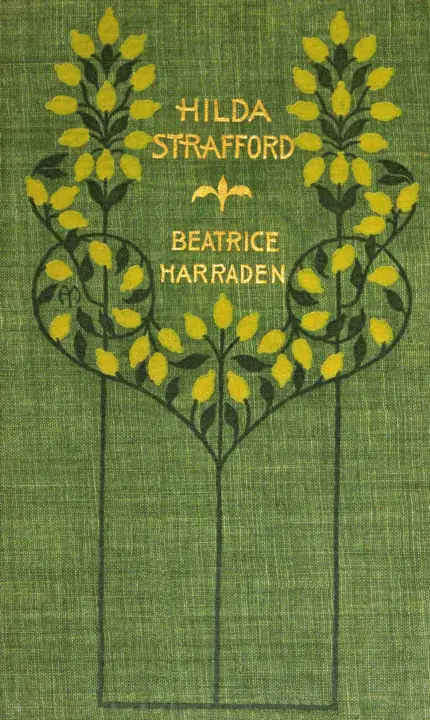
Hilda Strafford: A California Story
Beatrice Harraden
THE CLASSIC COLLECTION · 1894
"A Bird of Passage and Other Stories" by Beatrice Harraden is a collection of stories written in the late 19th century. The main narrative follows a young girl, a tuner, who intrigues the guests at a little hotel in Switzerland with her charm, musical talent, and mysterious past, hinting at themes of independence and the search for personal fulfillment. Throughout the opening tale, readers are invited to explore the girl's interactions with various characters, including a curious gentleman named Oswald, setting the stage for deeper explorations of identity and societal expectations. At the start of the narrative, we are introduced to the young girl as she enters the hotel salon, drenched but cheerful, revealing her witty character and independence when she states that she has no luggage or companions. Her interactions with an elderly lady and then Oswald Everard highlight her unique outlook on life, particularly her passion for music and her determination to succeed in a profession that is rarely chosen by women at that time. As she tunes a piano in the salon, she captivates the guests, simultaneously wresting their attention and respect while prompting reflections on her unconventional lifestyle. This sets a lively anecdote that balances themes of ambition, femininity, and the desire for connection in a world of cyclical expectations.
Introduction adapted from the source catalogue; source summaries may be automatically generated.
Free to read · English · 27,732 words · No account needed
MAKE TIME FOR A GOOD BOOK
On by default. Untick to stop anonymous reading totals. Each page counts after 10 seconds in view. How this works.
Anonymous counting is on unless you have switched it off.
"Yes," he answered; "it is a great nuisance. I cannot write. I have been wondering whether I could get any one to write for me. Do you know of any one?"
"No," she said bitterly; "we don't write here. We make butter and cheese, and we fatten up our poultry, and then we go to market and sell our butter, cheese, and poultry."
"Well," said Hieronymus, "and why shouldn't you?"
He looked up at her, and saw what a discontented expression had come
over her young face.
She took no notice of his interruption, but just switched the horse's ears with the end of her whip.
"That is what we do year after year," she continued, "until I suppose we have become so dull that we don't care to do anything else. That is what we have come into the world for: to make butter and cheese, and fatten up our poultry, and go to market."
"Yes," he answered cheerily, "and we all have to do it in some form or other. We all go to market to sell our goods, whether they be brains, or practical common-sense (which often, you know, has nothing to do with brains), or butter, or poultry. Now I don't know, of course, what you have in your basket; but supposing you have eggs, which you are taking to market. Well, you are precisely in the same condition as the poet who is on his way to a publisher's, carrying a new poem in his vest pocket. And yet there is a difference."
"Of course there is," she jerked out scornfully.
"Yes, there is a difference," he continued, placidly; "it is this: you will return without those eggs, but the poet will come back still carrying his poem in his breast-pocket!"
Then he laughed at his own remark.
"That is how things go in the great world, you know," he said. "Out in the great world there is an odd way of settling matters. Still they must be settled somehow or other!"
"Out in the world!" she exclaimed. "That is where I long to go."
"Then why on earth don't you?" he replied.
At that moment Mrs. Benbow came running out.
"I am so sorry to keep you waiting, Miss Hammond," she said to the young girl; "but what with the washing and the making ready for the brewing to-morrow, I don't know where to turn."
Then followed a series of messages to which Hieronymus paid no attention. And then Miss Hammond cracked her whip, waved her greetings with it, and the old white horse trotted away.
"And who is the rider of the horse?" asked Hieronymus.
Your reading position is saved on this browser. Take it to another device with a library code. Reading pages adapt to text, rather than matching a printed edition.
Beatrice Harraden
Beatrice Harraden
Beatrice Harraden
BEHIND THE BOOK
This eBook is for the use of anyone anywhere in the United States and most other parts of the world at no cost and with almost no restrictions whatsoever. You may copy it, give it away or re-use it under the terms of the Project Gutenberg License included with this eBook or online at www.gutenberg.org. If you are not located in the United States, you will have to check the laws of the country where you are located before using this eBook. Read the source licence.
The original source file, including credits and licence, is retained by this library. Request an original-format copy at no charge. Please include the book title and Project Gutenberg identifier #44322.
KEEP YOUR CURIOSITY GOING
Coulson Kernahan

Maurice Baring
Frances Wright
Cécile Tormay

Frederic Jesup Stimson

W. H. P. (William Henry Pope) Jarvis