
The Writing of News A Handbook with Chapters on Newspaper Correspondence and Copy Reading
Charles G. (Charles Griffith) Ross
THE CLASSIC COLLECTION · 1915
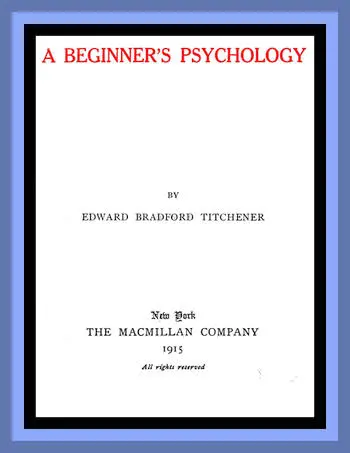
"A Beginner's Psychology" by Edward Bradford Titchener is a scientific publication written in the early 20th century. The book serves as an introductory guide to the field of psychology, aimed specifically at those who are new to the subject. Titchener approaches psychology with an analytical lens, emphasizing the importance of understanding foundational concepts and methodologies within the discipline. The opening of the work establishes the author's intent to create a resource that reflects his own learning experiences within psychology many years prior. Titchener discusses the significance of adopting a scientific attitude, which is distinct from common sense, and highlights the need for careful observation in understanding the mind's processes. He elaborates on the differences between science and everyday values, emphasizing psychology's focus on empirical facts rather than subjective meanings. This section sets the stage for a systematic exploration of the subject, preparing readers to engage deeply with the theories and practices that will follow.
Introduction adapted from the source catalogue; source summaries may be automatically generated.
Free to read · English · 102,636 words · No account needed
MAKE TIME FOR A GOOD BOOK
On by default. Untick to stop anonymous reading totals. Each page counts after 10 seconds in view. How this works.
Anonymous counting is on unless you have switched it off.
Perception, analysis of typical, 114 ff.;
made up of core and context, 114 f., 117, 121, 131, 165, 167;
meaning in, 117 ff., 123, 127, 129 ff., 133 f.;
varying complexity of, 121;
types of, 121 ff.;
qualitative, 122;
temporal, 122 ff.;
spatial, 124 f.;
complex, 125;
no class of intensive, 125;
of distance, 125 ff.;
of visual movement, 132 ff.;
of melody, 134 f.;
illusory, 135 ff.;
connection of elements in, 159 f.
Personal difference, 237.
Personal equation, 237.
Personalisation, tendency toward, 205, 323.
Personality, dual and multiple, 314 f.
Physics, leaves man out of the world, 8;
method of, 21 f.;
early became experimental, 25;
suffers from bias of language, 323.
Pitch, of tones, 52;
of noises, 55;
memory of absolute, 134.
Plants, psychology of, 13 f., 31 f., 230.
Pleasantness and unpleasantness, the qualities of simple feeling, 79,
81;
in memory, 188 f.
Pleasure and pain, 79, 84 ff.;
alleged determinants of action, 257 f.
Post-hypnotic suggestion, 345 f.
Pressure, sensation of, from skin, 43 ff.;
from muscle, 46 f.;
from joint, 46 f.;
organic, 64;
falls under Weber’s law, 68.
Primitive man, mind of, 303, 313;
primitive music, 134 f.
Problem, of psychology, 14 ff., 18, 113, 148, 231, 258, 331;
of attention, 93;
of meaning, 117 f.;
of action, 231 f., 258.
Process, see Mental processes, Psychoneural processes
Psychography, 309.
Psychologist, how concerned with himself, 3;
not a student of human nature, 3 f.;
not adequate to the whole of his science, 31.
Psychology, the science of mind, 2, 5;
subject-matter of, as defined by common sense, 6 ff., 17, 34, 321;
by science, 8 f., 329;
leaves man in the world, 9, 307;
takes account of nervous system, 10 ff., 17 f.;
of animals, 12 ff., 32, 51, 134, 219 f., 247, 267;
of plants, 13 f.,31 f., 230;
problem of human, 14 ff., 18, 113, 148, 231, 326 f.;
method of, 18 ff.;
has recently become experimental, 25 f., 34;
scope of, 30 ff., 329;
classification of, 31 ff.;
differential, 31 f., 309;
immaturity of, 25 f., 34;
difficulties of, to beginner, 34 ff., 90, 112 ff., 321 ff., 325 f.;
definitions of, 38;
may have begun with observation of expressive movements, 222;
describes a generalised world, 307;
has to do with self, 308 f.;
has nothing to do with knowledge or awareness, 324 f.;
in daily life, 329 f.;
results of, are useful in practice, 4 f., 33, 232, 281, 310.
Psychoneural processes, 164, 212.
Psychotechnics, 33.
Quality, of sensation, 65 f.;
as basis of qualitative perception, 122;
of simple feeling, 79, 81.
Question, as stimulus to thought, 276 ff., 330.
Rapport, hypnotic, 344 f.
Reaction experiment, history of, 236 f., 252 ff.;
simple form of, 238;
aids us to analyse action, 238 f., 253;
compound form of, 252 ff., 255;
has not developed in accordance with classification of action,
252 f.;
various uses of, 253 ff.;
association reaction, 254 f.
Reaction method, 253 ff.
Reaction time, 238;
sensory and motor, 240;
significance of, 242, 254.
Reason, 203, 207, 210, 301.
Receptive imagination, 197 f.
Recognition, analysis of, 177 ff.;
hinges on feeling of familiarity, 178, 181, 184 f., 276;
varies in definiteness, 179 f.;
direct and indirect, 180 f.;
halting and partial, 181;
lapses to direct apprehension, 181 ff.;
common-sense view of, 184;
illusions of, 187 f.
Recollection, 190 f.
Recurrent images, 75, 78.
Reflex, artificial, 244, 251;
physiological, 244 f.
Reinforcement, nervous, in attention, 106 ff., 164, 249 f.
Relational feelings and attitudes, 279.
Religious sentiments, 299 f., 302 f.
Remembrance, 190.
Repetition, as determinant of attention, 94, 163; strengthens associative tendencies, 153, 163.
Representative gesture, 268 f.
Resistance, perception of, 122.
Retina, complex structure of, 58 ff., 60, 63;
normal colour-blindness of, in daylight, 58, 62;
central blindness of, in twilight, 60;
compared with olfactory membrane, 63.
Your reading position is saved on this browser. Take it to another device with a library code. Reading pages adapt to text, rather than matching a printed edition.
BEHIND THE BOOK
This eBook is for the use of anyone anywhere in the United States and most other parts of the world at no cost and with almost no restrictions whatsoever. You may copy it, give it away or re-use it under the terms of the Project Gutenberg License included with this eBook or online at www.gutenberg.org. If you are not located in the United States, you will have to check the laws of the country where you are located before using this eBook. Read the source licence.
The original source file, including credits and licence, is retained by this library. Request an original-format copy at no charge. Please include the book title and Project Gutenberg identifier #51442.
KEEP YOUR CURIOSITY GOING
Charles G. (Charles Griffith) Ross
Hannah Webster Foster

Emily Lawless
Edwin Hamlin Carr

Charles De Lano Hine
Andrew Ure