
The Writing of News A Handbook with Chapters on Newspaper Correspondence and Copy Reading
Charles G. (Charles Griffith) Ross
THE CLASSIC COLLECTION · 1915
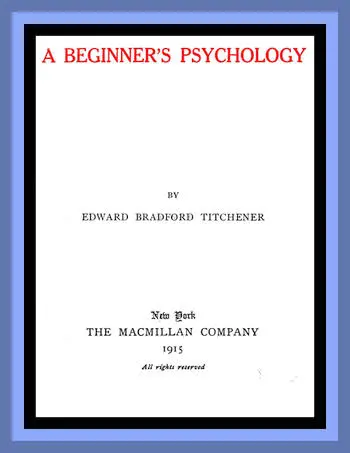
"A Beginner's Psychology" by Edward Bradford Titchener is a scientific publication written in the early 20th century. The book serves as an introductory guide to the field of psychology, aimed specifically at those who are new to the subject. Titchener approaches psychology with an analytical lens, emphasizing the importance of understanding foundational concepts and methodologies within the discipline. The opening of the work establishes the author's intent to create a resource that reflects his own learning experiences within psychology many years prior. Titchener discusses the significance of adopting a scientific attitude, which is distinct from common sense, and highlights the need for careful observation in understanding the mind's processes. He elaborates on the differences between science and everyday values, emphasizing psychology's focus on empirical facts rather than subjective meanings. This section sets the stage for a systematic exploration of the subject, preparing readers to engage deeply with the theories and practices that will follow.
Introduction adapted from the source catalogue; source summaries may be automatically generated.
Free to read · English · 102,636 words · No account needed
MAKE TIME FOR A GOOD BOOK
On by default. Untick to stop anonymous reading totals. Each page counts after 10 seconds in view. How this works.
Anonymous counting is on unless you have switched it off.
Index of change, 132.
Inhibition, nervous, in attention, 106 ff., 164, 249 f.;
initial and terminal, of associative tendencies, 157 f.;
of instincts, 209.
Initial inhibition, 157 f.
Instinct, popular view of, 203;
definition of, 204;
rôle of, in life of man, 205, 207;
list of human instincts, 205 ff.;
biological characters of, 208 ff.;
psychological characters of, 210 ff.;
and reason, 203, 207, 210, 301;
and emotion, 207, 211, 216, 219.
Instruction, 96 f., 214;
significance of, for action, 240 ff., 252;
negative, 250, 253.
Intellectual attitudes, 271 f.;
analysis of, 274 f.
Intellectual ‘common factor,’ 310 f.
Intellectual sentiments, 297 f., 299 f.;
and curiosity, 301.
Intensity of sensation, 66, 67 ff.;
and vividness, 92;
as determinant of attention, 94;
does not found a group of intensive perceptions, 125;
absolute impression of, 125, 285;
of feeling, in passion, 225 f., 304;
in classification of temperament, 227.
Interest, acquired, 97 f., 226;
in attention, 101;
natural, 207, 226.
Introspection, as method of psychology, 22;
formula of, 19, 22, 80;
difficulties of, 20 ff.;
experimental,23 ff.;
of feeling, 80.
Itch, 44.
Judgement, borrowed from social surroundings, 262 f., 291 f.;
terminus of thought, 276;
has no definite pattern, 279;
core of sentiment, 290.
Kinæsthetic sensations, 45 ff.;
meaning of term, 46;
blend with cutaneous sensations, 47 f.;
play a large part in perception, 65;
fall under Weber’s law, 68, 135;
enter into sense-feelings, 81 f., 319;
in attention, 101 f.;
as vehicle of meaning, 119 f., 140;
in visual perception of distance, 127 ff.;
empathic, in optical illusion, 137 f.;
imitative, in memory, 190 ff., 200;
empathic, in imagination, 198;
in motor reaction, 241;
in expectation, 273.
Knowledge, problem of, foreign to psychology, 324 ff.
Language, serves practical needs, 36, 313, 321;
relation of, to thought, 266 ff.;
spoken, originally gesture, 269 f.;
development of, 270;
unsafe guide to psychology of sentiment, 297;
embodies a theory of the self, 313, 316, 321 ff.;
disadvantages of, for science, 36, 321 ff.;
an unreliable index of mental process, 323.
Learning, 150 f., 152, 154 f.;
implies attention, 163 ff.;
importance of psychological situation for, 163 f., 165 f.;
and mnemonics, 193 f.
Light, sensations of, 56 f.;
all lights psychologically simple, 57;
contrast of, 61, 63;
adaptation to, 61;
after-images of, 62, 133;
intensity of, falls under Weber’s law, 68;
in sense-feelings, 81.
Man, inner, of common sense, 7;
‘man left in,’ of psychology, 9, 10 f., 17 f., 19, 307.
Marriage by proxy, of ideas, 166 f., 185.
Matter, 9.
Meaning, not a scientific term, 4, 26, 325;
may be stripped from process, 26 f.;
added to process, 27;
disjoined from process in time, 27 f.;
different, may attach to same process, 28 f.;
same, may attach to different processes, 29;
not covariant with process, 29 f.;
of touch-blends, 47 f.;
of organic complexes, 65;
does not inhere in mental elements, 90;
not to be confused with sensory vividness, 93;
of perception and idea, 113, 117 ff., 123, 127;
psychologically regarded, is context, 118 f.;
carried by kinæsthesis and organic sensations, 119 f., 140;
older than free image, 120;
carried physiologically, 120 f., 129 f., 181, 316;
in perceptions of time, 123;
in perceptions of space, 123, 127, 129 f., 133 f.;
in doctrine of association, 147 f., 149, 162, 163 f., 168;
and memory-idea, 185 f., 197;
of words, 150, 164, 269 f.;
in verbal image, 271;
in mental attitudes, 272;
of self, 315, 318 f.
Melody, perception of, 134 f.
Your reading position is saved on this browser. Take it to another device with a library code. Reading pages adapt to text, rather than matching a printed edition.
BEHIND THE BOOK
This eBook is for the use of anyone anywhere in the United States and most other parts of the world at no cost and with almost no restrictions whatsoever. You may copy it, give it away or re-use it under the terms of the Project Gutenberg License included with this eBook or online at www.gutenberg.org. If you are not located in the United States, you will have to check the laws of the country where you are located before using this eBook. Read the source licence.
The original source file, including credits and licence, is retained by this library. Request an original-format copy at no charge. Please include the book title and Project Gutenberg identifier #51442.
KEEP YOUR CURIOSITY GOING
Charles G. (Charles Griffith) Ross
Hannah Webster Foster

Emily Lawless
Edwin Hamlin Carr

Charles De Lano Hine
Andrew Ure