THE CLASSIC COLLECTION✦A dead man’s diaryCLASSIC FREE BOOKS
A dead man’s diary
Coulson Kernahan
THE CLASSIC COLLECTION · 1912
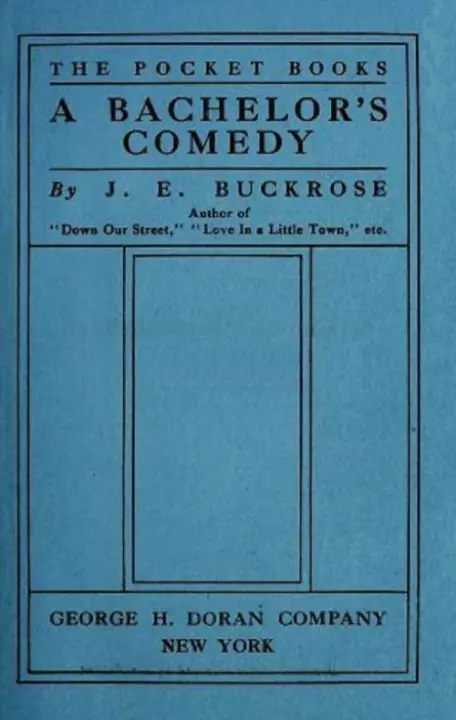
"A Bachelor's Comedy" by J. E. Buckrose is a novel written in the early 20th century. The story centers around the Reverend Andrew Deane, a young vicar navigating his new life in the quaint village of Gaythorpe-on-the-Marsh. As he attempts to establish himself, he grapples with the perception of his youthfulness and the burdens of his clerical responsibilities, all while encountering the charming eccentricities of his new parish's residents. The opening of the novel introduces Andrew as he travels to Gaythorpe, filled with hope and anxiety about his new role. He arrives at the station and is met by the churchwarden, Mr. Thorpe, as they make their way through the pastoral landscape. Andrew is determined to shed his boyish nickname "Andy" and take on the dignity of his position. The narrative unfolds with his interactions at the Vicarage, where he faces the challenge of maintaining discipline with his staff, notably the drunken gardener Sam Petch, while showing kindness to the endearing but needy villagers. This balance of humor, introspection, and the complexities of clerical life lays the groundwork for the deeper themes of community, expectation, and personal growth that will follow in Andrew's journey.
Introduction adapted from the source catalogue; source summaries may be automatically generated.
Free to read · English · 72,222 words · No account needed
MAKE TIME FOR A GOOD BOOK
On by default. Untick to stop anonymous reading totals. Each page counts after 10 seconds in view. How this works.
Anonymous counting is on unless you have switched it off.
Andy—it is a disgraceful thing to have to acknowledge—but Andy felt inclined to bend over and kiss Rose’s pretty flushed cheek, and yet he was tremendously in love with Elizabeth—perhaps because he was so tremendously in love with Elizabeth; but he caught back the wandering impulse and felt ashamed of his own wickedness. How could he——
But from that instant he began to feel less harshly toward certain sinners whom he had before condemned without a hearing. A little of the tolerant humanity of Brother Gulielmus, who had loved his flock so well, because he understood them, began to mellow Andy’s crude judgment.
However, he turned his present attention to Miss Fanny Kirke, who was forty-nine; and they discoursed pleasantly of the weather and the approaching holidays, and finally of Mr. Willie Kirke, who was playing popular airs on a concertina in the first waggon to lighten the way.
“He really seems able to do anything,” said Andy, with sincere
admiration.
“Always could,” said Miss Kirke. “Tiresome about his meals, even as a child, wouldn’t touch suet pudding or animal’s frys of any kind; but made a windmill out of a card, a pin, and a stick of firewood when he was five. I heard Mrs. Stamford once call him quite the Admirable Bright’un, and indeed he is.”
Andy began to chuckle, then he turned it into a cough. Miss Kirke had not intended a pun at all, and she added in a very low tone, glancing at Mrs. Jebb’s gauze veil that floated like a banner from the next waggon—
“He is just the sort of man to be taken in by a designing woman.”
“Oh, I’m sure——” remonstrated Andy.
“Don’t tell me!” interrupted Miss Kirke, her refinement for once upset by what was the obsessing fear of her existence.
“I can’t think it possible,” said Andy, unable to pretend, in face of that eye fixed on the floating veil, that he did not understand the drift of her remarks.
“Anything’s possible,” said Miss Fanny Kirke with some bitterness, “when you get a widow and a man together.”
Then the waggons rumbled round that turning where there first begins to be a cool saltiness in the air, and little Jimmy Simpson called out, jumping up on a seat—
“I smell the sea! I smell the sea!”
“Sit down, you naughty boy. You’ll tummel into the road,” said Sally, anxiously pulling at a sturdy leg.
He gave a kick and roared out—
“Want to tummel into the road!”
“Now, now,” said Mrs. Simpson. “Jimmy must be good, or else mother’ll take him home again.”
Your reading position is saved on this browser. Take it to another device with a library code. Reading pages adapt to text, rather than matching a printed edition.
BEHIND THE BOOK
This eBook is for the use of anyone anywhere in the United States and most other parts of the world at no cost and with almost no restrictions whatsoever. You may copy it, give it away or re-use it under the terms of the Project Gutenberg License included with this eBook or online at www.gutenberg.org. If you are not located in the United States, you will have to check the laws of the country where you are located before using this eBook. Read the source licence.
The original source file, including credits and licence, is retained by this library. Request an original-format copy at no charge. Please include the book title and Project Gutenberg identifier #49861.
KEEP YOUR CURIOSITY GOING
Coulson Kernahan

Maurice Baring
Frances Wright
Cécile Tormay

Frederic Jesup Stimson

W. H. P. (William Henry Pope) Jarvis