THE CLASSIC COLLECTION✦A dead man’s diaryCLASSIC FREE BOOKS
A dead man’s diary
Coulson Kernahan
THE CLASSIC COLLECTION · 1912
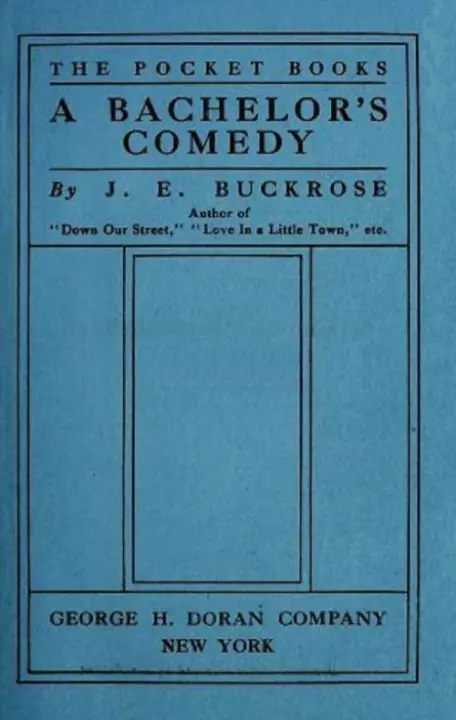
"A Bachelor's Comedy" by J. E. Buckrose is a novel written in the early 20th century. The story centers around the Reverend Andrew Deane, a young vicar navigating his new life in the quaint village of Gaythorpe-on-the-Marsh. As he attempts to establish himself, he grapples with the perception of his youthfulness and the burdens of his clerical responsibilities, all while encountering the charming eccentricities of his new parish's residents. The opening of the novel introduces Andrew as he travels to Gaythorpe, filled with hope and anxiety about his new role. He arrives at the station and is met by the churchwarden, Mr. Thorpe, as they make their way through the pastoral landscape. Andrew is determined to shed his boyish nickname "Andy" and take on the dignity of his position. The narrative unfolds with his interactions at the Vicarage, where he faces the challenge of maintaining discipline with his staff, notably the drunken gardener Sam Petch, while showing kindness to the endearing but needy villagers. This balance of humor, introspection, and the complexities of clerical life lays the groundwork for the deeper themes of community, expectation, and personal growth that will follow in Andrew's journey.
Introduction adapted from the source catalogue; source summaries may be automatically generated.
Free to read · English · 72,222 words · No account needed
MAKE TIME FOR A GOOD BOOK
On by default. Untick to stop anonymous reading totals. Each page counts after 10 seconds in view. How this works.
Anonymous counting is on unless you have switched it off.
The young man, too, was looking very jolly, with a pipe in his mouth and a good bicycle and every evidence of self-satisfied prosperity.
“Afternoon!” he said rather insolently, with a smirk that irritated Andy still further. He had been asked by old Wilton to speak to the young man, and he suddenly made up his mind that he would speak now.
“Stop!” he cried. “May I have a word with you?”
So they entered into a conversation which began all right, but ended, as it was bound to do under the circumstances, by Andy calling the young man a coward, and the young man calling Andy a blanked, interfering parson, who only dared to say things like that because he knew he wouldn’t have to fight.
“I don’t mind a fight,” said Andy, beginning to go white about the nose and to breathe heavily.
No one, of course, could maintain for one moment that Andy was the right
sort of parson.
“All very well to talk,” sneered the young man, sticking a crimson face close to Andy’s. “Do, then I’ll believe you! Parsons”—(he used adjectives)—“we’ll soon have done with parsons in this country” (and he used adjectives again).
“I’ll fight you,” said Andy slowly, “if you’ll promise to marry her if I
win.”
“If you win, I will,” panted the young man. “I can safely promise that. But you daren’t. You’ll get me to start and have me up for assault. I know you.”
He thrust his face so near that his rough moustache tickled Andy’s nose
and that was enough.
Andy began to take off his coat.
Then, for a few moments, ensued an unseemly and unchristian scene which no friend of the Vicar of Gaythorpe would wish to dwell on.
According to all the laws of fiction Andy ought to have come off victorious, but, as a matter of fact, he was badly beaten, and it was only by a fluke that he managed to give his opponent a black eye in return for his own damaged wrist.
The big young man silently watched him struggling to put on his coat, then, with a hand over the injured eye, assisted him into it.
“Do you know I’m the best boxer for ten miles round?” he asked grimly.
“I—I believe I’d heard so,” replied Andy, still very confused and hardly knowing what he said.
“And you made no more of going for me than as if I’d been a counter-jumper?” continued the young man.
“I forgot,” said Andy. “However——” and he began to trudge on, very much ashamed of himself.
Your reading position is saved on this browser. Take it to another device with a library code. Reading pages adapt to text, rather than matching a printed edition.
BEHIND THE BOOK
This eBook is for the use of anyone anywhere in the United States and most other parts of the world at no cost and with almost no restrictions whatsoever. You may copy it, give it away or re-use it under the terms of the Project Gutenberg License included with this eBook or online at www.gutenberg.org. If you are not located in the United States, you will have to check the laws of the country where you are located before using this eBook. Read the source licence.
The original source file, including credits and licence, is retained by this library. Request an original-format copy at no charge. Please include the book title and Project Gutenberg identifier #49861.
KEEP YOUR CURIOSITY GOING
Coulson Kernahan

Maurice Baring
Frances Wright
Cécile Tormay

Frederic Jesup Stimson

W. H. P. (William Henry Pope) Jarvis