THE CLASSIC COLLECTION✦A dead man’s diaryCLASSIC FREE BOOKS
A dead man’s diary
Coulson Kernahan
THE CLASSIC COLLECTION · 1912
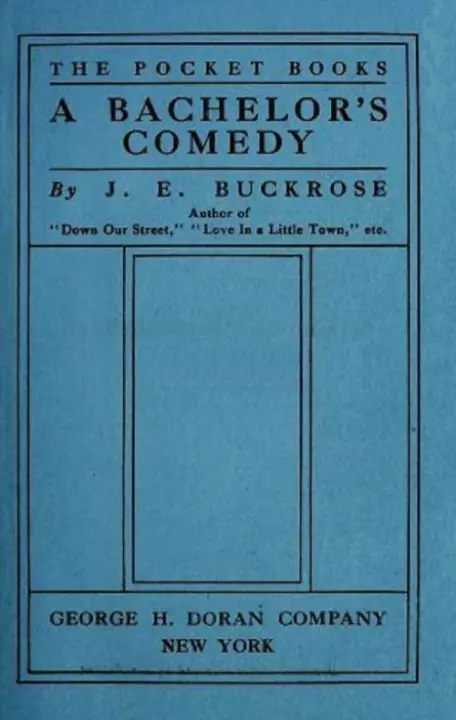
"A Bachelor's Comedy" by J. E. Buckrose is a novel written in the early 20th century. The story centers around the Reverend Andrew Deane, a young vicar navigating his new life in the quaint village of Gaythorpe-on-the-Marsh. As he attempts to establish himself, he grapples with the perception of his youthfulness and the burdens of his clerical responsibilities, all while encountering the charming eccentricities of his new parish's residents. The opening of the novel introduces Andrew as he travels to Gaythorpe, filled with hope and anxiety about his new role. He arrives at the station and is met by the churchwarden, Mr. Thorpe, as they make their way through the pastoral landscape. Andrew is determined to shed his boyish nickname "Andy" and take on the dignity of his position. The narrative unfolds with his interactions at the Vicarage, where he faces the challenge of maintaining discipline with his staff, notably the drunken gardener Sam Petch, while showing kindness to the endearing but needy villagers. This balance of humor, introspection, and the complexities of clerical life lays the groundwork for the deeper themes of community, expectation, and personal growth that will follow in Andrew's journey.
Introduction adapted from the source catalogue; source summaries may be automatically generated.
Free to read · English · 72,222 words · No account needed
MAKE TIME FOR A GOOD BOOK
On by default. Untick to stop anonymous reading totals. Each page counts after 10 seconds in view. How this works.
Anonymous counting is on unless you have switched it off.
“Well, Mr. Deane seemed rather anxious we should wash our hands,” laughed Norah, coming carelessly to Andy’s assistance. “I know what it is. The Vicarage is sacred, and you wash your hands when you enter in the same way as you take off your shoes at the door of a mosque.”
“The—the fact is,” said Andy, “Mrs. Jebb has made everything as smart as she could upstairs, and I expect she wanted you to see.”
“Oh, poor thing! I say, Mrs. Stamford, let us go after all. She’ll be so disappointed,” said Elizabeth.
“I’ll come too, if you like,” suggested Dick, whose conception of wit was rather elemental.
“Don’t be foolish, Dick,” said his mother, who actually enjoyed his jokes because they showed his frequent moods of sullen discontent had lifted for the time being.
Then they all went out and returned in five minutes, Norah’s nose being
conspicuously white.
“You see we’ve used all the luxuries you provided,” she said.
Andy gave an involuntary chuckle, for the coating of coarse, white violet powder had such an odd effect on her little nose, contrasted with her delicate face. Then all the others began to laugh too—Mrs. Stamford because the rest did, and she wished to be a sort of jolly-good-fellow with her son’s friends. It was really almost grotesque to see this woman run counter to every instinct but that of mother-love in order to please her boy—at least it would have been grotesque if it had not been almost tragic.
But a violent irritation was produced in her by the effort, all the same, and she turned sharply to Bill Atterton.
“When do you start work?”
“In October. At least I’m supposed to be reading with old Banks and Bardswell now, but I go up to Cambridge in October.”
“Hum,” said Mrs. Stamford. “Well, it’s time you did. You are getting too stout. Face of fourteen and figure of forty.”
The Atterton girls laughed and took it all in good part—they were so used to shafts of that kind flying about the family—but it hit Bill on his most tender spot.
“I can return the compliment,” he said, with a pleasant smile. “Now, you have the figure of sixteen and the face of sixty.”
They all involuntarily glanced at Mrs. Stamford’s spare, angular form and weather-beaten face, and found it too true to trifle with.
“What nonsense,” said Norah, with a lightning glance at Bill.
“Ha-ha! I call it rather good,” laughed Dick Stamford.
Your reading position is saved on this browser. Take it to another device with a library code. Reading pages adapt to text, rather than matching a printed edition.
BEHIND THE BOOK
This eBook is for the use of anyone anywhere in the United States and most other parts of the world at no cost and with almost no restrictions whatsoever. You may copy it, give it away or re-use it under the terms of the Project Gutenberg License included with this eBook or online at www.gutenberg.org. If you are not located in the United States, you will have to check the laws of the country where you are located before using this eBook. Read the source licence.
The original source file, including credits and licence, is retained by this library. Request an original-format copy at no charge. Please include the book title and Project Gutenberg identifier #49861.
KEEP YOUR CURIOSITY GOING
Coulson Kernahan

Maurice Baring
Frances Wright
Cécile Tormay

Frederic Jesup Stimson

W. H. P. (William Henry Pope) Jarvis