THE CLASSIC COLLECTION✦A dead man’s diaryCLASSIC FREE BOOKS
A dead man’s diary
Coulson Kernahan
THE CLASSIC COLLECTION · 1912
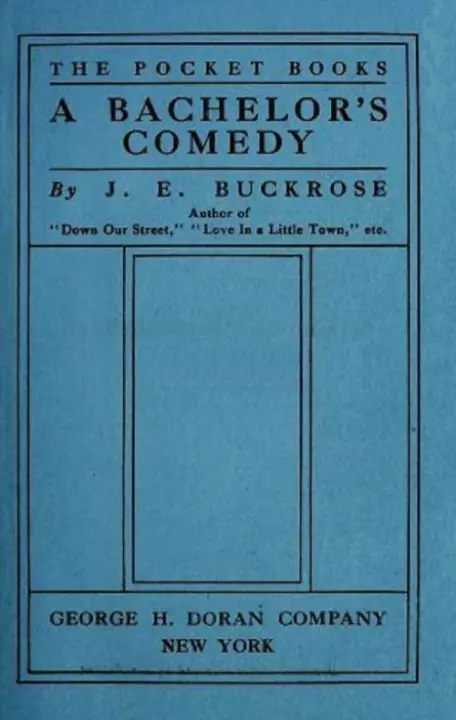
"A Bachelor's Comedy" by J. E. Buckrose is a novel written in the early 20th century. The story centers around the Reverend Andrew Deane, a young vicar navigating his new life in the quaint village of Gaythorpe-on-the-Marsh. As he attempts to establish himself, he grapples with the perception of his youthfulness and the burdens of his clerical responsibilities, all while encountering the charming eccentricities of his new parish's residents. The opening of the novel introduces Andrew as he travels to Gaythorpe, filled with hope and anxiety about his new role. He arrives at the station and is met by the churchwarden, Mr. Thorpe, as they make their way through the pastoral landscape. Andrew is determined to shed his boyish nickname "Andy" and take on the dignity of his position. The narrative unfolds with his interactions at the Vicarage, where he faces the challenge of maintaining discipline with his staff, notably the drunken gardener Sam Petch, while showing kindness to the endearing but needy villagers. This balance of humor, introspection, and the complexities of clerical life lays the groundwork for the deeper themes of community, expectation, and personal growth that will follow in Andrew's journey.
Introduction adapted from the source catalogue; source summaries may be automatically generated.
Free to read · English · 72,222 words · No account needed
MAKE TIME FOR A GOOD BOOK
On by default. Untick to stop anonymous reading totals. Each page counts after 10 seconds in view. How this works.
Anonymous counting is on unless you have switched it off.
The schoolmaster hovered round, pulling, pushing, commanding, advising—miraculously at the bottom when he had been at the top a second before—and at last he flung up his arms distractedly—“Ladies! Ladies! You don’t want to waddle, you want to willow!”
The musicians stopped; with the last wail of the fiddle the Spirit of Ancient Revelry fled through the window and, creeping ever more slowly, lay down to sleep again in the bushes at the edge of the green; people remembered that they were enlightened products of the twentieth century, with a superior education and a purpose in life, and a chance to be as good as anybody if they didn’t give themselves away.
“To willow—that’s a new verb! How clever of Mr. Kirke, and how appropriate to the present style of dress,” said Mrs. Atterton artificially, putting up her eyeglass.
She had to do something to obliterate the fact that her toupee was over one eye, and that she had, for a quarter of an hour, totally forgotten that she possessed a back.
“This kind of thing suits neither you nor me, Mr. Deane,” said the churchwarden to Andy behind his hand; “but, of course, we didn’t like to disoblige Mr. Atterton.”
Thus was the dignity of the Church restored.
“Silly sort of dance, I think,” remarked Rose Werrit to Dick Stamford; “but, of course, they had primitive ideas in those days.”
“Well, I liked it,” said Dick, who was more lined about the mouth and heavier about the eyes than a young man ought to be. “No stiffness about it.”
“We’re not dancing now, Mr. Stamford,” giggled Rose, moving her arm.
“Oh, I thought we were. I forget what I’m doing when I’m with such a pretty girl as you,” responded Dick, whose mode of compliment had been learned in circles where, in such matters, you dot your i’s and cross your t’s.
Rose frowned, but only as an offering to propriety, and accompanied Dick in high feather to a buffet where supper was already in progress.
Mrs. Will Werrit, Mrs. Thorpe, and Mrs. Jebb again foregathered round a little table and criticised the refreshments.
“Never was a cook yet who could make bread,” said Mrs. Thorpe. “The inside of these sandwiches is all right—but the bread——”
“There’s a tang about the butter too,” said Mrs. Will Werrit.
“Talking of butter,” said Mrs. Jebb, rather left out and anxious to make herself conversationally felt, “it’s a queer thing—I’m telling you in strictest confidence—that Mr. Deane never touches it now.”
Your reading position is saved on this browser. Take it to another device with a library code. Reading pages adapt to text, rather than matching a printed edition.
BEHIND THE BOOK
This eBook is for the use of anyone anywhere in the United States and most other parts of the world at no cost and with almost no restrictions whatsoever. You may copy it, give it away or re-use it under the terms of the Project Gutenberg License included with this eBook or online at www.gutenberg.org. If you are not located in the United States, you will have to check the laws of the country where you are located before using this eBook. Read the source licence.
The original source file, including credits and licence, is retained by this library. Request an original-format copy at no charge. Please include the book title and Project Gutenberg identifier #49861.
KEEP YOUR CURIOSITY GOING
Coulson Kernahan

Maurice Baring
Frances Wright
Cécile Tormay

Frederic Jesup Stimson

W. H. P. (William Henry Pope) Jarvis