THE CLASSIC COLLECTION✦A dead man’s diaryCLASSIC FREE BOOKS
A dead man’s diary
Coulson Kernahan
THE CLASSIC COLLECTION · 1912
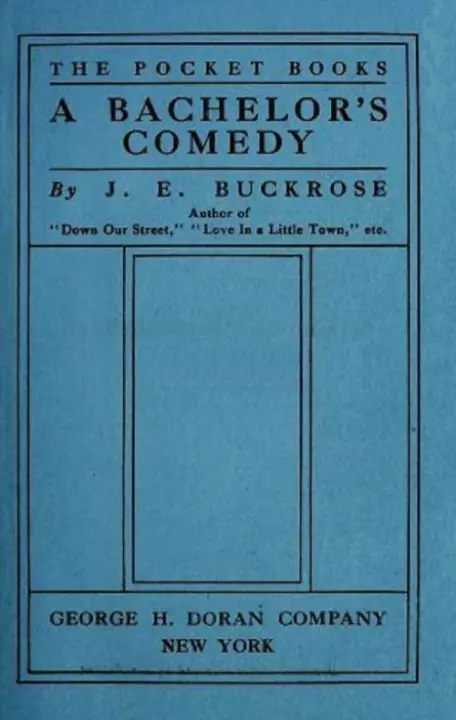
"A Bachelor's Comedy" by J. E. Buckrose is a novel written in the early 20th century. The story centers around the Reverend Andrew Deane, a young vicar navigating his new life in the quaint village of Gaythorpe-on-the-Marsh. As he attempts to establish himself, he grapples with the perception of his youthfulness and the burdens of his clerical responsibilities, all while encountering the charming eccentricities of his new parish's residents. The opening of the novel introduces Andrew as he travels to Gaythorpe, filled with hope and anxiety about his new role. He arrives at the station and is met by the churchwarden, Mr. Thorpe, as they make their way through the pastoral landscape. Andrew is determined to shed his boyish nickname "Andy" and take on the dignity of his position. The narrative unfolds with his interactions at the Vicarage, where he faces the challenge of maintaining discipline with his staff, notably the drunken gardener Sam Petch, while showing kindness to the endearing but needy villagers. This balance of humor, introspection, and the complexities of clerical life lays the groundwork for the deeper themes of community, expectation, and personal growth that will follow in Andrew's journey.
Introduction adapted from the source catalogue; source summaries may be automatically generated.
Free to read · English · 72,222 words · No account needed
MAKE TIME FOR A GOOD BOOK
On by default. Untick to stop anonymous reading totals. Each page counts after 10 seconds in view. How this works.
Anonymous counting is on unless you have switched it off.
“I’ll give up beer, then,” agreed Sam Petch; but he made certain mental reservations of which Andy, naturally, could know nothing. Every man had a right to beer on a Saturday night, of course; that was the privilege of a British working-man which was above and beyond all other agreements.
Then Andy went back into the house with a complete sense of failure dogging his footsteps. It was a ridiculous and undignified thing to do, to make a compact of that nature with a drunken gardener. He ought to have insisted in a dignified manner upon instant reform or instant dismissal.
“Mrs. Jebb,” he said, looking in at the kitchen door, “please do not send butter into the room with my meals. I shall not be taking any for some time.”
“What? No butter?” said Mrs. Jebb. “Are you bilious? Well, I know towards the last Mr. Jebb never could——”
“And I am dining out to-night,” continued Andy, who was particularly disinclined, just then, for Mr. Jebb.
“How convenient! I mean, how strange!” said Mrs. Jebb. “I was just about to ask if you would have any objection to my going over to Millsby Hall this evening.”
“Why—are you invited too?” said Andy, very much astonished. “I mean, there’s no reason why you should not be dining with the Attertons, only I hadn’t heard——”
“Once a lady always a lady, of course,” replied Mrs. Jebb, smoothing her lace cravat. “But the conventions of life are such that, as lady-cook-housekeeper, I neither am, nor expect to be, bidden to Mrs. Atterton’s table. I was referring to the Long Night.”
She gave to the two last words such a melancholy emphasis that Andy had a vague idea, for the moment, that she was in some new way referring to the demise of Mr. Jebb.
“The long night?” he echoed stupidly.
“I mean the final evening of the Parish Dancing Class,” said Mrs. Jebb, “which Mr. and Miss Fanny Kirke have pressed me to attend.”
“Of course,” said Andy. “I’d forgotten. It is to be held at Millsby Hall, of course, so that Mrs. Atterton may see the final practice of the country dances for the Garden Fête next week.”
“Mr. and Miss Kirke told me in confidence,” added Mrs. Jebb, with an indescribable air of being ‘in the know,’ “that Mrs. Atterton’s back would not permit of her coming to the village schoolroom.”
“Ah,” said Andy, to whom even the back of the Beloved’s mamma was sacred. “Well, go, by all means, Mrs. Jebb. I expect I shall see you dancing like a girl.”
Your reading position is saved on this browser. Take it to another device with a library code. Reading pages adapt to text, rather than matching a printed edition.
BEHIND THE BOOK
This eBook is for the use of anyone anywhere in the United States and most other parts of the world at no cost and with almost no restrictions whatsoever. You may copy it, give it away or re-use it under the terms of the Project Gutenberg License included with this eBook or online at www.gutenberg.org. If you are not located in the United States, you will have to check the laws of the country where you are located before using this eBook. Read the source licence.
The original source file, including credits and licence, is retained by this library. Request an original-format copy at no charge. Please include the book title and Project Gutenberg identifier #49861.
KEEP YOUR CURIOSITY GOING
Coulson Kernahan

Maurice Baring
Frances Wright
Cécile Tormay

Frederic Jesup Stimson

W. H. P. (William Henry Pope) Jarvis