THE CLASSIC COLLECTION✦A dead man’s diaryCLASSIC FREE BOOKS
A dead man’s diary
Coulson Kernahan
THE CLASSIC COLLECTION · 1912
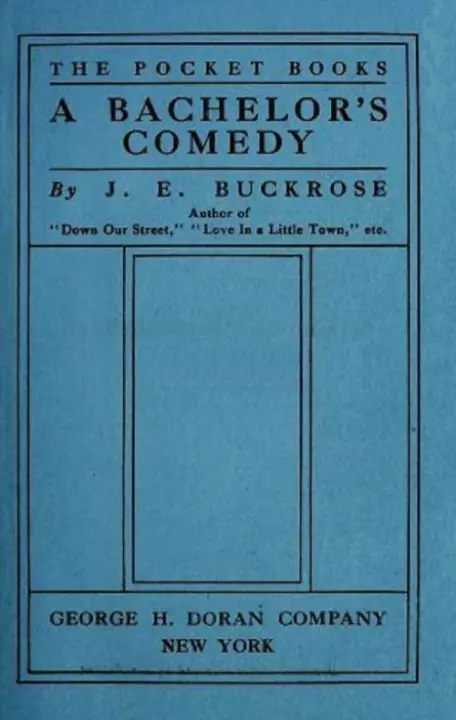
"A Bachelor's Comedy" by J. E. Buckrose is a novel written in the early 20th century. The story centers around the Reverend Andrew Deane, a young vicar navigating his new life in the quaint village of Gaythorpe-on-the-Marsh. As he attempts to establish himself, he grapples with the perception of his youthfulness and the burdens of his clerical responsibilities, all while encountering the charming eccentricities of his new parish's residents. The opening of the novel introduces Andrew as he travels to Gaythorpe, filled with hope and anxiety about his new role. He arrives at the station and is met by the churchwarden, Mr. Thorpe, as they make their way through the pastoral landscape. Andrew is determined to shed his boyish nickname "Andy" and take on the dignity of his position. The narrative unfolds with his interactions at the Vicarage, where he faces the challenge of maintaining discipline with his staff, notably the drunken gardener Sam Petch, while showing kindness to the endearing but needy villagers. This balance of humor, introspection, and the complexities of clerical life lays the groundwork for the deeper themes of community, expectation, and personal growth that will follow in Andrew's journey.
Introduction adapted from the source catalogue; source summaries may be automatically generated.
Free to read · English · 72,222 words · No account needed
MAKE TIME FOR A GOOD BOOK
On by default. Untick to stop anonymous reading totals. Each page counts after 10 seconds in view. How this works.
Anonymous counting is on unless you have switched it off.
“What!” cried Mrs. Dixon.
“Mr. Stamford engaged—you can’t mean it!” said Irene.
“Oh!” said Phyllis. Nothing else. But she wore Eastern beads that morning, with a flimsy blouse, and her expression now matched her toilet—she looked somehow like a chorus girl who had strayed accidentally into melodrama.
After a good deal more conversation on the subject, during which Andy really felt as if he were walking with bare feet on red-hot cinders, he rose to depart, in spite of an urgent invitation to remain for luncheon.
“Then you must have a sandwich,” urged Mrs. Dixon.
He replied most truly that he would rather not.
“Oh, if you won’t stay to lunch we shall insist,” said Irene.
“We should really consider it quite unkind,” said Mrs. Dixon.
So he was obliged to masticate another sandwich, and that seemed to add the last touch to his desolation. For though it is a dignified and even heroic thing to be dogged through misfortune by dragons, there is only plain annoyance in being dogged by ham-sandwiches.
But the climax was reached when Andy, long after luncheon time, arrived home and awaited tea in his study, where the maid appeared bearing the tray, while Mrs. Jebb fluttered after with a plate in her hand.
“I thought,” said she, signing to her underling to depart, “that you would be glad of a few sandwiches after your drive. We had nothing but ham in the——”
She stopped short with her mouth open, for Andy had seized the plate from her and flung the sandwiches upon the fire.
“Bread and butter,” he said thickly.
It was atrocious. It was everything that can possibly be said against such an action. But it did Andy good.
The only drawback was that he had to spend quite an hour, later in the evening, in talking to Mrs. Jebb about Mr. Jebb and the glories of the past.
When they parted, Mrs. Jebb, having forgiven him, eye-cornered him from the doorway and said, very softly—
“I understand. I know what”—she made a pause—“what tooth-ache is,
myself.”
She felt sure he would also understand that by “tooth” she meant “heart.” Only a woman can put these things delicately enough.
But Andy stared after her in heavy amazement as the door closed.
“Toothache!” he thought to himself. “Surely I haven’t been telling her I had toothache, have I? Oh, well, it doesn’t matter.”
For a few minutes he sat staring into the fire, then he got up and went to his desk, and his work gained strength, no doubt, as work always does, from love and sorrow decently borne.
Your reading position is saved on this browser. Take it to another device with a library code. Reading pages adapt to text, rather than matching a printed edition.
BEHIND THE BOOK
This eBook is for the use of anyone anywhere in the United States and most other parts of the world at no cost and with almost no restrictions whatsoever. You may copy it, give it away or re-use it under the terms of the Project Gutenberg License included with this eBook or online at www.gutenberg.org. If you are not located in the United States, you will have to check the laws of the country where you are located before using this eBook. Read the source licence.
The original source file, including credits and licence, is retained by this library. Request an original-format copy at no charge. Please include the book title and Project Gutenberg identifier #49861.
KEEP YOUR CURIOSITY GOING
Coulson Kernahan

Maurice Baring
Frances Wright
Cécile Tormay

Frederic Jesup Stimson

W. H. P. (William Henry Pope) Jarvis