THE CLASSIC COLLECTION✦A dead man’s diaryCLASSIC FREE BOOKS
A dead man’s diary
Coulson Kernahan
THE CLASSIC COLLECTION · 1912
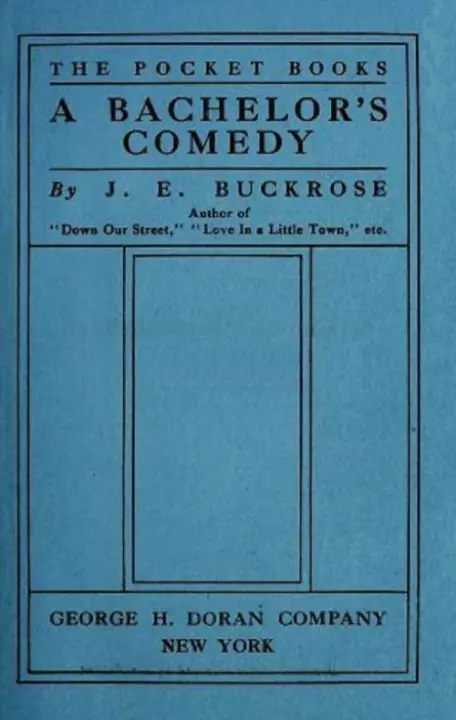
"A Bachelor's Comedy" by J. E. Buckrose is a novel written in the early 20th century. The story centers around the Reverend Andrew Deane, a young vicar navigating his new life in the quaint village of Gaythorpe-on-the-Marsh. As he attempts to establish himself, he grapples with the perception of his youthfulness and the burdens of his clerical responsibilities, all while encountering the charming eccentricities of his new parish's residents. The opening of the novel introduces Andrew as he travels to Gaythorpe, filled with hope and anxiety about his new role. He arrives at the station and is met by the churchwarden, Mr. Thorpe, as they make their way through the pastoral landscape. Andrew is determined to shed his boyish nickname "Andy" and take on the dignity of his position. The narrative unfolds with his interactions at the Vicarage, where he faces the challenge of maintaining discipline with his staff, notably the drunken gardener Sam Petch, while showing kindness to the endearing but needy villagers. This balance of humor, introspection, and the complexities of clerical life lays the groundwork for the deeper themes of community, expectation, and personal growth that will follow in Andrew's journey.
Introduction adapted from the source catalogue; source summaries may be automatically generated.
Free to read · English · 72,222 words · No account needed
MAKE TIME FOR A GOOD BOOK
On by default. Untick to stop anonymous reading totals. Each page counts after 10 seconds in view. How this works.
Anonymous counting is on unless you have switched it off.
“I fear,” said the gentleman, very much worried, “that I shall now not have time to see the parrot. My train leaves at two-fifteen.”
“Does it really?” said Elizabeth.
“I would have stayed on, but I have an important meeting to-night,” he continued, pushing his hat up from his forehead. “But”—he relaxed into an affectionate smile—“I shall hope to come again soon—very soon. I shall explain that to Mrs. Atterton.”
“We shall have to hurry frightfully if we are to be back in time,” said Elizabeth, suiting the action to the word.
“I trust—I may hope—for a welcome—from you,” panted Mr. Parrish, who was not in such good walking form as Elizabeth.
But she pretended not to hear, and finally landed a very tired and perspiring ornithologist at the family luncheon table only three minutes late.
“And what did you think of William?” asked Mrs. Atterton earnestly.
“We never saw him. We lost our way in the wood,” said Elizabeth.
“Lost your way in Millsby wood!” began Bill, when a beseeching glance from his sister checked him, and he added good-naturedly: “Well, there are a lot of—er—rum turnings.”
Only about five minutes afterwards the bottled-in chuckle suddenly
exploded.
“Bill,” said his mother—his father was away—“Bill, what are you
laughing at?”
“Elizabeth’s bump of locality,” responded that youth.
“There is nothing amusing in that,” said Mrs. Atterton coldly.
“No, mother,” said Bill, with unusual meekness, and Mrs. Atterton could not think why her daughter turned so red. She hoped there was nothing going on between Elizabeth and the ornithologist, because he lived nearly all the year abroad, and she did want this home-girl of hers to remain near home.
But after lunch Bill did remark to his sister—
“I say—I don’t want a stuffed owl for a brother-in-law.”
“That’s no worse,” retorted the goaded Elizabeth, “than having a live donkey for a brother.”
Then she retired to her room, and Bill went out with a grin to exercise
the dogs.
There is a theory held by many wise people that if we were all happy we should all be good and clever; but facts at present do seem rather to dispute it. For instance, Andy was undoubtedly less happy than he had ever been in his life, though he was beginning to get hold of the meaning of life, and yet he was both better and cleverer than when he was happy.
Your reading position is saved on this browser. Take it to another device with a library code. Reading pages adapt to text, rather than matching a printed edition.
BEHIND THE BOOK
This eBook is for the use of anyone anywhere in the United States and most other parts of the world at no cost and with almost no restrictions whatsoever. You may copy it, give it away or re-use it under the terms of the Project Gutenberg License included with this eBook or online at www.gutenberg.org. If you are not located in the United States, you will have to check the laws of the country where you are located before using this eBook. Read the source licence.
The original source file, including credits and licence, is retained by this library. Request an original-format copy at no charge. Please include the book title and Project Gutenberg identifier #49861.
KEEP YOUR CURIOSITY GOING
Coulson Kernahan

Maurice Baring
Frances Wright
Cécile Tormay

Frederic Jesup Stimson

W. H. P. (William Henry Pope) Jarvis