The New Glutton or Epicure
Horace Fletcher
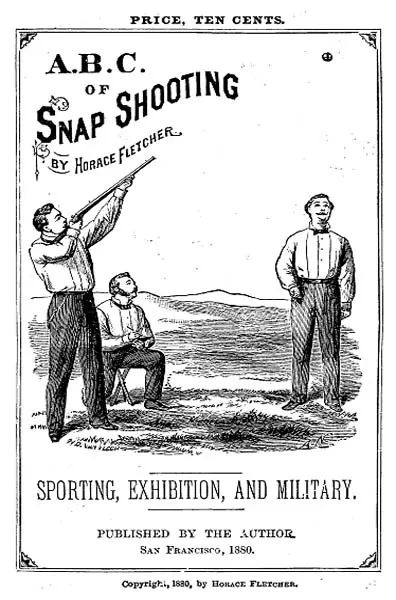
THE CLASSIC COLLECTION · 1880
"A.B.C. of Snap Shooting: Sporting, Exhibition, and Military" by Horace Fletcher is a practical guide on the art of snap shooting, written in the late 19th century. The book focuses on teaching readers how to quickly and effectively shoot using a rifle, emphasizing economy and skill development in various shooting scenarios. Written during the period when marksmanship was an essential skill for both sport and military purposes, it provides insights into effective shooting techniques and safety practices. The content of the book is structured around the principles of snap shooting, explaining the necessary techniques such as loading, aiming, and firing in a single, swift motion. Fletcher outlines the importance of using a .22 caliber rifle for practice, as well as providing detailed instructions on the types of shots one can take, including cross shots, drop shots, and trap shots. He emphasizes the practice routines involving tossing a bell-ball as a target, which reinforces the skills of timing and accuracy. Additionally, the book outlines rules for practice and competitions, making it a comprehensive resource for both aspiring shooters and those looking to refine their existing skills.
Introduction adapted from the source catalogue; source summaries may be automatically generated.
Free to read · English · 7,572 words · No account needed
MAKE TIME FOR A GOOD BOOK
On by default. Untick to stop anonymous reading totals. Each page counts after 10 seconds in view. How this works.
Anonymous counting is on unless you have switched it off.
10. The TRAP-SHOT is the most difficult, requires the quickest[31] action, and is consequently the very best practice, and is the hitting of balls thrown straight away from the firer by a spring-trap, or by hand, so that they fall not more than twenty-five feet distant.
11. The above are the cardinal directions, but any variety of shots can be made at will after these have been mastered.
12. Shooting at a bell-ball, suspended by a wire or cord, which can be done indoors, is excellent practice. The bell is made to swing, and as each hit gives it a new motion a variety of shots can be tried.
13. Balls only[32] should be used as flying targets, for the reason that a bullet may pass very near the center of an irregularly-shaped object, and not hit it, the miss conveying an erroneous impression of the aim.
14. Quickness[31] of action is most important in snap shooting, not only in firing but in loading.
15. Reload your piece immediately after discharging it, and be ready to fire again. That you may accustom yourself to be quick in all your movements, try how many[33] times you can fire, reload, and hit a bell-ball thrown up perpendicularly in a given time, say one or two minutes.
NOTE.--100 consecutive misses at first will not indicate an inability to learn to hit. Perseverance and attention to the suggestions here given will make one a good snap shot in less time than may at first seem possible.
1. Economy facilitates practice by removing the dread of expense which takes the keen edge off of any sport and discourages it.
The expense of an outfit, consisting of a rifle, one thousand cartridges, and a bell-ball is less than twenty-five dollars, which divided between three persons is very light.
Three persons can work together to advantage by taking the positions of firer, tosser and scorer, and benefit by friendly competition.
2. The rifle should be the elementary arm used in practice, and be handled with success on all the shots before the shot-gun is taken up.
True impressions only should be given the learner, which the rifle does, and the shot-gun does not, give.
Occasionally, the scattering of shot may allow an object to drop without being hit, when the gun has been held right on it, and again, a stray shot may hit, when the aim has been high, low, or to one side, in both of which cases the impressions given the firer are erroneous.
With the rifle this cannot occur, and every time one makes a hit he has received a true impression of the position the sights should hold relative to the bell.
Your reading position is saved on this browser. Take it to another device with a library code. Reading pages adapt to text, rather than matching a printed edition.
Horace Fletcher
Horace Fletcher
Horace Fletcher
Horace Fletcher
BEHIND THE BOOK
This eBook is for the use of anyone anywhere in the United States and most other parts of the world at no cost and with almost no restrictions whatsoever. You may copy it, give it away or re-use it under the terms of the Project Gutenberg License included with this eBook or online at www.gutenberg.org. If you are not located in the United States, you will have to check the laws of the country where you are located before using this eBook. Read the source licence.
The original source file, including credits and licence, is retained by this library. Request an original-format copy at no charge. Please include the book title and Project Gutenberg identifier #45030.
KEEP YOUR CURIOSITY GOING

Charles G. (Charles Griffith) Ross
Hannah Webster Foster

Emily Lawless
Edwin Hamlin Carr

Charles De Lano Hine
Andrew Ure