The New Glutton or Epicure
Horace Fletcher
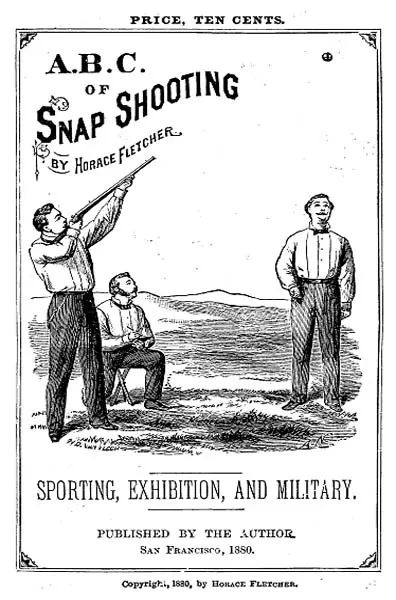
THE CLASSIC COLLECTION · 1880
"A.B.C. of Snap Shooting: Sporting, Exhibition, and Military" by Horace Fletcher is a practical guide on the art of snap shooting, written in the late 19th century. The book focuses on teaching readers how to quickly and effectively shoot using a rifle, emphasizing economy and skill development in various shooting scenarios. Written during the period when marksmanship was an essential skill for both sport and military purposes, it provides insights into effective shooting techniques and safety practices. The content of the book is structured around the principles of snap shooting, explaining the necessary techniques such as loading, aiming, and firing in a single, swift motion. Fletcher outlines the importance of using a .22 caliber rifle for practice, as well as providing detailed instructions on the types of shots one can take, including cross shots, drop shots, and trap shots. He emphasizes the practice routines involving tossing a bell-ball as a target, which reinforces the skills of timing and accuracy. Additionally, the book outlines rules for practice and competitions, making it a comprehensive resource for both aspiring shooters and those looking to refine their existing skills.
Introduction adapted from the source catalogue; source summaries may be automatically generated.
Free to read · English · 7,572 words · No account needed
MAKE TIME FOR A GOOD BOOK
On by default. Untick to stop anonymous reading totals. Each page counts after 10 seconds in view. How this works.
Anonymous counting is on unless you have switched it off.
In shooting at point blank range horizontally, the line of elevation is just counteracted by gravity.
In shooting straight up or straight down there is no lateral attraction to affect the course of the bullet, gravity acting only to aid or retard its speed, consequently the line of elevation will throw it off the target the full distance.
In shooting at any point in either the upper or lower quadrants, aim low; the lower as you approach either perpendicular.
The speed of a bullet diminishes as it travels, and as it requires much greater time to make the second than the first hundred yards, gravity has more time to depress it in that distance.
In bending backwards to shoot, remember that the rifle is inverted.
The flight of a bullet is not in a perfect curve; at first it travels almost straight, then curves gradually, then abruptly, till finally when it has lost its momentum, it drops perpendicularly, affected only by gravity.
If you are stationary and your target moves, aim ahead.
If you are in motion and your target is stationary aim behind, because your motion is given to the bullet.
If you and your target are both moving in the same direction at the same speed, near each other, aim at it, but if the distance be great, aim ahead, because your target keeps up its speed, while the momentum which you have given the bullet decreases as it travels.
The force of wind being irregular and capricious must be judged from personal observation and experience, but remember, that like gravity, it has more time to deflect a bullet during its second than during its first hundred yards flight.
Hold the gun firmly against your shoulder to prevent its kicking.
To counteract recoil, hold yourself against it by making a slight
movement forward as you fire.
The general fault in aiming, in snap shooting, is over-aiming.
The front sight should always be brought well down in the rear sight,
which is facilitated by having sufficient drop to the stock of the
piece.
Aim at an object going straight away from you, as if it were rising.
The shooting at still targets, either off-hand or from a rest, judging windage and the elevation required, nice cleaning, regular loading, etc., are very scientific and good practice for sharp shooting, but unfit one for snap shooting.
To be able to judge distance, windage, the height above or depression below the level, the speed and direction the object is moving, while you count one, two, three, is the skill which this system endeavors to teach, and which is solidly practical.
Your reading position is saved on this browser. Take it to another device with a library code. Reading pages adapt to text, rather than matching a printed edition.
Horace Fletcher

Horace Fletcher
Horace Fletcher
Horace Fletcher
BEHIND THE BOOK
This eBook is for the use of anyone anywhere in the United States and most other parts of the world at no cost and with almost no restrictions whatsoever. You may copy it, give it away or re-use it under the terms of the Project Gutenberg License included with this eBook or online at www.gutenberg.org. If you are not located in the United States, you will have to check the laws of the country where you are located before using this eBook. Read the source licence.
The original source file, including credits and licence, is retained by this library. Request an original-format copy at no charge. Please include the book title and Project Gutenberg identifier #45030.
KEEP YOUR CURIOSITY GOING

Charles G. (Charles Griffith) Ross
Hannah Webster Foster

Emily Lawless
Edwin Hamlin Carr

Charles De Lano Hine
Andrew Ure