THE CLASSIC COLLECTION✦An outlaw’s diary: the CommuneCLASSIC FREE BOOKS
An outlaw’s diary: the Commune
Cécile Tormay
THE CLASSIC COLLECTION · 1899
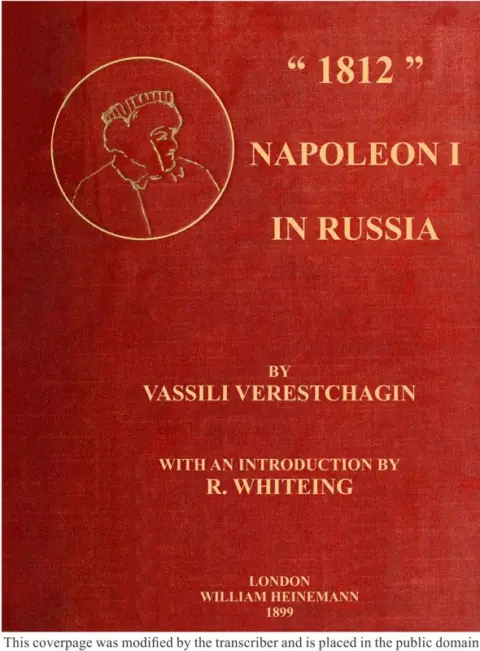
"1812: Napoleon I in Russia" by Vasilïĭ Vasilʹevich Vereshchagin is a historical account written in the late 19th century. The text presents a detailed perspective on Napoleon's ill-fated campaign against Russia, particularly emphasizing the artist's observations and experiences as a war correspondent. The insights within this work stem from Vereshchagin's efforts to bring a realist representation of the harsh realities of war to life, rather than glorifying it. The opening of the book sets the stage by contextualizing the lead-up to Napoleon’s invasion of Russia and introduces key figures such as Emperor Alexander. It highlights the escalating tensions between France and Russia, revealing Napoleon's ambition to assert dominance over Europe and the initial confidence of his troops. Through a vivid depiction of Napoleon's preparations and the overall atmosphere at the time, Vereshchagin establishes a compelling narrative that foreshadows the complexities and eventual misfortune of the campaign as viewed from a soldier's and artist's perspective.
Introduction adapted from the source catalogue; source summaries may be automatically generated.
Free to read · English · 78,599 words · No account needed
MAKE TIME FOR A GOOD BOOK
On by default. Untick to stop anonymous reading totals. Each page counts after 10 seconds in view. How this works.
Anonymous counting is on unless you have switched it off.
Ask the playwrights, whether they would dare to represent the action in such a way as it has been suggested to them by real life, with its logical conclusion, made unavoidable by the march of events, omitting, for once, the long-established, hackneyed, conventional termination?
“No,” the authors would tell you, “such a thing is not to be thought of,” and they will be in the right. Society, weighed down by cant, will not go to see such a play, however interesting it may be; so the author has to humour the public if he does not want to bring ruin on his manager and on himself.
The same is the case with artists, sculptors, even composers. How many favourites of the Muses have been driven into early graves by the animosity of the public against all new construction of poetical as well as musical ideas?
On one side we hear complaints of the dulness, the monotony, even the triviality, prevailing in art; people clamour for something inspired, something original; on the other hand, the same public arbitrarily chastises you for all that fails to come within the range of established, conventional ideas!
It is high time, it seems to me, to understand the necessity of treating art with tolerance and confidence, if we want it to fraternize with society, to become as one with it, to serve it faithfully and well in the present troubled times when the poet and the artist are soldiers at their posts.
“But, you representative of art,” I might be asked, “what are the tidings that you are so eager to announce to us—what are your discoveries that would be so entirely new to society?”
Well, what we should say would, perhaps, not be news, yet certainly the idea of it has not yet penetrated the consciousness of the people. Armed with the rich, varied resources of art we should tell people some truths.
“Give up,” we shall say to them, “give up enjoying yourselves amidst the illusions of the idealism which lulls your senses, of the idealism of high-sounding words and phrases. Look around you through the eye of sensible realism, and you will acquire the certitude of your mistake. You are not the Christians you assume yourselves to be. You are not representatives of Christian societies, of Christian countries.”
Those who kill their kind by the hundred thousand are not Christians.
Those who are always moved, in private as well as in public life, by the principle of “eye for eye, and tooth for tooth,” are not Christians.
Those who spend many hours of their lives in churches, yet who give nothing, or next to nothing, to the poor, are not Christians.
Your reading position is saved on this browser. Take it to another device with a library code. Reading pages adapt to text, rather than matching a printed edition.
BEHIND THE BOOK
This eBook is for the use of anyone anywhere in the United States and most other parts of the world at no cost and with almost no restrictions whatsoever. You may copy it, give it away or re-use it under the terms of the Project Gutenberg License included with this eBook or online at www.gutenberg.org. If you are not located in the United States, you will have to check the laws of the country where you are located before using this eBook. Read the source licence.
The original source file, including credits and licence, is retained by this library. Request an original-format copy at no charge. Please include the book title and Project Gutenberg identifier #51418.
KEEP YOUR CURIOSITY GOING
Cécile Tormay

Moritz Busch
John L. Ransom
Frances Wright
Cécile Tormay

Mabel Potter Daggett