
The Writing of News A Handbook with Chapters on Newspaper Correspondence and Copy Reading
Charles G. (Charles Griffith) Ross
THE CLASSIC COLLECTION · 1913
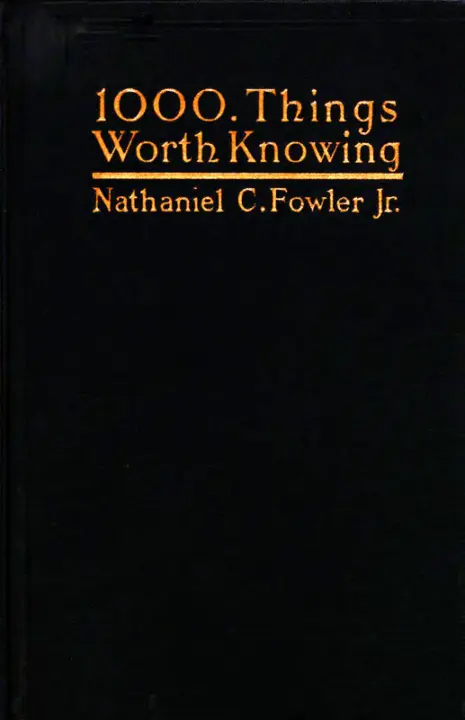
"1000 Things Worth Knowing" by Nathaniel C. Fowler is a non-fiction compilation written in the early 20th century. The book presents a plethora of interesting and lesser-known facts spanning various subjects, aimed at broadening the reader's general knowledge. The author’s intent is to convey these facts in simple English, making them accessible to the average reader. The opening of this work introduces the reader to Fowler’s goal of presenting over a thousand facts that are not commonly known yet hold significance and relevance to humankind. He emphasizes the importance of clarity and simplicity in explanations, thereby avoiding overly technical language. The preface sets the tone for a format that allows readers to easily consult information on diverse topics, which are referenced in an organized manner for quick navigation.
Introduction adapted from the source catalogue; source summaries may be automatically generated.
Free to read · English · 43,934 words · No account needed
MAKE TIME FOR A GOOD BOOK
On by default. Untick to stop anonymous reading totals. Each page counts after 10 seconds in view. How this works.
Anonymous counting is on unless you have switched it off.
=Spectacles and Glasses.=--If you find it difficult to read, or your eyes become weak and tired, the chances are you need proper glasses. Don't attempt to fit them to yourself. Employ a first-class optician or oculist, the latter if the trouble appears to be serious.
Sporting, Speed, and Other Records
The following records are compiled from the latest and best authorities:
=Airship Records=: Highest altitude reached, 17,881 feet; longest non-stop flight, 635-5/8 miles in 13 hours, 22 minutes; longest time in the air, 16-1/2 hours.
=Automobile Records=: 1 mile, 25.40 s.; 2 miles, 51.28 s.; 5 miles, 2 m., 34 s.; 50 miles, 35m., 52-1/2 s.; 100 miles, 1h., 12 m., 41 1-5 s.; 300 miles, 3 h., 53 m., 33-1/2 s.; 500 miles, 6 h., 21 m., 6 3-10 s.
=Baseball=: Baseball became the National Game in 1885, although it was played to some extent as early as 1840. The first baseball club was known as the New York Knickerbockers, which was organized in 1845, and the first match game was played at Hoboken, N. J., in 1846. The first rules governing baseball were made in New York City, in 1857, and the National Baseball League was formed in New York City during the same year. The first champion team was that of New York, in 1858, but it was not until 1868 that a salaried team was in existence. The National League was formed in 1876, and the American League in 1881. The largest attendance at a baseball match was in New York, Oct. 17, 1911, at which time 38,281 people were present.
=Billiards=: Straight rail, 5 × 10 table, best run, 1,535 points, made by Maurice Vignaux in Paris; straight rail, 4-1/2 × 9 table, best run, 3,000 points, Jake Schaefer in San Francisco; 14-inch balk line, anchor in, best run, 566, Jake Schaefer in New York; 14-inch balk line, anchor barred, best run, 359, Frank Ives in Chicago; 18-inch balk line, best run, 200, Frank Ives in New York; 18-inch balk line, best average, 50, Frank Ives in New York; 18-inch balk line (no shot in), best run, 111, Jake Schaefer in Chicago; 18-inch balk line (no shot in), best average, 19 3-13, Frank Ives in Chicago; high run, 18.2 balk line, 1,009 single inning, W. W. Spink in Los Angeles.
=Bowling=: Individual three-game score, Thomas Hally, Detroit, 705.
=Endurance Records=: Relay Race, Young Men's Christian Association boys carried message from New York to Chicago; time, 118 h., 35 m.; distance, 1,200 miles. (Run suspended during Sunday, July 19.)
5,100 miles, go as you please, 51 miles per day for 100 days, track 44 laps to mile, George D. Noremac, New York.
4,000 quarter-miles in 4,000 periods of 10 minutes (walking a quarter-mile at the commencement of and within each consecutive 10 minutes), performed twice by William Gales, at Cardiff, and at London, England.
1,000 miles in 1,000 consecutive hours, walking 1 mile each hour, by Charles F. Morse, at Jackson, Mich., starting at 1 P. M., Jan. 11, 1897, and ending at 4 A. M., Feb. 22, 1897, track 39 laps to mile.
Your reading position is saved on this browser. Take it to another device with a library code. Reading pages adapt to text, rather than matching a printed edition.
BEHIND THE BOOK
This eBook is for the use of anyone anywhere in the United States and most other parts of the world at no cost and with almost no restrictions whatsoever. You may copy it, give it away or re-use it under the terms of the Project Gutenberg License included with this eBook or online at www.gutenberg.org. If you are not located in the United States, you will have to check the laws of the country where you are located before using this eBook. Read the source licence.
The original source file, including credits and licence, is retained by this library. Request an original-format copy at no charge. Please include the book title and Project Gutenberg identifier #56796.
KEEP YOUR CURIOSITY GOING
Charles G. (Charles Griffith) Ross
Hannah Webster Foster

Emily Lawless
Edwin Hamlin Carr

Charles De Lano Hine
Andrew Ure