
The Writing of News A Handbook with Chapters on Newspaper Correspondence and Copy Reading
Charles G. (Charles Griffith) Ross
THE CLASSIC COLLECTION · 1913
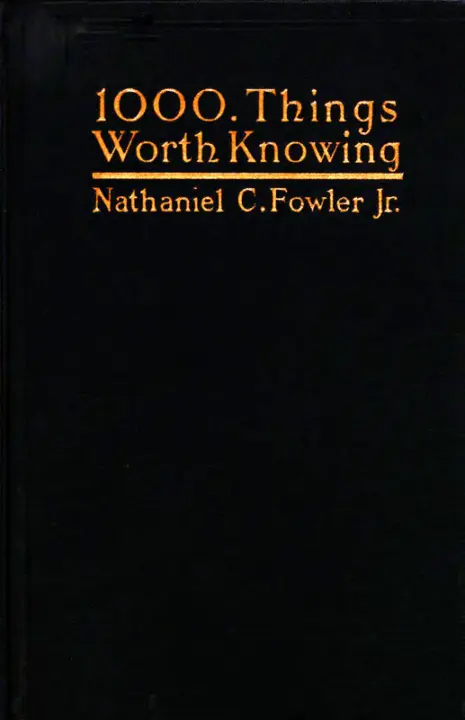
"1000 Things Worth Knowing" by Nathaniel C. Fowler is a non-fiction compilation written in the early 20th century. The book presents a plethora of interesting and lesser-known facts spanning various subjects, aimed at broadening the reader's general knowledge. The author’s intent is to convey these facts in simple English, making them accessible to the average reader. The opening of this work introduces the reader to Fowler’s goal of presenting over a thousand facts that are not commonly known yet hold significance and relevance to humankind. He emphasizes the importance of clarity and simplicity in explanations, thereby avoiding overly technical language. The preface sets the tone for a format that allows readers to easily consult information on diverse topics, which are referenced in an organized manner for quick navigation.
Introduction adapted from the source catalogue; source summaries may be automatically generated.
Free to read · English · 43,934 words · No account needed
MAKE TIME FOR A GOOD BOOK
On by default. Untick to stop anonymous reading totals. Each page counts after 10 seconds in view. How this works.
Anonymous counting is on unless you have switched it off.
=Gravity.=--The force of gravity, unscientifically speaking, is the influence which one body has upon another, commonly known as attraction. All material substances attempt to draw others to them, and the larger the substance, the greater its attractiveness or drawing power. The earth, being larger than anything near it, draws everything to it. A ball thrown into the air returns to the earth as soon as the force which propelled it upward is exhausted. If the ball were larger than the earth, the earth would move toward the ball, or rather each would move toward the other, but the smaller body would go the greater distance. The entire universe would, undoubtedly, come together in one solid mass if the bodies were not held apart by laws and energies, which are not yet fully understood by men. Sir Isaac Newton discovered the action of gravity, but no one knows exactly what it is.
Great American Inventions
The following list of fifteen great American inventions is taken from Killikelly's "Curious Questions":
(1) The Cotton Gin.
(2) The Planting Machine.
(3) The Grass Mower and Reaper.
(4) The Rotary Printing-Press.
(5) Steam Navigation.
(6) The Hot-Air Engine.
(7) The Sewing-Machine.
(8) The India-Rubber Industry.
(9) The Machine Manufacture of Horseshoes.
(10) The Sand-Blast for Carving.
(11) The Gauge Lathe.
(12) The Grain Elevator.
(13) Artificial Ice-Making on Large Scale.
(14) The Electric Magnet and Its Practical Application.
(15) The Telephone.
"=Great Eastern.="--The "Great Eastern" was, in her time, the largest vessel in the world, but would be considered small compared with the giant ocean liners of to-day. She was built in London and launched in 1858. She cost $300,000. She had a length of 680 ft., breadth of 82-1/2 ft., or 118 ft. including the paddle boxes, and a height of 58 ft. Her motive power consisted of eight engines with a total of 11,000 horse power. She was slow and unwieldy, and was not a success except for the laying of the Atlantic cable.
=Great Libraries.=--The Congressional Library, Washington, contains 1,800,000 volumes; Boston Public Library and New York Public Library, each 900,000; Harvard University Library, 800,000; New York State Library, 520,000; Yale University Library, 400,000; Bibliothèque nationale, Paris, 2,600,000; British Museum, London, 2,000,000; Imper. publicnaja biblioteka, St. Petersburg, 1,330,000; Königliche Bibliothek, Berlin, 1,200,000; Kön. Hof-u. Staatsbibliothek, Munich, 1,000,000; K. u. k. Hofbibliothek, Vienna, 900,000.
=Great Tunnels.=--The Arlberg tunnel under the Alps is 6-3/4 miles long. The Gunnison tunnel in Colorado is 6 miles long. The Hoosac tunnel in Massachusetts is 4-3/4 miles long. The Mont Cenis in Italy and France is 8 miles long. The New Croton water tunnel in New York is 33-1/8 miles long. The Otira in New Zealand is 5 1-3 miles long. The tunnel which drains the Freiberg mines, Saxony, is 31-1/2 miles long.
Your reading position is saved on this browser. Take it to another device with a library code. Reading pages adapt to text, rather than matching a printed edition.
BEHIND THE BOOK
This eBook is for the use of anyone anywhere in the United States and most other parts of the world at no cost and with almost no restrictions whatsoever. You may copy it, give it away or re-use it under the terms of the Project Gutenberg License included with this eBook or online at www.gutenberg.org. If you are not located in the United States, you will have to check the laws of the country where you are located before using this eBook. Read the source licence.
The original source file, including credits and licence, is retained by this library. Request an original-format copy at no charge. Please include the book title and Project Gutenberg identifier #56796.
KEEP YOUR CURIOSITY GOING
Charles G. (Charles Griffith) Ross
Hannah Webster Foster

Emily Lawless
Edwin Hamlin Carr

Charles De Lano Hine
Andrew Ure