THE CLASSIC COLLECTION✦A treatise of civil power in ecclesiastical causesCLASSIC FREE BOOKS
A treatise of civil power in ecclesiastical causes
John Milton
THE CLASSIC COLLECTION · 1671
"Paradise Regained" by John Milton is an epic poem first published in 1671. This brief epic depicts Christ's forty days in the wilderness, where Satan attempts to break his resolve through increasingly sophisticated temptations. Unlike Milton's ornate "Paradise Lost," this work employs a plainer style to chronicle Christ's spiritual battle. Through offers of food, wealth, power, and ancient wisdom, Satan tests the fasting Jesus, who responds with scripture and steadfast refusal. The poem explores themes of reversal and hunger—both literal and spiritual—as Christ resists temptation to regain what humanity lost in Eden.
Introduction adapted from the source catalogue; source summaries may be automatically generated.
Free to read · English · 15,879 words · No account needed
MAKE TIME FOR A GOOD BOOK
On by default. Untick to stop anonymous reading totals. Each page counts after 10 seconds in view. How this works.
Anonymous counting is on unless you have switched it off.
Paradise Regained
by John Milton
I, who erewhile the happy Garden sung
By one man’s disobedience lost, now sing
Recovered Paradise to all mankind,
By one man’s firm obedience fully tried
Through all temptation, and the Tempter foiled
In all his wiles, defeated and repulsed,
And Eden raised in the waste Wilderness.
Thou Spirit, who led’st this glorious Eremite
Into the desert, his victorious field
Against the spiritual foe, and brought’st him thence 10
By proof the undoubted Son of God, inspire,
As thou art wont, my prompted song, else mute,
And bear through highth or depth of Nature’s bounds,
With prosperous wing full summed, to tell of deeds
Above heroic, though in secret done,
And unrecorded left through many an age:
Worthy to have not remained so long unsung.
Now had the great Proclaimer, with a voice
More awful than the sound of trumpet, cried
Repentance, and Heaven’s kingdom nigh at hand 20
To all baptized. To his great baptism flocked
With awe the regions round, and with them came
From Nazareth the son of Joseph deemed
To the flood Jordan—came as then obscure,
Unmarked, unknown. But him the Baptist soon
Descried, divinely warned, and witness bore
As to his worthier, and would have resigned
To him his heavenly office. Nor was long
His witness unconfirmed: on him baptized
Heaven opened, and in likeness of a Dove 30
The Spirit descended, while the Father’s voice
From Heaven pronounced him his beloved Son.
That heard the Adversary, who, roving still
About the world, at that assembly famed
Would not be last, and, with the voice divine
Nigh thunder-struck, the exalted man to whom
Such high attest was given a while surveyed
With wonder; then, with envy fraught and rage,
Flies to his place, nor rests, but in mid air
To council summons all his mighty Peers, 40
Within thick clouds and dark tenfold involved,
A gloomy consistory; and them amidst,
With looks aghast and sad, he thus bespake:—
“O ancient Powers of Air and this wide World
(For much more willingly I mention Air,
This our old conquest, than remember Hell,
Our hated habitation), well ye know
How many ages, as the years of men,
This Universe we have possessed, and ruled
In manner at our will the affairs of Earth, 50
Since Adam and his facile consort Eve
Lost Paradise, deceived by me, though since
With dread attending when that fatal wound
Shall be inflicted by the seed of Eve
Upon my head. Long the decrees of Heaven
Delay, for longest time to Him is short;
And now, too soon for us, the circling hours
This dreaded time have compassed, wherein we
Must bide the stroke of that long-threatened wound
(At least, if so we can, and by the head 60
Broken be not intended all our power
To be infringed, our freedom and our being
In this fair empire won of Earth and Air)—
For this ill news I bring: The Woman’s Seed,
Destined to this, is late of woman born.
His birth to our just fear gave no small cause;
But his growth now to youth’s full flower, displaying
All virtue, grace and wisdom to achieve
Things highest, greatest, multiplies my fear.
Before him a great Prophet, to proclaim 70
His coming, is sent harbinger, who all
Invites, and in the consecrated stream
Pretends to wash off sin, and fit them so
Purified to receive him pure, or rather
To do him honour as their King. All come,
And he himself among them was baptized—
Not thence to be more pure, but to receive
The testimony of Heaven, that who he is
Thenceforth the nations may not doubt. I saw
The Prophet do him reverence; on him, rising 80
Out of the water, Heaven above the clouds
Unfold her crystal doors; thence on his head
A perfet Dove descend (whate’er it meant);
And out of Heaven the sovraign voice I heard,
‘This is my Son beloved,—in him am pleased.’
His mother, than, is mortal, but his Sire
He who obtains the monarchy of Heaven;
And what will He not do to advance his Son?
His first-begot we know, and sore have felt,
When his fierce thunder drove us to the Deep; 90
Who this is we must learn, for Man he seems
In all his lineaments, though in his face
The glimpses of his Father’s glory shine.
Ye see our danger on the utmost edge
Of hazard, which admits no long debate,
But must with something sudden be opposed
(Not force, but well-couched fraud, well-woven snares),
Ere in the head of nations he appear,
Their king, their leader, and supreme on Earth.
I, when no other durst, sole undertook 100
The dismal expedition to find out
And ruin Adam, and the exploit performed
Successfully: a calmer voyage now
Will waft me; and the way found prosperous once
Induces best to hope of like success.”
He ended, and his words impression left
Of much amazement to the infernal crew,
Distracted and surprised with deep dismay
At these sad tidings. But no time was then
For long indulgence to their fears or grief: 110
Unanimous they all commit the care
And management of this man enterprise
To him, their great Dictator, whose attempt
At first against mankind so well had thrived
In Adam’s overthrow, and led their march
From Hell’s deep-vaulted den to dwell in light,
Regents, and potentates, and kings, yea gods,
Of many a pleasant realm and province wide.
So to the coast of Jordan he directs
His easy steps, girded with snaky wiles, 120
Where he might likeliest find this new-declared,
This man of men, attested Son of God,
Temptation and all guile on him to try—
So to subvert whom he suspected raised
To end his reign on Earth so long enjoyed:
But, contrary, unweeting he fulfilled
The purposed counsel, pre-ordained and fixed,
Of the Most High, who, in full frequence bright
Of Angels, thus to Gabriel smiling spake:—
“Gabriel, this day, by proof, thou shalt behold, 130
Thou and all Angels conversant on Earth
With Man or men’s affairs, how I begin
To verify that solemn message late,
On which I sent thee to the Virgin pure
In Galilee, that she should bear a son,
Great in renown, and called the Son of God.
Then told’st her, doubting how these things could be
To her a virgin, that on her should come
The Holy Ghost, and the power of the Highest
O’ershadow her. This Man, born and now upgrown, 140
To shew him worthy of his birth divine
And high prediction, henceforth I expose
To Satan; let him tempt, and now assay
His utmost subtlety, because he boasts
And vaunts of his great cunning to the throng
Of his Apostasy. He might have learnt
Less overweening, since he failed in Job,
Whose constant perseverance overcame
Whate’er his cruel malice could invent.
He now shall know I can produce a man, 150
Of female seed, far abler to resist
All his solicitations, and at length
All his vast force, and drive him back to Hell—
Winning by conquest what the first man lost
By fallacy surprised. But first I mean
To exercise him in the Wilderness;
There he shall first lay down the rudiments
Of his great warfare, ere I send him forth
To conquer Sin and Death, the two grand foes.
By humiliation and strong sufferance 160
His weakness shall o’ercome Satanic strength,
And all the world, and mass of sinful flesh;
That all the Angels and æthereal Powers—
They now, and men hereafter—may discern
From what consummate virtue I have chose
This perfet man, by merit called my Son,
To earn salvation for the sons of men.”
So spake the Eternal Father, and all Heaven
Admiring stood a space; then into hymns
Burst forth, and in celestial measures moved, 170
Circling the throne and singing, while the hand
Sung with the voice, and this the argument:—
“Victory and triumph to the Son of God,
Now entering his great duel, not of arms,
But to vanquish by wisdom hellish wiles!
The Father knows the Son; therefore secure
Ventures his filial virtue, though untried,
Against whate’er may tempt, whate’er seduce,
Allure, or terrify, or undermine.
Be frustrate, all ye stratagems of Hell, 180
And, devilish machinations, come to nought!”
So they in Heaven their odes and vigils tuned.
Meanwhile the Son of God, who yet some days
Lodged in Bethabara, where John baptized,
Musing and much revolving in his breast
How best the mighty work he might begin
Of Saviour to mankind, and which way first
Publish his godlike office now mature,
One day forth walked alone, the Spirit leading
And his deep thoughts, the better to converse 190
With solitude, till, far from track of men,
Thought following thought, and step by step led on,
He entered now the bordering Desert wild,
And, with dark shades and rocks environed round,
His holy meditations thus pursued:—
“O what a multitude of thoughts at once
Awakened in me swarm, while I consider
What from within I feel myself, and hear
What from without comes often to my ears,
Ill sorting with my present state compared! 200
When I was yet a child, no childish play
To me was pleasing; all my mind was set
Serious to learn and know, and thence to do,
What might be public good; myself I thought
Born to that end, born to promote all truth,
All righteous things. Therefore, above my years,
The Law of God I read, and found it sweet;
Made it my whole delight, and in it grew
To such perfection that, ere yet my age
Had measured twice six years, at our great Feast 210
I went into the Temple, there to hear
The teachers of our Law, and to propose
What might improve my knowledge or their own,
And was admired by all. Yet this not all
To which my spirit aspired. Victorious deeds
Flamed in my heart, heroic acts—one while
To rescue Israel from the Roman yoke;
Then to subdue and quell, o’er all the earth,
Brute violence and proud tyrannic power,
Till truth were freed, and equity restored: 220
Yet held it more humane, more heavenly, first
By winning words to conquer willing hearts,
And make persuasion do the work of fear;
At least to try, and teach the erring soul,
Not wilfully misdoing, but unware
Misled; the stubborn only to subdue.
These growing thoughts my mother soon perceiving,
By words at times cast forth, inly rejoiced,
And said to me apart, ‘High are thy thoughts,
O Son! but nourish them, and let them soar 230
To what highth sacred virtue and true worth
Can raise them, though above example high;
By matchless deeds express thy matchless Sire.
For know, thou art no son of mortal man;
Though men esteem thee low of parentage,
Thy Father is the Eternal King who rules
All Heaven and Earth, Angels and sons of men.
A messenger from God foretold thy birth
Conceived in me a virgin; he foretold
Thou shouldst be great, and sit on David’s throne, 240
And of thy kingdom there should be no end.
At thy nativity a glorious quire
Of Angels, in the fields of Bethlehem, sung
To shepherds, watching at their folds by night,
And told them the Messiah now was born,
Where they might see him; and to thee they came,
Directed to the manger where thou lay’st;
For in the inn was left no better room.
A Star, not seen before, in heaven appearing,
Guided the Wise Men thither from the East, 250
To honour thee with incense, myrrh, and gold;
By whose bright course led on they found the place,
Affirming it thy star, new-graven in heaven,
By which they knew thee King of Israel born.
Just Simeon and prophetic Anna, warned
By vision, found thee in the Temple, and spake,
Before the altar and the vested priest,
Like things of thee to all that present stood.’
This having heart, straight I again revolved
The Law and Prophets, searching what was writ 260
Concerning the Messiah, to our scribes
Known partly, and soon found of whom they spake
I am—this chiefly, that my way must lie
Through many a hard assay, even to the death,
Ere I the promised kingdom can attain,
Or work redemption for mankind, whose sins’
Full weight must be transferred upon my head.
Yet, neither thus disheartened or dismayed,
The time prefixed I waited; when behold
The Baptist (of whose birth I oft had heard, 270
Not knew by sight) now come, who was to come
Before Messiah, and his way prepare!
I, as all others, to his baptism came,
Which I believed was from above; but he
Straight knew me, and with loudest voice proclaimed
Me him (for it was shewn him so from Heaven)—
Me him whose harbinger he was; and first
Refused on me his baptism to confer,
As much his greater, and was hardly won.
But, as I rose out of the laving stream, 280
Heaven opened her eternal doors, from whence
The Spirit descended on me like a Dove;
And last, the sum of all, my Father’s voice,
Audibly heard from Heaven, pronounced me his,
Me his beloved Son, in whom alone
He was well pleased: by which I knew the time
Now full, that I no more should live obscure,
But openly begin, as best becomes
The authority which I derived from Heaven.
And now by some strong motion I am led 290
Into this wilderness; to what intent
I learn not yet. Perhaps I need not know;
For what concerns my knowledge God reveals.”
So spake our Morning Star, then in his rise,
And, looking round, on every side beheld
A pathless desert, dusk with horrid shades.
The way he came, not having marked return,
Was difficult, by human steps untrod;
And he still on was led, but with such thoughts
Accompanied of things past and to come 300
Lodged in his breast as well might recommend
Such solitude before choicest society.
Full forty days he passed—whether on hill
Sometimes, anon in shady vale, each night
Under the covert of some ancient oak
Or cedar to defend him from the dew,
Or harboured in one cave, is not revealed;
Nor tasted human food, nor hunger felt,
Till those days ended; hungered then at last
Among wild beasts. They at his sight grew mild, 310
Nor sleeping him nor waking harmed; his walk
The fiery serpent fled and noxious worm;
The lion and fierce tiger glared aloof.
But now an aged man in rural weeds,
Following, as seemed, the quest of some stray eye,
Or withered sticks to gather, which might serve
Against a winter’s day, when winds blow keen,
To warm him wet returned from field at eve,
He saw approach; who first with curious eye
Perused him, then with words thus uttered spake:— 320
“Sir, what ill chance hath brought thee to this place,
So far from path or road of men, who pass
In troop or caravan? for single none
Durst ever, who returned, and dropt not here
His carcass, pined with hunger and with droughth.
I ask the rather, and the more admire,
For that to me thou seem’st the man whom late
Our new baptizing Prophet at the ford
Of Jordan honoured so, and called thee Son
Of God. I saw and heard, for we sometimes 330
Who dwell this wild, constrained by want, come forth
To town or village nigh (nighest is far),
Where aught we hear, and curious are to hear,
What happens new; fame also finds us out.”
To whom the Son of God:—“Who brought me hither
Will bring me hence; no other guide I seek.”
“By miracle he may,” replied the swain;
“What other way I see not; for we here
Live on tough roots and stubs, to thirst inured
More than the camel, and to drink go far— 340
Men to much misery and hardship born.
But, if thou be the Son of God, command
That out of these hard stones be made thee bread;
So shalt thou save thyself, and us relieve
With food, whereof we wretched seldom taste.”
He ended, and the Son of God replied:—
“Think’st thou such force in bread? Is it not written
(For I discern thee other than thou seem’st),
Man lives not by bread only, but each word
Proceeding from the mouth of God, who fed 350
Our fathers here with manna? In the Mount
Moses was forty days, nor eat nor drank;
And forty days Eliah without food
Wandered this barren waste; the same I now.
Why dost thou, then, suggest to me distrust
Knowing who I am, as I know who thou art?”
Whom thus answered the Arch-Fiend, now undisguised:—
“’Tis true, I am that Spirit unfortunate
Who, leagued with millions more in rash revolt,
Kept not my happy station, but was driven 360
With them from bliss to the bottomless Deep—
Yet to that hideous place not so confined
By rigour unconniving but that oft,
Leaving my dolorous prison, I enjoy
Large liberty to round this globe of Earth,
Or range in the Air; nor from the Heaven of Heavens
Hath he excluded my resort sometimes.
I came, among the Sons of God, when he
Gave up into my hands Uzzean Job,
To prove him, and illustrate his high worth; 370
And, when to all his Angels he proposed
To draw the proud king Ahab into fraud,
That he might fall in Ramoth, they demurring,
I undertook that office, and the tongues
Of all his flattering prophets glibbed with lies
To his destruction, as I had in charge:
For what he bids I do. Though I have lost
Much lustre of my native brightness, lost
To be beloved of God, I have not lost
To love, at least contemplate and admire, 380
What I see excellent in good, or fair,
Or virtuous; I should so have lost all sense.
What can be then less in me than desire
To see thee and approach thee, whom I know
Declared the Son of God, to hear attent
Thy wisdom, and behold thy godlike deeds?
Men generally think me much a foe
To all mankind. Why should I? they to me
Never did wrong or violence. By them
I lost not what I lost; rather by them 390
I gained what I have gained, and with them dwell
Copartner in these regions of the World,
If not disposer—lend them oft my aid,
Oft my advice by presages and signs,
And answers, oracles, portents, and dreams,
Whereby they may direct their future life.
Envy, they say, excites me, thus to gain
Companions of my misery and woe!
At first it may be; but, long since with woe
Nearer acquainted, now I feel by proof 400
That fellowship in pain divides not smart,
Nor lightens aught each man’s peculiar load;
Small consolation, then, were Man adjoined.
This wounds me most (what can it less?) that Man,
Man fallen, shall be restored, I never more.”
To whom our Saviour sternly thus replied:—
“Deservedly thou griev’st, composed of lies
From the beginning, and in lies wilt end,
Who boast’st release from Hell, and leave to come
Into the Heaven of Heavens. Thou com’st, indeed, 410
As a poor miserable captive thrall
Comes to the place where he before had sat
Among the prime in splendour, now deposed,
Ejected, emptied, gazed, unpitied, shunned,
A spectacle of ruin, or of scorn,
To all the host of Heaven. The happy place
Imparts to thee no happiness, no joy—
Rather inflames thy torment, representing
Lost bliss, to thee no more communicable;
So never more in Hell than when in Heaven. 420
But thou art serviceable to Heaven’s King!
Wilt thou impute to obedience what thy fear
Extorts, or pleasure to do ill excites?
What but thy malice moved thee to misdeem
Of righteous Job, then cruelly to afflict him
With all inflictions? but his patience won.
The other service was thy chosen task,
To be a liar in four hundred mouths;
For lying is thy sustenance, thy food.
Yet thou pretend’st to truth! all oracles 430
By thee are given, and what confessed more true
Among the nations? That hath been thy craft,
By mixing somewhat true to vent more lies.
But what have been thy answers? what but dark,
Ambiguous, and with double sense deluding,
Which they who asked have seldom understood,
And, not well understood, as good not known?
Who ever, by consulting at thy shrine,
Returned the wiser, or the more instruct
To fly or follow what concerned him most, 440
And run not sooner to his fatal snare?
For God hath justly given the nations up
To thy delusions; justly, since they fell
Idolatrous. But, when his purpose is
Among them to declare his providence,
To thee not known, whence hast thou then thy truth,
But from him, or his Angels president
In every province, who, themselves disdaining
To approach thy temples, give thee in command
What, to the smallest tittle, thou shalt say 450
To thy adorers? Thou, with trembling fear,
Or like a fawning parasite, obey’st;
Then to thyself ascrib’st the truth foretold.
But this thy glory shall be soon retrenched;
No more shalt thou by oracling abuse
The Gentiles; henceforth oracles are ceased,
And thou no more with pomp and sacrifice
Shalt be enquired at Delphos or elsewhere—
At least in vain, for they shall find thee mute.
God hath now sent his living Oracle 460
Into the world to teach his final will,
And sends his Spirit of Truth henceforth to dwell
In pious hearts, an inward oracle
To all truth requisite for men to know.”
So spake our Saviour; but the subtle Fiend,
Though inly stung with anger and disdain,
Dissembled, and this answer smooth returned:—
“Sharply thou hast insisted on rebuke,
And urged me hard with doings which not will,
But misery, hath wrested from me. Where 470
Easily canst thou find one miserable,
And not inforced oft-times to part from truth,
If it may stand him more in stead to lie,
Say and unsay, feign, flatter, or abjure?
But thou art placed above me; thou art Lord;
From thee I can, and must, submiss, endure
Cheek or reproof, and glad to scape so quit.
Hard are the ways of truth, and rough to walk,
Smooth on the tongue discoursed, pleasing to the ear,
And tunable as sylvan pipe or song; 480
What wonder, then, if I delight to hear
Her dictates from thy mouth? most men admire
Virtue who follow not her lore. Permit me
To hear thee when I come (since no man comes),
And talk at least, though I despair to attain.
Thy Father, who is holy, wise, and pure,
Suffers the hypocrite or atheous priest
To tread his sacred courts, and minister
About his altar, handling holy things,
Praying or vowing, and voutsafed his voice 490
To Balaam reprobate, a prophet yet
Inspired: disdain not such access to me.”
To whom our Saviour, with unaltered brow:—
“Thy coming hither, though I know thy scope,
I bid not, or forbid. Do as thou find’st
Permission from above; thou canst not more.”
He added not; and Satan, bowling low
His gray dissimulation, disappeared,
Into thin air diffused: for now began
Night with her sullen wing to double-shade 500
The desert; fowls in their clay nests were couched;
And now wild beasts came forth the woods to roam.
Your reading position is saved on this browser. Take it to another device with a library code. Reading pages adapt to text, rather than matching a printed edition.
John Milton
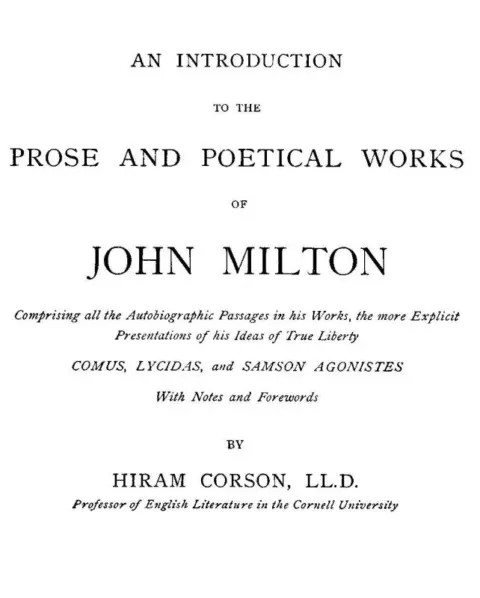
John Milton
John Milton
John Milton
BEHIND THE BOOK
This eBook is for the use of anyone anywhere in the United States and most other parts of the world at no cost and with almost no restrictions whatsoever. You may copy it, give it away or re-use it under the terms of the Project Gutenberg License included with this eBook or online at www.gutenberg.org. If you are not located in the United States, you will have to check the laws of the country where you are located before using this eBook. Read the source licence.
The original source file, including credits and licence, is retained by this library. Request an original-format copy at no charge. Please include the book title and Project Gutenberg identifier #58.
KEEP YOUR CURIOSITY GOING

David Patterson (Spirit) Hatch

David Patterson (Spirit) Hatch

David Patterson (Spirit) Hatch
Cécile Tormay

Moritz Busch
John L. Ransom