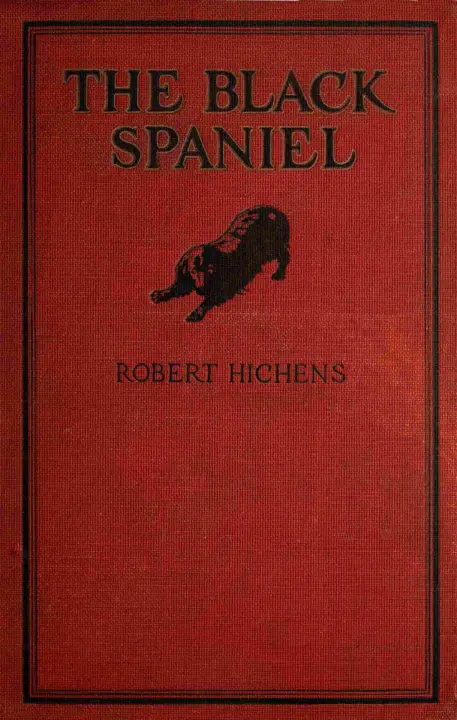
The black spaniel, and other stories
Robert Hichens
THE CLASSIC COLLECTION · 1905
"Desert Air" by Robert Hichens is a novel written in the early 20th century. The story explores the effects of climate and environment on human nature, particularly focusing on the psychological transformation that individuals experience in exotic and extreme settings. Set against the backdrop of the Sahara Desert, the narrative delves into human behavior under the influence of such an intense atmosphere. The plot follows the narrator and his acquaintance, Henry Marnier, as they embark on a journey to Beni-Kouidar, a remote town in the Sahara. The narrator observes Marnier, who is depicted as a serious and intellectual young man, undergo a significant change upon exposure to the exhilarating desert air. As they navigate their experiences in the town, including encounters with local culture and a strange dancer named Algia, Marnier becomes increasingly entranced by the atmosphere, leading to a tragic outcome when he is found murdered in a sandstorm. The story culminates in a chilling reflection on how the elements can reshape a person's desires and actions, ultimately resulting in unforeseen consequences.
Introduction adapted from the source catalogue; source summaries may be automatically generated.
Free to read · English · 4,641 words · No account needed
MAKE TIME FOR A GOOD BOOK
On by default. Untick to stop anonymous reading totals. Each page counts after 10 seconds in view. How this works.
Anonymous counting is on unless you have switched it off.
On an evening of last summer I was dining in London at the Carlton with two men. One of them was an excellent type of young England, strong, healthy, athletic, and straightforward. The other was a clever London doctor who was building up a great practice in the West End. At dessert the conversation turned upon a then recent tragedy in which a great reputation had gone down, and young England spoke rather contemptuously of the victim, with the superior surprise human beings generally express about the sin which does not happen to be theirs.
“I can’t understand it!” was his conclusion. “It’s beyond me.”
“Climate,” said the doctor quietly.
“What?”
“Climate. Air.”
Young England looked inexpressively astonished.
“But hang it all!” he exclaimed, “you don’t mean to say change of air means change of nature?”
“Not to everyone. Not to you, perhaps. Have you travelled much?”
“Well, I’ve been to Paris for the Grand Prix, and to Monte----”
“For the gambling. That’s hardly travelling. Now, I’ve studied this subject a little, quietly in Harley Street. I’m no traveller myself, but I have dozens of patients who are. And I’m convinced that the modern facilities for travel, besides giving an infinity of pleasure, bring about innumerable tragedies.”
He turned to me.
“You go abroad a great deal. What do you say?”
“That you’re perfectly right. And I’m prepared to affirm that, in highly-strung, imaginative, or over-worked people change of climate does sometimes actually cause, or seem to cause, change of nature.”
Young England, who was by no means highly-strung or imaginative, looked politely dubious, but the doctor was evidently pleased.
“An ally!” he cried.
He glanced at me for an instant, then added:
“You’ve got a case that proves it, at any rate to you, in your mind.”
“Quite true.”
“Can you give it us?”
“Jove! let’s have it!” exclaimed young England.
“Certainly, if you like,” I said. “I don’t know whether you ever heard of the Marnier affair?”
Young England shook his head, but the doctor replied at once.
“Three years ago, wasn’t it?”
“Four.”
“And it happened in some remote place in the Sahara Desert?”
“In Beni-Kouidar. I was with Henry Marnier in Beni-Kouidar at the time.”
“Go ahead!” said young England more eagerly.
“Poor Marnier was not an old friend of mine, but an acquaintance whom I had met casually at Beni-Mora, which is known as a health resort.”
“I send patients there sometimes,” said the doctor.
Your reading position is saved on this browser. Take it to another device with a library code. Reading pages adapt to text, rather than matching a printed edition.
BEHIND THE BOOK
This eBook is for the use of anyone anywhere in the United States and most other parts of the world at no cost and with almost no restrictions whatsoever. You may copy it, give it away or re-use it under the terms of the Project Gutenberg License included with this eBook or online at www.gutenberg.org. If you are not located in the United States, you will have to check the laws of the country where you are located before using this eBook. Read the source licence.
The original source file, including credits and licence, is retained by this library. Request an original-format copy at no charge. Please include the book title and Project Gutenberg identifier #23418.
KEEP YOUR CURIOSITY GOING
Coulson Kernahan

Maurice Baring
Frances Wright
Cécile Tormay

Frederic Jesup Stimson

W. H. P. (William Henry Pope) Jarvis