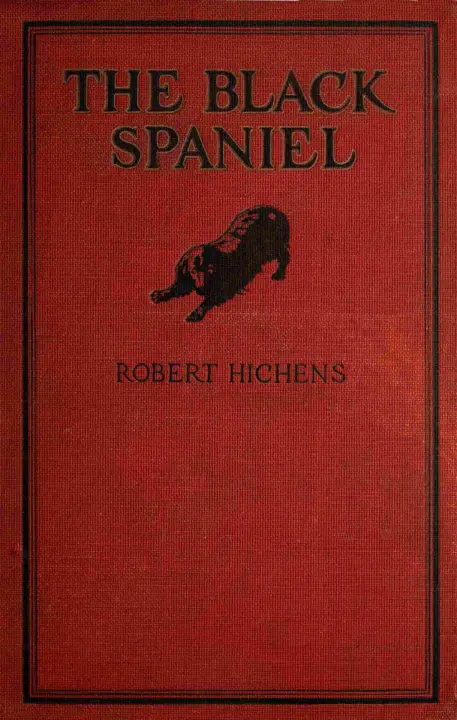
The black spaniel, and other stories
Robert Hichens
THE CLASSIC COLLECTION · 1905
"The Spinster" by Robert Hichens is a novel written in the early 20th century that delves into themes of love, betrayal, and the complexities of human relationships. The story revolves around Lord Inley, his wife Lady Vere, and the character Miss Bassett, a spinster who plays a pivotal role in the unfolding drama. The narrative captures the psychological intricacies of its characters while probing into the societal perceptions of spinsters during that era. The book begins with the protagonists at dinner, where the death of Miss Bassett is mentioned, triggering deep emotions in Inley. As the narrative unfolds, it reveals the tumultuous relationship between Inley and Vere, including infidelities and the tension arising from their intertwined lives. Inley grapples with his feelings about Vere's past affair with a mutual friend, Seymour Glynd, and the unintended role that Miss Bassett played in protecting both Vere and their child from a potential disaster. Amidst this drama, Miss Bassett is depicted as a misunderstood character, whose life and quiet strength ultimately spark tragic events, leading to her untimely death. The story captures the essence of human vulnerability and the often-painful choices made in the name of love.
Introduction adapted from the source catalogue; source summaries may be automatically generated.
Free to read · English · 4,423 words · No account needed
MAKE TIME FOR A GOOD BOOK
On by default. Untick to stop anonymous reading totals. Each page counts after 10 seconds in view. How this works.
Anonymous counting is on unless you have switched it off.
I had arrived at Inley Abbey that afternoon, and was sitting at dinner with Inley and his pretty wife, whom I had not seen for five years, since the day I was his best man, when we all heard faintly the tolling of a church bell. Lady Inley shook her shoulders in a rather exaggerated shudder.
“Someone dead!” said her husband.
“It’s a mistake to build a church in the grounds of a house,” Lady Inley said in her clear, drawling soprano voice. “That noise gives me the blues.”
“Whom can it be for?” asked Inley.
“Miss Bassett, probably,” Lady Inley replied carelessly, helping herself to a bonbon from a little silver dish.
Inley started.
“Miss Sarah Bassett! What makes you think so?”
“Oh, while you were away in town she got ill. Didn’t you know?”
“No,” said Inley.
I could see that he was moved. His dark, short face had changed suddenly, and he stopped eating his fruit. Lady Inley went on crunching the bonbon between her little white teeth with all the enjoyment of a pretty marmoset.
“Influenza,” she said airily. “And then pneumonia. Of course, at her age, you know---- By the way, what is her age, Nino?”
“No idea,” said Inley shortly.
He was listening to the dim and monotonous sound of the church bell.
Lady Inley turned to me with the childish, confidential movement which men considered one of her many charms.
“Miss Bassett is, or was, one of those funny old spinsters who always look the same and always ridiculous. Dry twigs, you know. One size all the way down. Very little hair, and no emotions. If it weren’t for the sake of cats, one would wonder why such people are born. But they’re always cat-lovers. I suppose that’s why they’re so often called old cats.”
She uttered a little high-pitched laugh, and got up.
“Don’t be too long,” she said to me carelessly as I opened the dining-room door for her. “I want to sing ‘Ohé Charmette’ to you.
“I won’t be long,” I answered, thinking what exquisite eyes she had.
She turned, and went out in her delicious, thin way. No wonder she had made skeletons the rage in London. When I came back to the dinner-table Inley was sitting with both his brown hands clenched on the cloth. His black eyes--inherited from his dead mother, who had been one of the Neapolitan aristocracy--were glittering.
“What is it, Nino?” I asked as I sat down.
We had been such intimate friends that even my five years’ absence abroad had not built up a barrier between us.
Your reading position is saved on this browser. Take it to another device with a library code. Reading pages adapt to text, rather than matching a printed edition.
BEHIND THE BOOK
This eBook is for the use of anyone anywhere in the United States and most other parts of the world at no cost and with almost no restrictions whatsoever. You may copy it, give it away or re-use it under the terms of the Project Gutenberg License included with this eBook or online at www.gutenberg.org. If you are not located in the United States, you will have to check the laws of the country where you are located before using this eBook. Read the source licence.
The original source file, including credits and licence, is retained by this library. Request an original-format copy at no charge. Please include the book title and Project Gutenberg identifier #23410.
KEEP YOUR CURIOSITY GOING
Coulson Kernahan

Maurice Baring
Frances Wright
Cécile Tormay

Frederic Jesup Stimson

W. H. P. (William Henry Pope) Jarvis