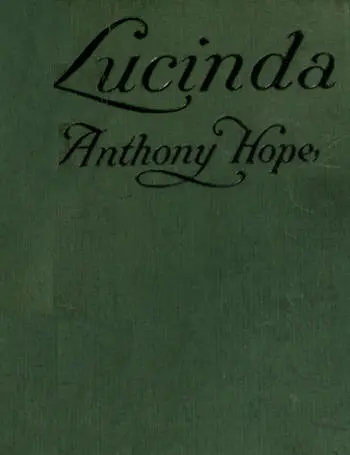
Lucinda
Anthony Hope
THE CLASSIC COLLECTION · 1893
"Half a Hero: A Novel" by Anthony Hope is a work of fiction written in the early 20th century. The novel is set in a political context, revolving around the character James Medland, a newly appointed premier navigating the personal and political turmoil of his position. The story explores themes of ambition, personal conflict, and the societal pressures surrounding its characters, particularly focusing on Medland's complex relationships and the challenges he faces in governance. The opening of the novel introduces an array of characters intertwined in the political landscape of New Lindsey. The story begins with a discussion about the potential appointment of Mr. Medland and the apprehensions surrounding his past and private life. Lady Eynesford, the governor's wife, expresses her disdain for Mr. Medland, setting the tone of social tension. As the narrative unfolds, Medland is portrayed entering Government House amid mixed sentiments, showing glimpses of his character through interactions with others, including his daughter Daisy and a growing political crowd. This initial setting establishes the conflict and character dynamics that will drive the plot forward, hinting at both Medland's ambitions and the challenges he anticipates in his new role.
Introduction adapted from the source catalogue; source summaries may be automatically generated.
Free to read · English · 64,059 words · No account needed
MAKE TIME FOR A GOOD BOOK
On by default. Untick to stop anonymous reading totals. Each page counts after 10 seconds in view. How this works.
Anonymous counting is on unless you have switched it off.
In the garden the question was settled without serious difference of opinion. If Sir Robert Perry really could not go on--and Lady Eynesford was by no means prepared to concede even that--then Mr. Puttock, bourgeois as he was, or Mr. Coxon, conceited and priggish though he might be, must come in. At any rate, the one indisputable fact was the impossibility of Mr. Medland: this was, to Lady Eynesford's mind, axiomatic, and, in the safe privacy of her family circle (for Miss Scaife counted as one of the family, and Captain Heseltine and Mr. Flemyng did not count at all), she went so far as to declare that, let the Governor do as he would (in the inconceivable case of his being so foolish as to do anything of the kind), she at least would not receive Mr. Medland. Having launched this hypothetical thunderbolt, she asked Alicia Derosne to give her another cup of tea. Alicia poured out the tea, handed it to her sister-in-law, and asked,
"But, Mary, what is there so dreadful about Mr. Medland?"
"Everything," said Lady Eynesford.
"Still," suggested Miss Scaife, "if the creatures are bent on having
him----"
"My dear Eleanor, what is a Governor for?" demanded Lady Eynesford.
"To do as he's told and subscribe to the Cup," interposed Dick Derosne. And he added, "They are having a palaver. Old Perry's been in an hour and a half."
Captain Heseltine and Mr. Flemyng looked at their watches and nodded
gravely.
"Poor Willie!" murmured Lady Eynesford. "He'll miss his ride."
Poor Willie--that is to say, His Excellency William Delaporte, Baron Eynesford, Governor of New Lindsey--deserved all the sympathy his wife's exclamation implied, and even more. For, after a vast amount of fencing and an elaborate disquisition on the state of parties in the colony, Sir Robert Perry decisively refused the dissolution the Governor offered, and ended by saying, with eyebrows raised and the slightest shrug of his shoulders,
"In fact, sir, it's my duty to advise you to send for Mr. Medland."
The Governor pushed his chair back from the table.
"You won't try again?" he asked.
"Impossible, until he has failed."
"You think Puttock out of the question?"
"Quite. He has not following enough: people wouldn't stand Medland being passed over. Really, I don't think you'll find Medland hard to get on with. He's a very able man. For myself, I like him."
The Governor sat silent for a few minutes. Sir Robert, conceiving that his interview was at an end, rose to take leave. Lord Eynesford expressed much regret at being obliged to lose his services: Sir Robert replied suitably, and was at the door before the Governor reverted to Mr. Medland.
Your reading position is saved on this browser. Take it to another device with a library code. Reading pages adapt to text, rather than matching a printed edition.
Anthony Hope
Anthony Hope
Anthony Hope
Anthony Hope
BEHIND THE BOOK
This eBook is for the use of anyone anywhere in the United States and most other parts of the world at no cost and with almost no restrictions whatsoever. You may copy it, give it away or re-use it under the terms of the Project Gutenberg License included with this eBook or online at www.gutenberg.org. If you are not located in the United States, you will have to check the laws of the country where you are located before using this eBook. Read the source licence.
The original source file, including credits and licence, is retained by this library. Request an original-format copy at no charge. Please include the book title and Project Gutenberg identifier #22191.
KEEP YOUR CURIOSITY GOING
Coulson Kernahan

Maurice Baring
Frances Wright
Cécile Tormay

Frederic Jesup Stimson

W. H. P. (William Henry Pope) Jarvis