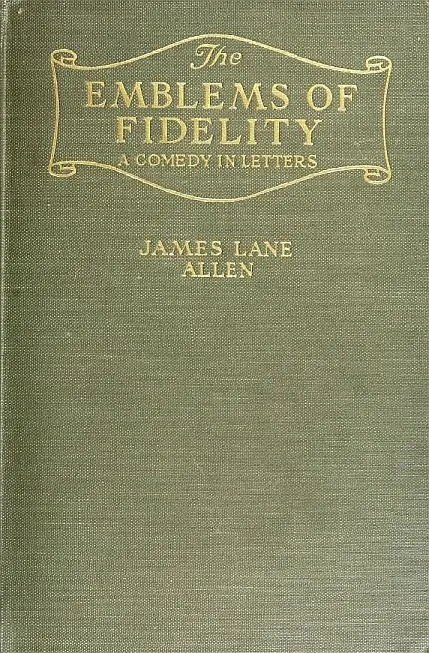
The Emblems of Fidelity: A Comedy in Letters
James Lane Allen
THE CLASSIC COLLECTION · 1895
"Aftermath" by James Lane Allen is a novel written during the late 19th century. The book serves as the continuation of the narrative from "A Kentucky Cardinal," following the complex relationships and emotions among the characters, primarily focusing on the engaged couple, Georgiana and Adam. The theme revolves around love, nature, and the struggles of personal identity within romantic entanglements, highlighting how personal desires often conflict with societal expectations. The opening of "Aftermath" introduces us to Adam, who is immersed in nurturing his garden, particularly his butterbeans, and partaking in lighthearted banter with his fiancée, Georgiana. The dialogue reveals their playful dynamic, along with contrasting elements of their personalities—Adam's earnestness toward nature and Georgiana's humorous scorn. As they engage in discussions about poetry and letters, we gain insight into their unique relationship, as well as the presence of Sylvia, another character intertwined in their lives. The atmosphere is filled with humor, tenderness, and underlying tensions, setting a vivid backdrop for their impending marriage, as Adam grapples with his deep connection to the natural world and the complexities of love, foreshadowing the challenges that await them in their shared life.
Introduction adapted from the source catalogue; source summaries may be automatically generated.
Free to read · English · 21,239 words · No account needed
MAKE TIME FOR A GOOD BOOK
On by default. Untick to stop anonymous reading totals. Each page counts after 10 seconds in view. How this works.
Anonymous counting is on unless you have switched it off.
I was happily at work this morning among my butterbeans--a vegetable of solid merit and of a far greater suitableness to my palate than such bovine watery growths as the squash and the beet. Georgiana came to her garden window and stood watching me.
"You work those butterbeans as though you loved them," she said,
scornfully.
"I do love them. I love all vines."
"Are you cultivating them as vines or as vegetables?"
"It makes no difference to nature."
"Do you expect me to be a vine when we are married?"
"I hope you'll not turn out a mere vegetable. How should you like to
be my Virginia-creeper?"
"And what would you be?"
"Well, what would you like? A sort of honeysuckle frame?"
"Oh, anything! Only support me and give me plenty of room to bloom."
I do not always reply to Georgiana, though I always could if I chose. Whenever I remain silent about anything she changes the subject.
"Did you know that Sylvia once wrote a poem on a vegetable?"
"I did not."
"You don't speak as though you cared."
"You must know how deeply interested I am."
"Then why don't you ask to see the poem?"
"Was it on butterbeans?"
"The idea! Sylvia has better taste."
"I suppose I'd better look into this poem."
"You are not to laugh at it!"
"I shall weep."
"No; you are not to weep. Promise."
"What am I to promise?"
"That you will read it unmoved."
"I do promise--solemnly, cheerfully."
"Then come and get it."
I went over and stood under the window. Georgiana soon returned and dropped down to me a piece of writing-paper.
"Sylvia wrote it before she began to think about the boys."
"It must be a very early poem."
"It is; and this is the only copy; please don't lose it."
"Then I think you ought to take it back at once. Let me beg of you not to risk it--" But she was gone; and I turned to my arbor and sat down to read Sylvia's poem, which I found to be inscribed to "The Potato," and to run as follows:
"What on this wide earth
That is made or does by nature grow
Is more homely yet more beautiful
Than the useful Potato?
"What would this world full of people do,
Rich and poor, high and low,
Were it not for this little-thought-of
But very necessary Potato?
"True, 'tis homely to look on,
Nothing pretty even in its blow,
But it will bear acquaintance,
This useful Potato.
"For when it is cooked and opened
It's so white and mellow,
You forget it ever was homely,
This useful Potato.
Your reading position is saved on this browser. Take it to another device with a library code. Reading pages adapt to text, rather than matching a printed edition.
James Lane Allen
James Lane Allen
James Lane Allen
James Lane Allen
BEHIND THE BOOK
This eBook is for the use of anyone anywhere in the United States and most other parts of the world at no cost and with almost no restrictions whatsoever. You may copy it, give it away or re-use it under the terms of the Project Gutenberg License included with this eBook or online at www.gutenberg.org. If you are not located in the United States, you will have to check the laws of the country where you are located before using this eBook. Read the source licence.
The original source file, including credits and licence, is retained by this library. Request an original-format copy at no charge. Please include the book title and Project Gutenberg identifier #13554.
KEEP YOUR CURIOSITY GOING
Coulson Kernahan

Maurice Baring
Frances Wright
Cécile Tormay

Frederic Jesup Stimson

W. H. P. (William Henry Pope) Jarvis