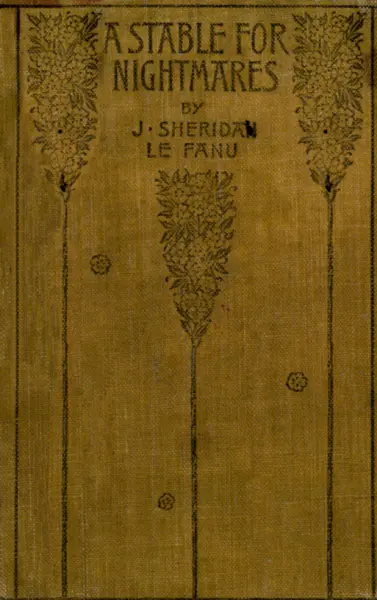
A Stable for Nightmares; or, Weird Tales
Joseph Sheridan Le Fanu & Charles L. (Charles Lawrence), Sir Young
THE CLASSIC COLLECTION · 1836
"Two Ghostly Mysteries" by Joseph Sheridan Le Fanu is a collection of two supernatural stories written during the mid-19th century. The first tale, "A Chapter in the History of a Tyrone Family", revolves around a tragic narrative centered on family and loss, featuring the protagonist's emotional turmoil following the death of her sister. The second story, "The Murdered Cousin", focuses on themes of suspicion and intrigue within a family, likely revealing dark secrets connected to a gruesome murder. At the start of the collection, the story "A Chapter in the History" introduces the narrator, Fanny Richardson, who recounts her childhood in a wealthy yet emotionally cold family. Following her sister's marriage and subsequent death, Fanny grapples with feelings of neglect from her parents and the overwhelming loneliness that ensues. As the story unfolds, the tension builds around the mystery of her sister's death and the haunting events that accompany it. The opening sections set the stage for a tale steeped in themes of loss, familial duty, and the eerie presence of the supernatural, leading readers to anticipate a rich exploration of the impact of such dark occurrences on the human psyche.
Introduction adapted from the source catalogue; source summaries may be automatically generated.
Free to read · English · 27,919 words · No account needed
MAKE TIME FOR A GOOD BOOK
On by default. Untick to stop anonymous reading totals. Each page counts after 10 seconds in view. How this works.
Anonymous counting is on unless you have switched it off.
INTRODUCTION. In the following narrative, I have endeavoured to give as nearly as possible the "ipsissima verba" of the valued friend from whom I received it, conscious that any aberration from her mode of telling the tale of her own life, would at once impair its accuracy and its effect. Would that, with her words, I could also bring before you her animated gesture, her expressive countenance, the solemn and thrilling air and accent with which she related the dark passages in her strange story; and, above all, that I could communicate the impressive consciousness that the narrator had seen with her own eyes, and personally acted in the scenes which she described; these accompaniments, taken with the additional circumstance, that she who told the tale was one far too deeply and sadly impressed with religious principle, to misrepresent or fabricate what she repeated as fact, gave to the tale a depth of interest which the events recorded could hardly, themselves, have produced. I became acquainted with the lady from whose lips I heard this narrative, nearly twenty years since, and the story struck my fancy so much, that I committed it to paper while it was still fresh in my mind, and should its perusal afford you entertainment for a listless half hour, my labour shall not have been bestowed in vain. I find that I have taken the story down as she told it, in the first person, and, perhaps, this is as it should be. She began as follows.
My maiden name was Richardson,[A] the designation of a family of some distinction in the county of Tyrone. I was the younger of two daughters, and we were the only children. There was a difference in our ages of nearly six years, so that I did not, in my childhood, enjoy that close companionship which sisterhood, in other circumstances, necessarily involves; and while I was still a child, my sister was married. The person upon whom she bestowed her hand, was a Mr. Carew, a gentleman of property and consideration in the north of England. I remember well the eventful day of the wedding; the thronging carriages, the noisy menials, the loud laughter, the merry faces, and the gay dresses. Such sights were then new to me, and harmonized ill with the sorrowful feelings with which I regarded the event which was to separate me, as it turned out, for ever, from a sister whose tenderness alone had hitherto more than supplied all that I wanted in my mother's affection. The day soon arrived which was to remove the happy couple from Ashtown-house. The carriage stood at the hall-door, and my poor sister kissed me again, and again, telling me that I should see her soon. The carriage drove away, and I gazed after it until my eyes filled with tears, and, returning slowly to my chamber, I wept more bitterly, and so, to speak more desolately, than ever I had done before. My father had never seemed to love, or to take an interest in me. He had desired a son, and I think he never thoroughly forgave me my unfortunate sex. My having come into the world at all as his child, he regarded as a kind of fraudulent intrusion, and, as his antipathy to me had its origin in an imperfection of mine, too radical for removal, I never even hoped to stand high in his good graces. My mother was, I dare say, as fond of me as she was of any one; but she was a woman of a masculine and a worldly cast of mind. She had no tenderness or sympathy for the weaknesses, or even for the affections of woman's nature, and her demeanour towards me was peremptory, and often even harsh. It is not to be supposed, then, that I found in the society of my parents much to supply the loss of my sister. About a year after her marriage, we received letters from Mr. Carew, containing accounts of my sister's health, which, though not actually alarming, were calculated to make us seriously uneasy. The symptoms most dwelt upon, were loss of appetite and cough. The letters concluded by intimating that he would avail himself of my father and mother's repeated invitation to spend some time at Ashtown, particularly as the physician who had been consulted as to my sister's health had strongly advised a removal to her native air. There were added repeated assurances that nothing serious was apprehended, as it was supposed that a deranged state of the liver was the only source of the symptoms which seemed to intimate consumption. In accordance with this announcement, my sister and Mr. Carew arrived in Dublin, where one of my father's carriages awaited them, in readiness to start upon whatever day or hour they might choose for their departure. It was arranged that Mr. Carew was, as soon as the day upon which they were to leave Dublin was definitely fixed, to write to my father, who intended that the two last stages should be performed by his own horses, upon whose speed and safety far more reliance might be placed than upon those of the ordinary post-horses, which were, at that time, almost without exception, of the very worst order. The journey, one of about ninety miles, was to be divided; the larger portion to be reserved for the second day. On Sunday, a letter reached us, stating that the party would leave Dublin on Monday, and, in due course, reach Ashtown upon Tuesday evening. Tuesday came: the evening closed in, and yet no carriage appeared; darkness came on, and still no sign of our expected visitors. Hour after hour passed away, and it was now past twelve; the night was remarkably calm, scarce a breath stirring, so that any sound, such as that produced by the rapid movement of a vehicle, would have been audible at a considerable distance. For some such sound I was feverishly listening. It was, however, my father's rule to close the house at nightfall, and the window-shutters being fastened, I was unable to reconnoitre the avenue as I would have wished. It was nearly one o'clock, and we began almost to despair of seeing them upon that night, when I thought I distinguished the sound of wheels, but so remote and faint as to make me at first very uncertain. The noise approached; it become louder and clearer; it stopped for a moment. I now heard the shrill screaking of the rusty iron, as the avenue gate revolved on its hinges; again came the sound of wheels in rapid motion.
Your reading position is saved on this browser. Take it to another device with a library code. Reading pages adapt to text, rather than matching a printed edition.
Joseph Sheridan Le Fanu & Charles L. (Charles Lawrence), Sir Young
Joseph Sheridan Le Fanu
Joseph Sheridan Le Fanu
Joseph Sheridan Le Fanu
BEHIND THE BOOK
This eBook is for the use of anyone anywhere in the United States and most other parts of the world at no cost and with almost no restrictions whatsoever. You may copy it, give it away or re-use it under the terms of the Project Gutenberg License included with this eBook or online at www.gutenberg.org. If you are not located in the United States, you will have to check the laws of the country where you are located before using this eBook. Read the source licence.
The original source file, including credits and licence, is retained by this library. Request an original-format copy at no charge. Please include the book title and Project Gutenberg identifier #12828.
KEEP YOUR CURIOSITY GOING
Coulson Kernahan

Maurice Baring
Frances Wright
Cécile Tormay
Francis Greenleaf Allinson & Anne C. E. (Anne Crosby Emery) Allinson

Frederic Jesup Stimson