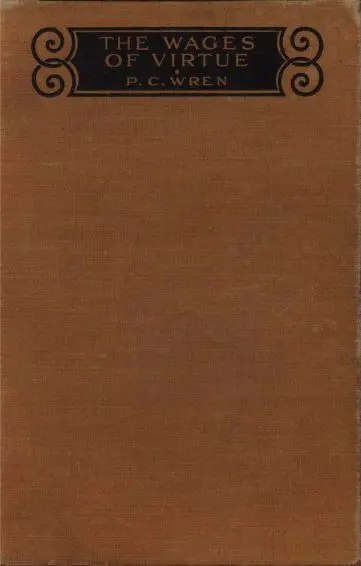
The Wages of Virtue
Percival Christopher Wren
THE CLASSIC COLLECTION · 1914
"Snake and Sword: A Novel" by Percival Christopher Wren is a work of fiction likely written in the early 20th century. The narrative revolves around the intertwined fates of Colonel Matthew Devon de Warrenne, his wife Lenore, and their son Damocles, set against the backdrop of British colonial India. The themes of bravery, love, and the emotional weight of family heredity permeate the story, exploring how trauma and valor shape the lives of the characters. The opening of the novel introduces Colonel de Warrenne, who, in a moment of grief and impulsivity, pins his awarded Victoria Cross to the night-dress of his dying wife, Lenore. The narrative then shifts to a tense and gripping moment where Lenore finds herself in peril, literally standing on a snake, as she summons the courage to protect her unborn child. This event foreshadows the significant impact of fear and bravery on both Lenore's life and the life of her son, Damocles, who is born amidst tragedy. The complex relationships and emotional struggles set the stage for the analysis of fate, loss, and legacy, which will unfold as the story progresses.
Introduction adapted from the source catalogue; source summaries may be automatically generated.
Free to read · English · 78,312 words · No account needed
MAKE TIME FOR A GOOD BOOK
On by default. Untick to stop anonymous reading totals. Each page counts after 10 seconds in view. How this works.
Anonymous counting is on unless you have switched it off.
When Colonel Matthew Devon de Warrenne, V.C., D.S.O., of the Queen’s Own (118th) Bombay Lancers, pinned his Victoria Cross to the bosom of his dying wife’s night-dress, in token of his recognition that she was the braver of the twain, he was not himself.
He was beside himself with grief.
Afterwards he adjured the sole witness of this impulsive and emotional act, Major John Decies, never to mention his “damned theatrical folly” to any living soul, and to excuse him on the score of an ancient sword-cut on the head and two bad sun-strokes.
For the one thing in heaven above, on the earth beneath, or in the waters under the earth, that Colonel de Warrenne feared, was breach of good form and stereotyped convention.
And the one thing he loved was the dying woman.
This last statement applies also to Major John Decies, of the Indian Medical Service, Civil Surgeon of Bimariabad, and may even be expanded, for the one thing he ever had loved was the dying woman….
Colonel Matthew Devon de Warrenne did the deed that won him his Victoria Cross, in the open, in the hot sunlight and in hot blood, sword in hand and with hot blood on the sword-hand—fighting for his life.
His wife did the deed that moved him to transfer the Cross to her, in darkness, in cold blood, in loneliness, sickness and silence—fighting for the life of her unborn child against an unseen foe.
Colonel de Warrenne’s type of brave deed has been performed thousands of times and wherever brave men have fought.
His wife’s deed of endurance, presence of mind, self-control and cool courage is rarer, if not unique.
To appreciate this fully, it must be known that she had a horror of snakes, so terrible as to amount to an obsession, a mental deformity, due, doubtless, to the fact that her father (Colonel Mortimer Seymour Stukeley) died of snake-bite before her mother’s eyes, a few hours before she herself was born.
Bearing this in mind, judge of the conduct that led Colonel de Warrenne, distraught, to award her his Cross “For Valour”.
One oppressive June evening, Lenore de Warrenne returned from church (where she had, as usual, prayed fervently that her soon-expected first-born might be a daughter), and entered her dressing-room. Here her Ayah divested her of hat, dress, and boots, and helped her into the more easeful tea-gown and satin slippers.
“Bootlair wanting ishweets for dinner-table from go-down,[1] please, Mem-Sahib,” observed Ayah, the change of garb accomplished.
[1] Store-room.
Your reading position is saved on this browser. Take it to another device with a library code. Reading pages adapt to text, rather than matching a printed edition.
Percival Christopher Wren
Percival Christopher Wren
Percival Christopher Wren
BEHIND THE BOOK
This eBook is for the use of anyone anywhere in the United States and most other parts of the world at no cost and with almost no restrictions whatsoever. You may copy it, give it away or re-use it under the terms of the Project Gutenberg License included with this eBook or online at www.gutenberg.org. If you are not located in the United States, you will have to check the laws of the country where you are located before using this eBook. Read the source licence.
The original source file, including credits and licence, is retained by this library. Request an original-format copy at no charge. Please include the book title and Project Gutenberg identifier #10667.
KEEP YOUR CURIOSITY GOING
Coulson Kernahan

Maurice Baring
Frances Wright
Cécile Tormay

Frederic Jesup Stimson

W. H. P. (William Henry Pope) Jarvis