THE CLASSIC COLLECTION✦A Christmas greetingCLASSIC FREE BOOKS
A Christmas greeting
Marie Corelli
THE CLASSIC COLLECTION · 1900
"The Master-Christian" by Marie Corelli is a novel written during the late 19th century. The book explores themes of faith, the moral state of the church, and the struggles of its central character, Cardinal Felix Bonpre, a devout and introspective priest grappling with the complexities of modern belief and the apparent decline of faith in society. The opening of the book introduces us to Rouen, a picturesque city filled with an atmosphere of devotion as the Angelus bells ring. We are immediately introduced to Cardinal Bonpre, whose deep contemplations are intertwined with the musicality of the cathedral around him. As he walks through the church, reflecting on the fleeting nature of life, he expresses his concern over the apparent lack of faith in contemporary times, which he attributes to a failure within the Church. The mood becomes heavier when he is confronted with the question of Christ's return and the future of faith on Earth. Cardinal Bonpre's humility and inner turmoil set the stage for his journey as he seeks to address the spiritual needs of the people amidst the overwhelming challenges posed by modernity and skepticism.
Introduction adapted from the source catalogue; source summaries may be automatically generated.
Free to read · English · 224,622 words · No account needed
MAKE TIME FOR A GOOD BOOK
On by default. Untick to stop anonymous reading totals. Each page counts after 10 seconds in view. How this works.
Anonymous counting is on unless you have switched it off.
All the bells were ringing the Angelus. The sun was sinking;--and from the many quaint and beautiful grey towers which crown the ancient city of Rouen, the sacred chime pealed forth melodiously, floating with sweet and variable tone far up into the warm autumnal air. Market women returning to their cottage homes after a long day's chaffering disposal of their fruit, vegetable, and flower-wares in the town, paused in their slow trudge along the dusty road and crossed themselves devoutly,--a bargeman, lazily gliding down the river on his flat unwieldly craft, took his pipe from his mouth, lifted his cap mechanically, and muttered more from habit than reflection--"Sainte Marie, Mere de Dieu, priez pour nous!"--and some children running out of school, came to a sudden standstill, listening and glancing at each other, as though silently questioning whether they should say the old church-formula among themselves or no? Whether, for example, it might not be more foolish than wise to repeat it? Yes;--even though there was a rumour that the Cardinal-Archbishop of a certain small, half-forgotten, but once historically-famed Cathedral town of France had come to visit Rouen that day,--a Cardinal-Archbishop reputed to be so pure of heart and simple in nature, that the people of his far-off and limited diocese regarded him almost as a saint,--would it be right or reasonable for them, as the secularly educated children of modern Progress, to murmur an "Angelus Domini," while the bells rang? It was a doubtful point;--for the school they attended was a Government one, and prayers were neither taught nor encouraged there, France having for a time put God out of her national institutions. Nevertheless, the glory of that banished Creator shone in the deepening glow of the splendid heavens,--and--from the silver windings of the Seine which, turning crimson in the light, looped and garlanded the time-honoured old city as with festal knots of rosy ribbon, up to the trembling tops of the tall poplar trees fringing the river banks,--the warm radiance palpitated with a thousand ethereal hues of soft and changeful colour, transfusing all visible things into the misty semblance of some divine dwelling of dreams. Ding-dong--ding dong! The last echo of the last bell died away upon the air--the last words enunciated by devout priests in their cloistered seclusion were said--"In hora mortis nostrae! Amen!"--the market women went on their slow way homeward,--the children scampered off in different directions, easily forgetful of the Old-World petition they had thought of, yet left unuttered,--the bargeman and his barge slipped quietly away together down the windings of the river out of sight;--the silence following the clangour of the chimes was deep and impressive--and the great Sun had all the heaven to himself as he went down. Through the beautiful rose-window of the Cathedral of Notre Dame, he flashed his parting rays, weaving bright patterns of ruby, gold and amethyst on the worn pavement of the ancient pile which enshrines the tomb of Richard the Lion-Hearted, as also that of Henry the Second, husband to Catherine de Medicis and lover of the brilliant Diane de Poitiers,--and one broad beam fell purpling aslant into the curved and fretted choir-chapel especially dedicated to the Virgin, there lighting up with a warm glow the famous alabaster tomb known as "Le Mourant" or "The Dying One." A strange and awesome piece of sculpture truly, is this same "Mourant"!--showing, as it does with deft and almost appalling exactitude, the last convulsion of a strong man's body gripped in the death-agony. No delicate delineator of shams and conventions was the artist of olden days whose ruthless chisel shaped these stretched sinews, starting veins, and swollen eyelids half-closed over the tired eyes!--he must have been a sculptor of truth,--truth downright and relentless,--truth divested of all graceful coverings, and nude as the "Dying One" thus realistically portrayed. Ugly truth too,--unpleasant to the sight of the worldly and pleasure-loving tribe who do not care to be reminded of the common fact that they all, and we all, must die. Yet the late sunshine flowed very softly on and over the ghastly white, semi-transparent form, outlining it with as much tender glory as the gracious figure of Mary Virgin herself, bending with outstretched hands from a grey niche, fine as a cobweb of old lace on which a few dim jewels are sewn. Very beautiful, calm and restful at this hour was "Our Lady's Chapel," with its high, dark intertwisting arches, mutilated statues, and ancient tattered battle-banners hanging from the black roof and swaying gently with every little breath of wind. The air, perfumed with incense-odours, seemed weighted with the memory of prayers and devotional silences,--and in the midst of it all, surrounded by the defaced and crumbling emblems of life and death, and the equally decaying symbols of immortality, with the splendours of the sinking sun shedding roseate haloes about him, walked one for whom eternal truths outweighed all temporal seemings,--Cardinal Felix Bonpre, known favourably, and sometimes alluded to jestingly at the Vatican, as "Our good Saint Felix." Tall and severely thin, with fine worn features of ascetic and spiritual delicacy, he had the indefinably removed air of a scholar and thinker, whose life was not, and never could be in accordance with the latter-day customs of the world; the mild blue eyes, clear and steadfast, most eloquently suggested "the peace of God that passeth all understanding";--and the sensitive intellectual lines of the mouth and chin, which indicated strength and determined will, at the same time declared that both strength and will were constantly employed in the doing of good and the avoidance of evil. No dark furrows of hesitation, cowardice, cunning, meanness or weakness marred the expressive dignity and openness of the Cardinal's countenance,--the very poise of his straight spare figure and the manner in which he moved, silently asserted that inward grace of spirit without which there is no true grace of body,--and as he paused in his slow pacing to and fro to gaze half-wistfully, half-mournfully upon the almost ghastly artistic achievement of "Le Mourant" he sighed, and his lips moved as if in prayer. For the brief, pitiful history of human life is told in that antique and richly-wrought alabaster,--its beginning, its ambition, and its end. At the summit of the shrine, an exquisite bas-relief shows first of all the infant clinging to its mother's breast,--a stage lower down is seen the boy in the eager flush of youth, speeding an arrow to its mark from the bent bow,--then, on a still larger, bolder scale of design is depicted the proud man in the zenith of his career, a noble knight riding forth to battle and to victory, armed cap-a-pie, his war-steed richly caparisoned, his lance in rest,--and finally, on the sarcophagus itself is stretched his nude and helpless form, with hands clenched in the last gasping struggle for breath, and every muscle strained and fighting against the pangs of dissolution.
Your reading position is saved on this browser. Take it to another device with a library code. Reading pages adapt to text, rather than matching a printed edition.
Marie Corelli
Marie Corelli
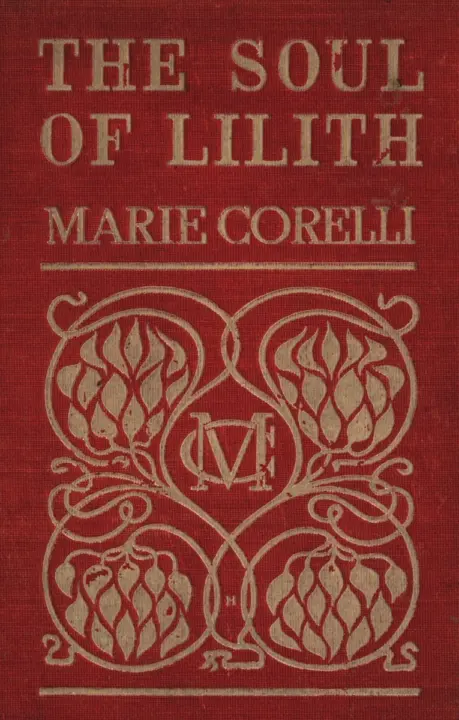
Marie Corelli

Marie Corelli
BEHIND THE BOOK
This eBook is for the use of anyone anywhere in the United States and most other parts of the world at no cost and with almost no restrictions whatsoever. You may copy it, give it away or re-use it under the terms of the Project Gutenberg License included with this eBook or online at www.gutenberg.org. If you are not located in the United States, you will have to check the laws of the country where you are located before using this eBook. Read the source licence.
The original source file, including credits and licence, is retained by this library. Request an original-format copy at no charge. Please include the book title and Project Gutenberg identifier #4285.
KEEP YOUR CURIOSITY GOING
Coulson Kernahan

Maurice Baring
Frances Wright
Cécile Tormay

Frederic Jesup Stimson

W. H. P. (William Henry Pope) Jarvis