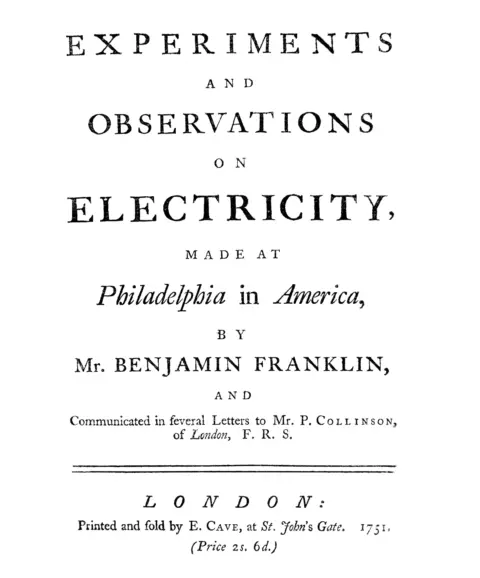
Experiments and Observations on Electricity Made at Philadelphia in America
Benjamin Franklin
THE CLASSIC COLLECTION · 1921
The whistle by Benjamin Franklin is a brief moral essay, originally an extract from a personal letter, written in the late 18th century. It reflects on prudence and value, using a childhood anecdote to teach the danger of overpaying—whether in money, time, freedom, or character—for things that are not truly worth their cost.
The narrator recalls spending all his small change on a toy whistle as a child, only to be teased for paying far too much. The sting of that lesson becomes a lifelong maxim: “Don’t give too much for the whistle.” He then applies it to adult life, noting people who sacrifice integrity and peace for court favor, neglect their affairs for popularity, hoard wealth at the cost of comfort and friendship, chase sensual pleasures that ruin health and improvement, indulge in showy living that ends in debt and prison, and even enter marriages that bring misery. He concludes that much human unhappiness comes from misjudging the real value of things and paying dearly for hollow satisfactions.
Introduction adapted from the source catalogue; source summaries may be automatically generated.
Free to read · English · 652 words · No account needed
MAKE TIME FOR A GOOD BOOK
On by default. Untick to stop anonymous reading totals. Each page counts after 10 seconds in view. How this works.
Anonymous counting is on unless you have switched it off.
Transcriber’s Note
Italic text displayed as: italic
Copyright, 1921,
Brad Stephens & Co., Boston
By
BENJAMIN FRANKLIN
Extract from a Letter Written by
Franklin to Madame Brillon
November, 1779
Published by
BRAD STEPHENS & COMPANY
142 BERKELEY STREET,
BOSTON
When I was a child of seven years old, my friends, on a holiday, filled my pocket with coppers. I went directly to a shop where they sold toys for children; and, being charmed with the sound of a whistle, that I met by the way in the hands of another boy, I voluntarily offered and gave all my money for one. I then came home, and went whistling all over the house, much pleased with my whistle, but disturbing all the family. My brothers, and sisters, and cousins, understanding the bargain I had made, told me I had given four times as much for it as it was worth; put me in mind what good things I might have bought with the rest of the money; and laughed at me so much for my folly, that I cried with vexation, and the reflection gave me more chagrin than the whistle gave me pleasure.
This, however, was afterwards of use to me, the impression continuing on my mind; so that often, when I was tempted to buy some unnecessary thing, I said to myself, Don’t give too much for the whistle; and I saved my money.
As I grew up, came into the world, and observed the actions of men,
I thought I met with many, very many, who gave too much for the
whistle.
When I saw one too ambitious of court favor, sacrificing his time in attendance on levees, his repose, his liberty, his virtue, and perhaps his friends, to attain it, I have said to myself, This man gives too much for his whistle.
When I saw another fond of popularity, constantly employing himself in political bustles, neglecting his own affairs, and ruining them by that neglect, He pays, indeed, said I, too much for his whistle.
If I knew a miser, who gave up every kind of comfortable living, all the pleasure of doing good to others, all the esteem of his fellow-citizens, and the joys of benevolent friendship, for the sake of accumulating wealth, Poor man, said I, you pay too much for your whistle.
When I met with a man of pleasure, sacrificing every laudable improvement of the mind, or of his fortune, to mere corporeal sensations, and ruining his health in their pursuit, Mistaken man, said I, you are providing pain for yourself, instead of pleasure; you give too much for your whistle.
Your reading position is saved on this browser. Take it to another device with a library code. Reading pages adapt to text, rather than matching a printed edition.
BEHIND THE BOOK
This eBook is for the use of anyone anywhere in the United States and most other parts of the world at no cost and with almost no restrictions whatsoever. You may copy it, give it away or re-use it under the terms of the Project Gutenberg License included with this eBook or online at www.gutenberg.org. If you are not located in the United States, you will have to check the laws of the country where you are located before using this eBook. Read the source licence.
The original source file, including credits and licence, is retained by this library. Request an original-format copy at no charge. Please include the book title and Project Gutenberg identifier #78663.
KEEP YOUR CURIOSITY GOING
Abby Morton Diaz
Helen Hunt Jackson
Mary Frances Blaisdell
Stuart Dodgson Collingwood
Kate Douglas Smith Wiggin
Hesba Stretton