Anne Page
Netta Syrett
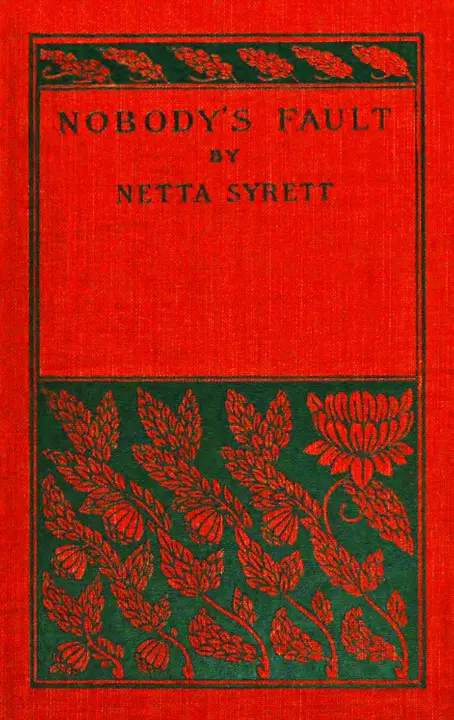
THE CLASSIC COLLECTION · 1896
"Nobody's Fault" by Netta Syrett is a novel written in the late 19th century. The story revolves around Bridget Ruan, a young woman grappling with her identity as she straddles two worlds: her upbringing as the daughter of a publican and the refined education she received at a private school. The narrative delves into themes of class distinction, personal aspiration, and the struggles of familial relationships. At the start of the novel, we are introduced to Bridget's world through the contrasting settings of a cozy drawing-room and the damp London streets outside. The dialogue reveals her background and her recent literary endeavors, which have garnered attention from her friends and acquaintances. As the opening unfolds, Bridget's character is fleshed out through her interactions with friends from school and her reflections on her social status, showcasing her longing for a more meaningful life that transcends her current circumstances. She grapples with feelings of jealousy, pride, and a deep desire for growth in her pursuit of writing. The narrative hints at her internal conflict between her origins and her ambitions as she navigates the complexities of belonging and self-identity.
Introduction adapted from the source catalogue; source summaries may be automatically generated.
Free to read · English · 50,450 words · No account needed
MAKE TIME FOR A GOOD BOOK
On by default. Untick to stop anonymous reading totals. Each page counts after 10 seconds in view. How this works.
Anonymous counting is on unless you have switched it off.
And the rest, a few,
Escape their prison and depart
On the wide ocean of life anew.
There the freed prisoner, where’er his heart
Listeth, will sail;
Nor doth he know how there prevail,
Despotic on that sea,
Trade winds which cross it from eternity.
Out in the London Square a dismal November fog mingled with the gathering twilight, and blotted out the trees and the opposite houses.
Mrs. Trelawney’s drawing-room, where the fire burnt clear, and the softly shaded lamps shed a subdued light, was very pleasant by contrast. Mrs. Trelawney herself sat on one side of the fire in a low seat, beside which a small table was drawn up, covered with multi-colored silks for the embroidery she held.
“Are you very busy just now?” she asked presently of a man who sat
leaning back in an arm-chair opposite her on the other side of the
table.
“Busy? Stevens is never busy,” her husband assured her. He rose lazily from the sofa as he spoke, and sat down on the arm of his wife’s chair. “He sits in his den before a good fire, with a novel in one hand, and the editorial cigar in the other; and that’s what he calls hard work!”
Stevens groaned. “May you never do anything harder! You don’t mention the kind of novel over which I’m usually to be found gnashing my teeth!”
“Poor man! as bored and savage as all that?” Mrs. Trelawney asked, smiling. “But you get a good one sometimes, of course.”
“Once in three months, perhaps. Oh! there are mitigations of misery, I allow. Last night, for instance, I reviewed a book that interested me. It was good; very good,” he added, meditatively.
“A new writer?”
“Yes, or new to me, at least. It was a woman’s book,--not the usual woman’s novel with a capital W, though, Heaven be praised! The writer’s name is Bridget Ruan. I don’t know whether--”
Mrs. Trelawney dropped her needlework with an exclamation. She turned swiftly to her husband, her eyes shining.
“How splendid!” she said softly, a thrill of excitement and triumph in
her voice.
“You know her?” Stevens inquired curiously.
“She is my great friend.” Mrs. Trelawney lifted her head proudly as she
spoke.
“Why, you know Bridget Ruan, Mr. Stevens!” she exclaimed, a moment later. “She used to stop with me years ago, after we both left school, you know. You were very much interested in her--”
“Not the clever little girl, whose father--”
Your reading position is saved on this browser. Take it to another device with a library code. Reading pages adapt to text, rather than matching a printed edition.
BEHIND THE BOOK
This eBook is for the use of anyone anywhere in the United States and most other parts of the world at no cost and with almost no restrictions whatsoever. You may copy it, give it away or re-use it under the terms of the Project Gutenberg License included with this eBook or online at www.gutenberg.org. If you are not located in the United States, you will have to check the laws of the country where you are located before using this eBook. Read the source licence.
The original source file, including credits and licence, is retained by this library. Request an original-format copy at no charge. Please include the book title and Project Gutenberg identifier #71360.
KEEP YOUR CURIOSITY GOING
Coulson Kernahan

Maurice Baring
Frances Wright
Cécile Tormay

Frederic Jesup Stimson

W. H. P. (William Henry Pope) Jarvis