The Maker of Rainbows, and Other Fairy-tales and Fables
Richard Le Gallienne
THE CLASSIC COLLECTION · 1907
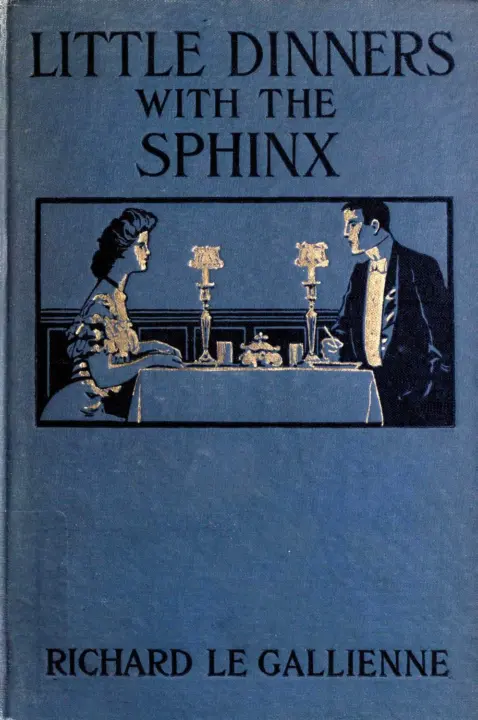
"Little Dinners With the Sphinx, and Other Prose Fancies" by Richard Le Gallienne is a collection of prose reflections written in the early 20th century. The text features a series of philosophical and whimsical conversations between the narrator and a character known as the Sphinx, exploring themes of love, beauty, and the nature of existence against the backdrop of elegant dinner settings. The opening portion introduces a reunion between the narrator and the Sphinx after a considerable time apart. They engage in light-hearted yet profound discussions about their changes over the years, intertwining humor and sentimentality as they reminisce and reflect on sorrows and pleasures. The conversation flows into the realms of philosophy, touching on the mystical connections between gastronomy and human emotions. The narrative style evokes a sense of intimacy and wit, inviting readers into a world where intellectual banter and understated emotion coexist at the dinner table, setting the tone for a deeper exploration of human experience through the metaphor of dining.
Introduction adapted from the source catalogue; source summaries may be automatically generated.
Free to read · English · 39,721 words · No account needed
MAKE TIME FOR A GOOD BOOK
On by default. Untick to stop anonymous reading totals. Each page counts after 10 seconds in view. How this works.
Anonymous counting is on unless you have switched it off.
The Sphinx and I had not met for quite a long time. We hadn’t dined together for--O I should think--four years; and it was strange to both of us to be sitting opposite to each other once more in the friendly glitter of a little dinner table--that glitter which is made up of skillfully mitigated electric light falling on various delicate objects of pleasure: the slim, fluted crystal of the wineglasses, the lustral linen, the tinkling ice in its silver jug, the moon-white roses, and the opals on the Sphinx’s long fingers.
We were both a trifle conscious, and we looked at each other half
inquiringly across the table.
“Are we the same people?” presently asked the Sphinx.
“Of course, you are, my dear Sphinx; but I hope, for your sake, that I
am not.”
“For my sake?”
“I mean that it is a poor compliment to a woman one adores always to bring the same man to dinner.”
“I see--you have haven’t changed a bit.... Yes, you have,” she added, after a pause. “Why, you’re growing grey. How have you managed that at your age?”
“‘Sorrows like mine would blanch an angel’s hair,’” I answered, with pathos, quoting from a noble sonnet of our own time.
“Sorrows! If you said pleasures, you would be nearer the mark. It is pleasure, not sorrow, that makes the butterfly’s wings turn grey.”
“One’s sorrows are one’s pleasures--are they not?” I retorted.
“Yes!” said the Sphinx, wistfully, “you are right. ‘Of our tears she hath made us pearls, and of our sobbing she hath made unto us a song’--who said that? Was it you?”
“Very likely,” said I.
“Yes! you are right,” she continued. “Our pleasures we could spare--but not our sorrows--our beautiful sorrows.”
“Sorrows,” I ventured, “are the opals of the soul.”
Then the Sphinx stretched her opalled hand across the table and patted mine and said, “You dear,” just as in the old days.
The tears came to my eyes.
“Mark your influence!” I said. “That is the first good thing I have said for four years.”
“What appalling faithfulness!” laughed the Sphinx. “But I would rather a man were faithful to me with his brain than with his heart. It means more. Faithful hearts are comparatively common--but when a man is faithful with his brain....”
“His hair turns grey,” I got in.
“Yes! Now tell me about your grey hair. I am sure you have some beautiful explanation to offer, some picturesque excuse, some vindicatory fancy.”
“Suppose I were to say that I grew it grey to please a girl who thought she would like it so?”
Your reading position is saved on this browser. Take it to another device with a library code. Reading pages adapt to text, rather than matching a printed edition.
Richard Le Gallienne
Richard Le Gallienne
Richard Le Gallienne
Richard Le Gallienne
BEHIND THE BOOK
This eBook is for the use of anyone anywhere in the United States and most other parts of the world at no cost and with almost no restrictions whatsoever. You may copy it, give it away or re-use it under the terms of the Project Gutenberg License included with this eBook or online at www.gutenberg.org. If you are not located in the United States, you will have to check the laws of the country where you are located before using this eBook. Read the source licence.
The original source file, including credits and licence, is retained by this library. Request an original-format copy at no charge. Please include the book title and Project Gutenberg identifier #64854.
KEEP YOUR CURIOSITY GOING

David Patterson (Spirit) Hatch

David Patterson (Spirit) Hatch

David Patterson (Spirit) Hatch
Coulson Kernahan

Ralph Waldo Emerson

Maurice Baring