
The Writing of News A Handbook with Chapters on Newspaper Correspondence and Copy Reading
Charles G. (Charles Griffith) Ross
THE CLASSIC COLLECTION · 1912
"How to Plan a Library Building for Library Work" by Charles C. Soule is a practical guidebook on library architecture written in the early 20th century. This work provides detailed insights into the essential features, considerations, and methodologies involved in designing and constructing a library. It emphasizes the importance of functionality over aesthetics, underlining that a library should serve its community effectively while being adaptable to future changes. The opening of the guide presents an advocacy for thoughtful library design, stressing the necessity of cooperation among librarians, architects, and building committees to create a library that is not only beautiful but also functional and efficient. It articulates principles about the utility of library spaces, the historical evolution of library building types, and the significance of considering future growth and needs in the planning process. The prelude sets a reflective tone, indicated by the author's ardent belief in libraries as "workshops for the future" rather than relics of the past, aiming to ensure that libraries are built with purpose and practicality at their core.
Introduction adapted from the source catalogue; source summaries may be automatically generated.
Free to read · English · 96,355 words · No account needed
MAKE TIME FOR A GOOD BOOK
On by default. Untick to stop anonymous reading totals. Each page counts after 10 seconds in view. How this works.
Anonymous counting is on unless you have switched it off.
A library is a prominent public building As practical and technical as a schoolhouse; A workshop for the future, not a relic of the past. Seldom rich enough for its needs, it abhors waste. Change and growth will soon supplant it. Build it for use, not show; for now, not for ever:— Tastefully, tactfully, thriftily, thoroughly.
To plan it, find an able librarian,
To construct it, get a skillful architect,
To control both, choose a wise committee.
These three, by patient study and debate,
Can satisfy taste without sacrificing use—
Achieving complete and felicitous success.
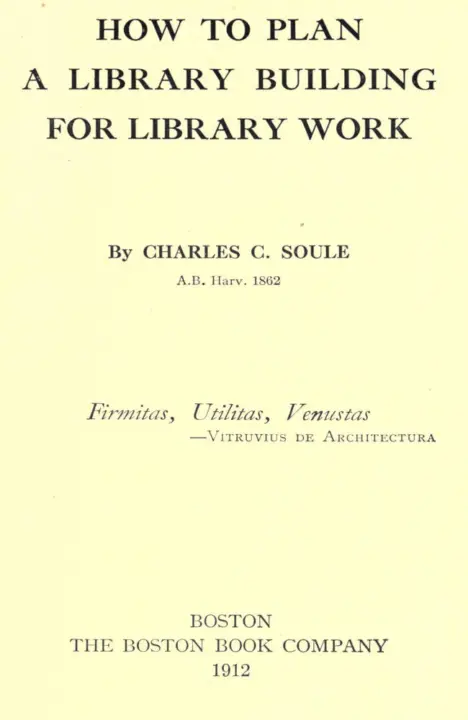
HOW TO PLAN
A LIBRARY BUILDING
FOR LIBRARY WORK
By CHARLES C. SOULE
A.B. Harv. 1862
Firmitas, Utilitas, Venustas
—VITRUVIUS DE ARCHITECTURA
The Riverdale Press, Brookline, Boston, Mass.
To
The Architect
who is the Librarian’s best friend
when they plan together
a sound, useful and beautiful building
this volume is inscribed
Of the author of this volume it was said by President Hill at the 1906 A. L. A. Conference, “he has given the subject of Library Architecture more thought and attention, probably, than any other member.”
Mr. Soule is well known to older librarians. To introduce him to a younger generation and to architects, we would say that although he is a publisher and bookseller, and not professionally a librarian, he has had an effective training in library science. He joined the American Library Association in 1879, became at once a working member, has attended twenty Conferences, and has been elected to office, as follows:
1888-1899—Trustee of the Brookline (Mass.) Public Library.
1890-1908—Publishing Board, A. L. A.
1890—Vice-president.
1893-1896, 1900-1905—Member of the Council.
1894-1906—Trustee Endowment Fund.
1906-1912—Member of the Institute.
In 1890, when a prominent trustee had been quoted as saying, “it was no use consulting librarians about building, for no two of them agree on any one point,” he wrote, and the 1890 Conference unanimously adopted, “Points of Agreement among Librarians on Library Architecture.”
In 1892 he published in the Boston press an exhaustive series of nine letters, taking the side of the librarians of the country against what they thought to be radical errors in the management and building of the Boston Public Library.
In 1901 he wrote the article “Library,” for Sturgis’s Dictionary of
Architecture.
In 1902 he wrote the A. L. A. tract on “Library Rooms and Buildings.”
For forty active years in business as a bookseller, he has handled and
issued books.
For over thirty years of membership in the A. L. A. he has been intimate with leading librarians.
Your reading position is saved on this browser. Take it to another device with a library code. Reading pages adapt to text, rather than matching a printed edition.
BEHIND THE BOOK
This eBook is for the use of anyone anywhere in the United States and most other parts of the world at no cost and with almost no restrictions whatsoever. You may copy it, give it away or re-use it under the terms of the Project Gutenberg License included with this eBook or online at www.gutenberg.org. If you are not located in the United States, you will have to check the laws of the country where you are located before using this eBook. Read the source licence.
The original source file, including credits and licence, is retained by this library. Request an original-format copy at no charge. Please include the book title and Project Gutenberg identifier #64560.
KEEP YOUR CURIOSITY GOING
Charles G. (Charles Griffith) Ross
Hannah Webster Foster

Emily Lawless
Edwin Hamlin Carr

Charles De Lano Hine
Andrew Ure