
The Writing of News A Handbook with Chapters on Newspaper Correspondence and Copy Reading
Charles G. (Charles Griffith) Ross
THE CLASSIC COLLECTION · 1705
"Medicina Gymnastica" by Francis Fuller is a scientific treatise written in the early 18th century. The book focuses on the importance of exercise in maintaining health and treating various ailments, emphasizing the interconnection between physical activity and the body's overall functioning. Fuller challenges the prevailing belief that medicine revolves primarily around internal remedies, advocating for a more holistic approach that includes physical exercise. At the start of the treatise, Fuller provides an insightful preface discussing the misconceptions surrounding physical health and medicine. He argues against the limited view of pharmacy as solely reliant on internal medications, instead highlighting the body's need for diverse methods to achieve wellness. He introduces the concept of exercise as an essential aspect of health, able to stimulate healing processes and enhance the efficacy of medicines. Fuller's observations draw on historical practices and personal experiences, setting the stage for a more comprehensive exploration of how exercise can play a pivotal role in treating specific diseases, particularly those affecting the lungs, and encouraging a shift in medical philosophy toward a balance between internal and external methods of healing.
Introduction adapted from the source catalogue; source summaries may be automatically generated.
Free to read · English · 42,831 words · No account needed
MAKE TIME FOR A GOOD BOOK
On by default. Untick to stop anonymous reading totals. Each page counts after 10 seconds in view. How this works.
Anonymous counting is on unless you have switched it off.
We whose Names are here Subscrib’d, having perus’d this Discourse, Entitled, Medicina Gymnastica, &c. Judge it well Worthy to be Communicated to the Publick.
Datum in Comitiis Censoriis ex ædibus nostri Collegii, ~Febr, 2.
1704/5~.
Edwardus Brown, Præses.
Walt. Charlton, }
W. Vaughan, }
Walt. Harris, }
Jo. Hawys, } Censores.
Joh. Bateman, Regist.
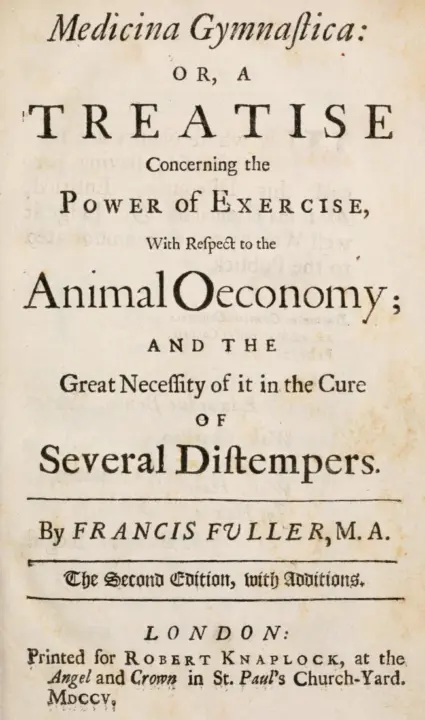
Medicina Gymnastica:
Concerning the
POWER of EXERCISE,
With Respect to the
Animal Oeconomy;
Great Necessity of it in the Cure
Several Distempers.
By FRANCIS FULLER, M. A.
The Second Edition, with Additions.
Printed for ROBERT KNAPLOCK, at the
Angel and Crown in St. Paul’s Church-Yard.
MDCCV.
The Generality of Men, have for a long time had too Narrow Thoughts of Physick, as if it were in a manner Confin’d to little more than Internals, without allowing themselves the Liberty of common Reasoning, by which they easily might have found that the Humane Body is liable to, and requires several Administrations of a very Different Nature, and that it is very unreasonable to suppose, that since there are so many ways for Diseases to enter upon us, there should be so few for Health to return by. Internals do indeed make up the far greatest part of the Means of Cure, but yet there are Considerable Cases, where the very Nature of the thing requires other Methods; and this would appear very obvious, if it were not for our too Partial Consideration of the Body of Man, by attributing too much to the Fluids, and too little to the Solids, both which, tho’ they have a Mutual Dependance upon one another, yet have each of ’em some Proprieties, and if out of Order, require something particular in the Application to restore ’em again. Consent in the Solids, answers to Mixture in the Fluids; and as an ill Ferment, as soon as it comes into the Blood, diffuses and mixes it self with the whole Mass, and cannot often be extirpated, till the Medicine given for that end, has been taken so long as to be diffus’d and intimately mix’d with the Blood likewise; so a Violent Seizure in one of the Solid Parts, commonly draws all the rest into Consent, and a particular Application to the Place primarily affected shall do no good, when a Universal one shall Cure; and a thing which would be trivial and Vain, if us’d as a Topick, shall by a Universal Administration prove of the greatest Importance. We see Contraries often prove Remedies to one another in the Juices, and Poisons become Beneficial, when oppos’d to certain Humours, why should we not then allow of the same Rule, in the Containing Parts of the Body? If by a Supine Course of Life, the Nervous parts are weakned and relax’d, why should we not suppose the contrary way of Living, the most likely to repair ’em? Since the Vigour of those parts is acquir’d by Use; they are the Active part of the Man, and not always liable to the Impressions of the Fluids, for tho’ you invigorate the Blood ever so much by the most generous Medicines, the Nerves may remain Effete and Languid notwithstanding; but if the Nervous parts are extended and exercis’d, the Blood and the Humours must necessarily partake of the Benefit, and soon discover it by the Increase of their Heat and Motion. There is so much of a Relative Nature in every thing, that can concern the Health or Distemperature of the Individual, that there is scarce any thing so prejudicial, or seemingly Absurd, but may in different Circumstances prove as Advantageous. The World has lately had full Evidence of the good Effects of an Intense Cold, equally apply’d to all the Parts of the Body at once, which Method of Curing would, not many Years agoe, have been thought very Extravagant, and certainly Destructive. On the contrary, there are other Cases, where a Warm Bath is only prevalent; and though some People have suppos’d it to be only a kind of a last Resort, when other things have been try’d in Vain, yet it is quite otherwise, it being impossible to remove some Diseases of the Limbs, without an universal equal Relaxation. Again, quite different from this is the equal Distribution of a greater Degree of Heat throughout the whole Body, which is procur’d by Habitual Exercise; in the former Method, the Parts are relax’d, in this they are strengthned, and in every Respect the Effects are widely different, tho’ in both ways there is a considerable Encrease of Heat. But to carry this enquiry farther, there are some Distempers, and those not altogether so rare neither, in the Cure of which no Positive Physick of any sort whatsoever, can be serviceable, nothing but a gradual Substraction of the Cause, an Alterative abstinence, if I may so speak, being necessary; as there have been some Gouts in some temperate Persons, of a strong and rank Constitution, which nothing could remove but a very low Diet, and an entire Abstinence from Flesh; to them Flesh being as Wine is to others, who Contract that Distemper by their Excess: and the same Observation holds good likewise in the ~Opthalmia~, and some other Cases of the Eyes, as any that will duly weigh the Circumstances of some Persons often subject to ’em, will find Reason to believe, so that some Men are by their Constitutions condemn’d to an Antidiluvian Diet of Roots and Vegetables, or else to suffer worse Inconveniences; and when those happen, it is absurd to expect, by the most Celebrated Remedy to cure the Disease, when the Cause continues. These are Instances of several Methods, widely differing from one another, and yet of absolute Necessity in their particular Cases, which shews us, that we ought not to be so eager after Courses of Pharmacy in all Cases, without distinguishing where other ways are most rational. It is one thing to dispose Nature to collect her own Strength, and throw off her Enemy; and it is another to assist her by the ~Corpuscula~, the Minute parts of a Medicine given inwardly; the first way has Regard to the whole Animal Oeconomy; the second reflects the Blood and Juices chiefly; the first may succeed, where the second cannot, because here the Laws of Motion, and the Rules of the Oeconomy are enforc’d, and brought to be assisting to a Recovery of Health, which in some few Cases can’t be effected by a private and simple Attempt upon the Blood only.
Your reading position is saved on this browser. Take it to another device with a library code. Reading pages adapt to text, rather than matching a printed edition.
BEHIND THE BOOK
This eBook is for the use of anyone anywhere in the United States and most other parts of the world at no cost and with almost no restrictions whatsoever. You may copy it, give it away or re-use it under the terms of the Project Gutenberg License included with this eBook or online at www.gutenberg.org. If you are not located in the United States, you will have to check the laws of the country where you are located before using this eBook. Read the source licence.
The original source file, including credits and licence, is retained by this library. Request an original-format copy at no charge. Please include the book title and Project Gutenberg identifier #63497.
KEEP YOUR CURIOSITY GOING
Charles G. (Charles Griffith) Ross
Hannah Webster Foster

Emily Lawless
Edwin Hamlin Carr

Charles De Lano Hine
Andrew Ure