THE CLASSIC COLLECTION✦An outlaw’s diary: the CommuneCLASSIC FREE BOOKS
An outlaw’s diary: the Commune
Cécile Tormay
THE CLASSIC COLLECTION · 1901
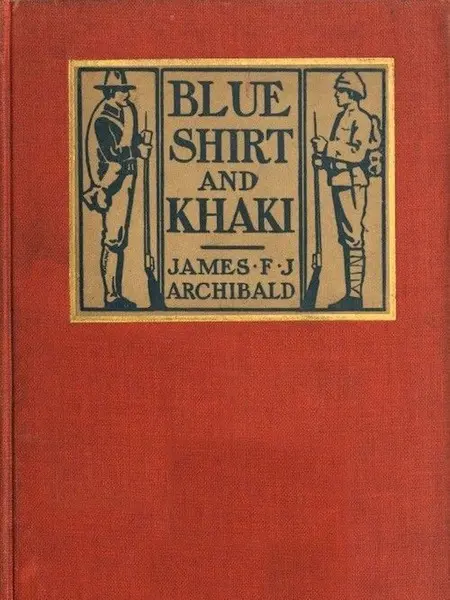
"Blue Shirt and Khaki: A Comparison" by James F. J. Archibald is a military analysis written in the early 20th century. The text provides a detailed examination of the British and American soldiers during the transition to modern warfare, reflecting on their equipment, training, and battlefield performance. Archibald draws comparisons between the two nations' military personnel, highlighting their similarities and differences, and explores the underlying sentiments of camaraderie, rivalry, and evolving perceptions of their respective strengths. The opening of the book sets the stage by immediately comparing the American and British soldiers in the wake of their military engagements during the late 19th century, notably in Cuba and the Boer War. Through vivid accounts of the battlefields and detailed observations of both armies’ approaches, Archibald introduces key figures such as Colonel Arthur Lee and Captain Slocum, emphasizing their respect for one another despite the competition between their nations. He reflects on the evolution of military traditions, equipment disparities, and the intrinsic qualities of the soldiers, suggesting that the American soldier's adaptability and the British soldier's historical prowess each have unique advantages that reflect their respective nations' military cultures. Archibald's firsthand experiences provide a rich context for his analyses, setting a compelling tone for the thorough examination that follows in subsequent chapters.
Introduction adapted from the source catalogue; source summaries may be automatically generated.
Free to read · English · 56,550 words · No account needed
MAKE TIME FOR A GOOD BOOK
On by default. Untick to stop anonymous reading totals. Each page counts after 10 seconds in view. How this works.
Anonymous counting is on unless you have switched it off.
By JAMES F. J. ARCHIBALD
Copyright, 1901, by
Silver, Burdett & Company
Press of I. J. Little & Co.
Astor Place, New York
To the Memory of My Father,
F. A. Archibald, D.D., LL.D.
Boer artillerists waiting under shell fire for the British advance 133
The battle of Pretoria, June 4, 1900; Boer guns in action; British advance along the first range of hills 137
The unpicturesqueness of modern war. In the range of this photograph of the battle of Diamond Hill the hardest fighting is going on. Twenty cannon and 3,000 rifles are firing, and two regiments are charging; but no more can be seen than is shown above 145
A difficult kopje; two hundred men are hiding behind the rocks 145
U. S. Officer providing for feeding the poor 147
Camp of a transport train in General French’s supply column 151
A base of supplies at de Aar Junction 155
An improvised commissariat cart in South Africa 162
A soldier with three months’ provisions 169
Major Burnham, the American Chief of Scouts for Lord Roberts 171
The old and the new military bridge at Modder River 174
Defense of a line of communication in the Transvaal 176
Canadian transport at a difficult drift 181
Cape carts with British officers’ personal luggage; nearly every officer had one of these carts 182
A British transport train on the veldt 183
Canadian transport at a difficult drift 187
The Guards and mounted infantry at Pretoria Station 191
Armament on an American transport 194
British soldiers leaving the Sumner after having exchanged uniforms with Americans 199
American transport Sumner in the harbor at Malta 205
A British transport taken from the merchant marine 205
The Eighth United States Infantry going ashore for drill at Malta 211
Colonel Jocelyn and Captain Croxton, Eighth U. S. Infantry, at Malta 211
Mr. R. H. Davis in Pretoria 217
Consul Hay and Vice-Consul Coolidge bidding good-by to Captain Slocum at Pretoria 222
A. D. T. Messenger James Smith in front of President Krüger’s house, immediately after presenting the message from the American children 226
The battle of Pretoria: Boers awaiting the British advance under artillery fire 229
The battle of Pretoria: British naval guns shelling forts 229
General De la Rey and staff at Pretoria; his nephew, twelve years old, is serving on the staff 232
Field cornets in Pretoria receiving orders from a general 233
Boer women bidding good-by to their men off for the front 235
Russian hospital corps with the Boers: the wounded man is Colonel Blake, formerly U. S. A. 235
Boers under heavy shell fire, awaiting British advance behind their defenses 243
Burghers’ horses during the battle of Pretoria 243
The Boer retreat from Pretoria 246
Your reading position is saved on this browser. Take it to another device with a library code. Reading pages adapt to text, rather than matching a printed edition.
BEHIND THE BOOK
This eBook is for the use of anyone anywhere in the United States and most other parts of the world at no cost and with almost no restrictions whatsoever. You may copy it, give it away or re-use it under the terms of the Project Gutenberg License included with this eBook or online at www.gutenberg.org. If you are not located in the United States, you will have to check the laws of the country where you are located before using this eBook. Read the source licence.
The original source file, including credits and licence, is retained by this library. Request an original-format copy at no charge. Please include the book title and Project Gutenberg identifier #55109.
KEEP YOUR CURIOSITY GOING
Cécile Tormay

Moritz Busch
John L. Ransom
Frances Wright
Cécile Tormay

Mabel Potter Daggett