THE CLASSIC COLLECTION✦Hurrell Froude: Memoranda and CommentsCLASSIC FREE BOOKS
Hurrell Froude: Memoranda and Comments
Louise Imogen Guiney
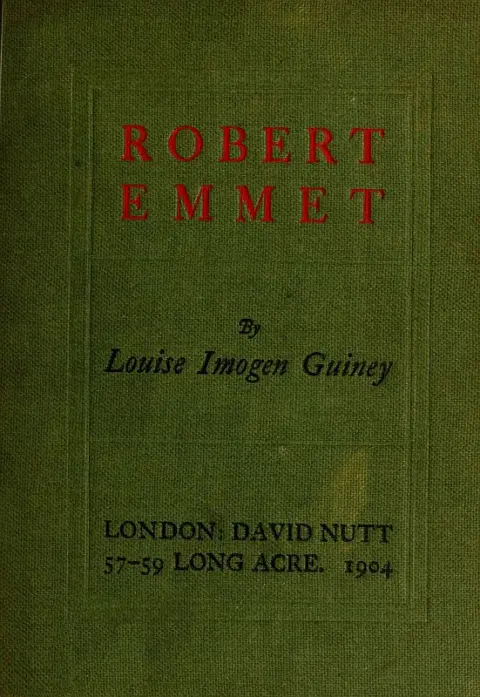
THE CLASSIC COLLECTION · 1904
"Robert Emmet: A Survey of His Rebellion and of His Romance" by Louise Imogen Guiney is a historical account written in the early 20th century. The book delves into the life and legacy of Robert Emmet, a prominent figure in Irish history known for his role in the rebellion against British rule and his romantic affiliation with Sarah Curran. Through a blend of historical detail and narrative, the author captures Emmet's passionate ideals and the tragic consequences of his actions within the broader context of Irish nationalism. The opening of the text introduces Robert Emmet's family background, outlining the lineage of both the Emmets and Masons, emphasizing their distinguished heritage and intellectual prowess. It paints a picture of a young and gifted man whose moral fervor and artistic talents are entwined with a deep sense of duty toward Ireland. The narrative establishes Emmet as a pivotal character shaped by the political turbulence of his time, leading to his eventual involvement in the rebellion of 1803. It also highlights his complex and enduring relationship with Sarah Curran, setting the stage for a tale not only of political ambition but also of deep personal sacrifice and tragic love.
Introduction adapted from the source catalogue; source summaries may be automatically generated.
Free to read · English · 21,683 words · No account needed
MAKE TIME FOR A GOOD BOOK
On by default. Untick to stop anonymous reading totals. Each page counts after 10 seconds in view. How this works.
Anonymous counting is on unless you have switched it off.
Printed by BALLANTYNE, HANSON & CO.
At the Ballantyne Press
To
in the Land of the Living to remind him of
old thoughts and of things once dear
THE following unscientific monograph, a sort of little historical descant, is founded upon all the accurate known literature of the subject, and also largely on the Hardwicke MSS. These, in so far as they relate to Emmet, the writer was first to consult and have copied, last winter, before they were catalogued. But while these sheets were in press, several interesting fragments from the MSS. appeared in the Cornhill Magazine for September, 1903, thus forestalling their present use. This discovery will condone the writer’s innocent claim, made on page 60, of printing the two letters there as unpublished matter.
The portrait is after Brocas’s hurried court-room sketch, made the day before the execution. The original print is in the Joly Collection of the National Library of Ireland. The head is too sharp and narrow, and yet it bears a marked resemblance, far exceeding that of either of the other portraits, to some of Robert Emmet’s collateral descendants. On such good à posteriori evidence it was chosen.
Oxford, Dec. 9, 1903.
THE four who lived to grow up of the seventeen children born to Robert Emmet, M.D., of Cork, later of Dublin, and Elizabeth Mason, his wife, were all, in their way, persons of genius. The Emmets were of Anglo-Norman stock, Protestants, settled for centuries in Ireland. The Masons, of like English origin, had merged it in repeated alliances with women of Kerry, where the Dane, the Norman, and later invaders from nearer quarters had never settled down to perturb the ancient Celtic social stream. Dr. Emmet was a man of clear brain and incorruptible honour. The mother of his children, to judge by her letters, many of which have been privately printed, must have been an exquisite being, high-minded, religious, loving, humorous, wise. Her eldest surviving son, Christopher Temple Emmet, was named for his two paternal grandparents, Christopher Emmet of Tipperary and Rebecca Temple, great-great-granddaughter of the first Baronet Temple of Stowe, in Buckinghamshire. The mention of that prolific, wide-branching, and extraordinary family of Temple as forebears of the younger Emmets is like a sharply accented note in a musical measure. It has never been played for what it is worth; no annalist has tracked certain Emmet qualities to this perfectly obvious ancestral source. The Temples had not only, in this case, the bygone responsibility to bear, for in a marked manner they kept on influencing their Emmet contemporaries, as in one continuous mood thought engenders thought. Says Mr. James Hannay: “The distinctive ηθος of the Temples has been a union of more than usual of the kind of talent which makes men of letters, with more than usual of the kind of talent which makes men of affairs.” The Emmets, too, shared the “distinctive ηθος” in the highest degree. Added to the restless two-winged intelligence, they had the heightened soberness, the moral elevation, which formed no separate inheritance. The Temples were, and are, a race of subtle but somewhat austere imagination, strongly inclined to republicanism, and to that individualism which is the norm of it. The Temple influence in eighteenth-century Ireland was, obliquely, the American influence: a new and heady draught at that time, a “draught of intellectual day.” If we seek for those unseen agencies which are so much more operative than mere descent, we cover a good deal of ground in remembering that Robert Emmet the patriot came of the same blood as Sidney’s friend, Cromwell’s chaplain, and Dorothy Osborne’s leal and philosophic husband. And he shared not only the Temple idiosyncrasy, but, unlike his remarkable brothers, the thin, dark, aquiline Temple face.
Your reading position is saved on this browser. Take it to another device with a library code. Reading pages adapt to text, rather than matching a printed edition.
Louise Imogen Guiney
Louise Imogen Guiney
Louise Imogen Guiney

Louise Imogen Guiney
BEHIND THE BOOK
This eBook is for the use of anyone anywhere in the United States and most other parts of the world at no cost and with almost no restrictions whatsoever. You may copy it, give it away or re-use it under the terms of the Project Gutenberg License included with this eBook or online at www.gutenberg.org. If you are not located in the United States, you will have to check the laws of the country where you are located before using this eBook. Read the source licence.
The original source file, including credits and licence, is retained by this library. Request an original-format copy at no charge. Please include the book title and Project Gutenberg identifier #51889.
KEEP YOUR CURIOSITY GOING
Cécile Tormay

Moritz Busch
John L. Ransom
Frances Wright
Cécile Tormay

Mabel Potter Daggett