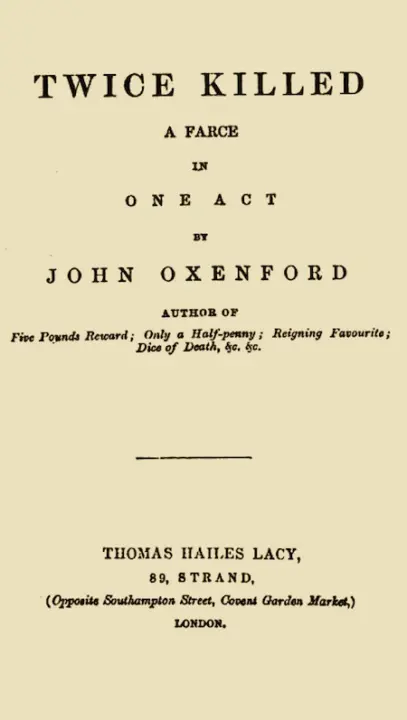
Twice Killed: A Farce in One Act
John Oxenford
THE CLASSIC COLLECTION · 1859
"Retained for the Defence: A Farce, in One Act" by John Oxenford is a comedic play written in the mid-19th century, likely during the Victorian era. This work is a farce, a genre characterized by exaggerated and improbable situations, and focuses on the comedic entanglements in a social setting. The narrative revolves around themes of mistaken identity and the absurdity of social distinctions, showcasing how appearances can be deceiving. The plot unfolds at an evening party hosted by Mr. De Windsor, who has just returned from watching a court case where a man named Pawkins was acquitted of theft, having been wrongfully accused. Eager to stand by the “innocent” Pawkins, De Windsor invites him to his party, leading to a series of humorous misunderstandings. The character of Whitewash, a barrister who defended Pawkins, finds himself tangled in a web of deception and comedy as De Windsor insists on marrying his daughter to him, believing he’s a noble defender of virtue. As the story unfolds, Pawkins inadvertently becomes the center of attention, while various characters' true intentions are hilariously revealed, ultimately culminating in a farcical resolution that highlights the ridiculousness of the societal situation.
Introduction adapted from the source catalogue; source summaries may be automatically generated.
Free to read · English · 6,875 words · No account needed
MAKE TIME FOR A GOOD BOOK
On by default. Untick to stop anonymous reading totals. Each page counts after 10 seconds in view. How this works.
Anonymous counting is on unless you have switched it off.
Twice Killed, A Day Well Spent, A Family Failing, Dice of Death, Only a Halfpenny, Reigning Favourite, Rape of the Lock, My Fellow Clerk, I and My Double, A Quiet Day, No Followers, What have I done? Porter's Knot, &c. &c.
THOMAS HAILES LACY,
89, STRAND,
(Opposite Southampton Street, Covent Garden Market),
LONDON.
First performed at the Royal Olympic Theatre,
on Monday, May 23rd, 1859.
Characters.
Guests, &c.
Time of Representation--45 MINUTES.
PERIOD--Present Day.
Costumes.
DE WINDSOR--Blue coat with metal buttons, white vest, black trousers.
WHITEWASH--Modern evening suit.
FERGUSON--Ditto.
THWAITES--Blue dress coat, white vest, black trousers, Berlin gloves.
PAWKINS--Long-tailed dress coat, colored vest, black trousers; hat and
umbrella.
AGATHA--Rich pink silk ball dress.
GUESTS--Evening dresses.
SCENE--A Drawing Room fitted up for an evening party--to the left a card table--doors, C. and L.
THWAITES, who has finished lighting candles in chandelier at back, C., steps back to survey the effect.
THWAITES. Now, that's what I call the real thing--the clean grit. The position of that bokey (bouquet) is such, that none but the purest taste could conceive,--those camellias, chastity itself. A fine combination! Cutting the turnips and carrots to make ornaments for the cold tongue; chusing the bokies at Covent Garden Market; mildly tempering the brilliant light of wax and gas with the soothing hue of flowers. I have brought all my arts to bear upon this sworry. The party who is a greengrocer in the morning, is the only perfect waiter in the evening.
Enter AGATHA, C.
AGATHA. (L.) So, Thwaites, the room appears quite ready?
THWAITES. (R.) Yes, Miss Agatha; without exaggeration I may venture to
say, we are lit up.
AGATHA. My father has not returned?
THWAITES. No, Miss Agatha, he has not--since he left the house at two in the afternoon--I haven't the slightest notion where he is gone.
AGATHA. Indeed! (laughing--sits, L. C.)
THWAITES. No--though I did my best to ascertain;--"Are you going far, sir?" says I. He stares, and he makes me no answer. "Shall you be long, sir?" says I. He stares again, and again he makes no answer. "Because sir," says I, "there's the party this evening!" "I know that, better than you do," says he, "for I shall have to pay for it!"--just like him, Miss Agatha--ha, ha, ha!
AGATHA. (aside--vexed) Really, 'pa must have a regular footman; these tradespeople whom he engages as occasional waiters don't understand subordination a bit.
Your reading position is saved on this browser. Take it to another device with a library code. Reading pages adapt to text, rather than matching a printed edition.
John Oxenford
BEHIND THE BOOK
This eBook is for the use of anyone anywhere in the United States and most other parts of the world at no cost and with almost no restrictions whatsoever. You may copy it, give it away or re-use it under the terms of the Project Gutenberg License included with this eBook or online at www.gutenberg.org. If you are not located in the United States, you will have to check the laws of the country where you are located before using this eBook. Read the source licence.
The original source file, including credits and licence, is retained by this library. Request an original-format copy at no charge. Please include the book title and Project Gutenberg identifier #49296.
KEEP YOUR CURIOSITY GOING
Maurice Baring
W. B. (William Butler) Yeats
Edward Martyn

John Brougham & Charlotte Brontë
Marguerite Merington
Leonid Andreyev