THE CLASSIC COLLECTION✦An outlaw’s diary: the CommuneCLASSIC FREE BOOKS
An outlaw’s diary: the Commune
Cécile Tormay
THE CLASSIC COLLECTION · 1909
"British and Foreign Arms & Armour" by Charles Henry Ashdown is a historical account written in the early 20th century. The work delves into the study of arms and armor from various historical periods, drawing connections between military artifacts and the socio-political contexts in which they were used. Readers can expect a comprehensive examination of weaponry styles, including details on the design, function, and evolution of arms across different cultures. The opening of the book lays the groundwork for Ashdown’s exploration by emphasizing the importance of understanding arms and armor as artifacts that reflect historical struggles, artistry, and development over time. He discusses the significance of heraldry and collectorship in the study of military equipment. The text notes the lack of accessible literature on the subject and aims to simplify complex concepts for beginners, providing a methodical approach to studying different periods of armor, beginning with prehistoric weaponry and the craftsmanship behind early tools and weapons from the Stone Age.
Introduction adapted from the source catalogue; source summaries may be automatically generated.
Free to read · English · 84,044 words · No account needed
MAKE TIME FOR A GOOD BOOK
On by default. Untick to stop anonymous reading totals. Each page counts after 10 seconds in view. How this works.
Anonymous counting is on unless you have switched it off.
Despite it being referred to, there is no illustration ‘Plate XLI’ in
this book.
BY
A. C. FOX-DAVIES
Of LINCOLN’S INN, BARRISTER-AT-LAW
ILLUSTRATED BY 9 PLATES IN COLOUR AND NEARLY 800 OTHER DESIGNS, MAINLY FROM DRAWINGS BY
In One Volume. Containing over 600 pages.
Large square 8vo, Cloth Gilt,
10s. 6d. net
HON. SEC. ST. ALBANS AND HERTS ARCHITECTURAL AND ARCHÆOLOGICAL SOCIETY; HON. CURATOR OF NUMISMATICS, HERTS COUNTY MUSEUM; AUTHOR OF “ST. ALBANS: HISTORICAL AND PICTURESQUE,” ETC.
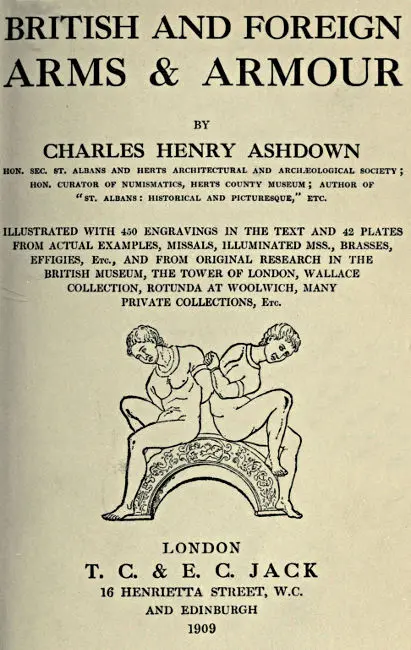
ILLUSTRATED WITH 450 ENGRAVINGS IN THE TEXT AND 42 PLATES FROM ACTUAL EXAMPLES, MISSALS, ILLUMINATED MSS., BRASSES, EFFIGIES, Etc., AND FROM ORIGINAL RESEARCH IN THE BRITISH MUSEUM, THE TOWER OF LONDON, WALLACE COLLECTION, ROTUNDA AT WOOLWICH, MANY PRIVATE COLLECTIONS, Etc.
LONDON
T. C. & E. C. JACK
16 HENRIETTA STREET, W.C.
AND EDINBURGH
1909
TO
THE PRESIDENT
THE VERY REV. THE DEAN OF ST. ALBANS, D.D.
THE MEMBERS
OF THE
ST. ALBANS AND HERTS ARCHITECTURAL AND
ARCHÆOLOGICAL SOCIETY,
The study of Arms and Armour is one of absorbing interest to a large and ever increasing number of the community, inasmuch as it appeals in a marked degree to the student of history, the antiquarian, and to those who work in the realms of art. To the first it appeals as a concrete reminder of the struggles of nations for liberty, independence, power, or conquest; to the second it breathes of the age in which it saw the light with all the feeling and tone which characterised it; to the third it is a source of delight by the consummate beauty of its form or the exquisite details of its adornment. Unfortunately there are few books extant which serve as a guide to the student, although there are many which deal with the subject. The great works of Meyrick, with Skelton his illustrator, are standard only in a sense that it is necessary to be thoroughly acquainted with the subject in order to guard against the many errors embodied in them. Grose is hopelessly antiquated, while Fosbroke, Stothard, Strutt, Shaw, Planché, Cotman, and others who flourished before or about the sixties, only deal pictorially or casually with the subject. The Rev. Charles Boutell by his translation of Lacombe did much to foster the study, but it was from a French point of view, and his epitome of English armour and arms, though excellent in its way, is only superficial, and a digest of his great works on Monumental Brasses. In the latter he probably did more to further the study than any preceding author; he was the first to rationally systematise the arrangement of armour in periods in consonance with the salient features it possessed, thus breaking through the previous methods of classifying it by reigns, which was obviously absurd, or by centuries, which was equally ridiculous. I have followed his method with but little variation in the pages of this book, inasmuch as no better arrangement is extant. It is a matter for great pride to myself that such standard works should have emanated from a former Hon. Secretary of the St. Albans and Herts Architectural and Archæological Society, and if the present volume should in any degree further the good work of my predecessor it will have achieved the height of my ambition. Hewitt is delightful reading, but his arrangement is unsystematic and involved; to the advanced student, however, he is invaluable. The later works of Demmin, Clephan, Gardner, &c., are masterly monographs upon the subject, but hopelessly out of place in the hands of a beginner.
Your reading position is saved on this browser. Take it to another device with a library code. Reading pages adapt to text, rather than matching a printed edition.
BEHIND THE BOOK
This eBook is for the use of anyone anywhere in the United States and most other parts of the world at no cost and with almost no restrictions whatsoever. You may copy it, give it away or re-use it under the terms of the Project Gutenberg License included with this eBook or online at www.gutenberg.org. If you are not located in the United States, you will have to check the laws of the country where you are located before using this eBook. Read the source licence.
The original source file, including credits and licence, is retained by this library. Request an original-format copy at no charge. Please include the book title and Project Gutenberg identifier #48573.
KEEP YOUR CURIOSITY GOING
Cécile Tormay

Moritz Busch
John L. Ransom
Frances Wright
Cécile Tormay

Mabel Potter Daggett