Transcriber's Note:
Inconsistent hyphenation and spelling in the original document have
been preserved.
Italic text is denoted by underscores.
Animal
Analogues.
Verses and Illustrations
By Robert Williams Wood.
Author of "How To Tell The Birds From the Flowers."
Published by Paul Elder and Company.
San Francisco and New York.
Copyright 1908
By
Paul Elder and Company.
Naught--Argonaut. 27.
Author's Add-end-'em. 28.
Good Mr. Darwin once contendeds
That Beetles were from Bees descended;
And as my pictures show, I think,
The Beet must be the missing-link.
The Sugar-Beet and Honey-Bee
Supply the Beetle's pedigree:
The family is now complete,--
The Bee, the Beetle and the Beet.
The Ant is known by his ant-ennae,
Where-as the pheas-ant hasn't any,
And that is why he wears, instead,
A small red cap upon his head:
Without his Fez, indeed the pheasant
Would be quite bald and quite un-Pleasant.
The superficial naturalists have often been misled, By failing to dis-crim-inate between the tail and head: It really is unfortunate such carelessness prevails, Because the Bunnies have their heads where Tunnies have their tails.
The marked aversion which we feel,
When in the presence of the Eel,
Makes many view with consternation,
The Elephant's front ele-vation.
Such folly must be clearly due
To their peculiar point of view.
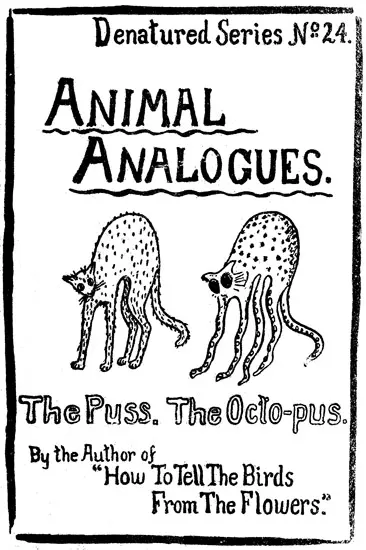
The Octo-pus or Cuttle-fish!
I'm sure that none of us would wish
To have him scuttle 'round the house,
Like puss, when she espies a mouse:
When you secure your house-hold pet,
Be very sure you do not get
The Octo-pus, or there may be
Dom-es-tic in-felis-ity.
The Gnu conspicuously wears
His coat of gnumerous bristling hairs,
While, as we see, the modest Newt
Of such a coat is destitute.
(I'm only telling this to you,
And it is strictly "entre gnu".)
In point of fact the Newt is nude,
And therefore he does not obtrude,
But hides in some secluded gnook,
Beneath the surface of the brook:
It's almost more than he can bear,
To slyly take his breath of air,
His need of which is absolute,
Because, you see, he is a Pneu-t.[A]
[A] This stands for air, like aero-static,
Greek--"pneumos"--air--comp-air "pneu-matic".
The Harrier, harassed by the Hare,
Presents a picture of despair;
Altho' as far as I'm concerned,
I love to see the tables turned.
The Harrier flies with all his might,
It is a harum-scare'm flight:
I'm not surprised he does not care
To meet the fierce pursuing Hare!
[Illustration; The Pipe-fish. The Sea-gar.]
To smoke a herring is to make
A most lamentable mistake,
Particularly since there are
The Pipe-fish and the long Sea-gar:
Bear this in mind when next you wish
To smoke your after-dinner fish.