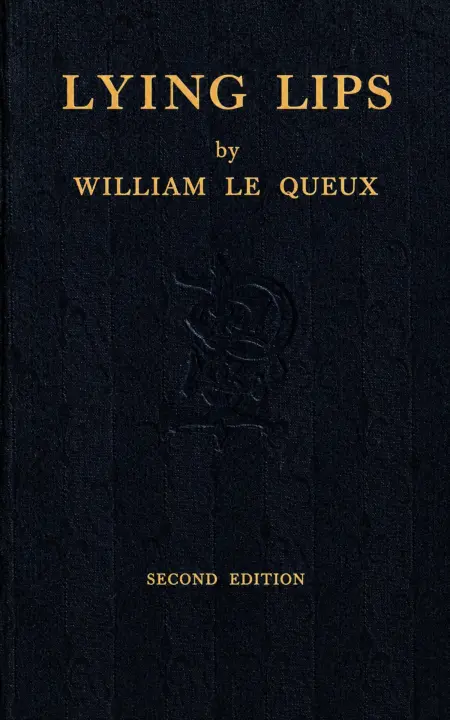
Lying lips
William Le Queux
THE CLASSIC COLLECTION · 1895
"The Temptress" by William Le Queux is a novel written in the early 20th century. The book unfolds a dramatic tale beginning in a bleak chapel on the penal island of New Caledonia, where a convict marries his bride amid grim circumstances. The story introduces the main characters, including a sorrowful husband serving a long sentence and his seemingly indifferent wife, who harbors deeper feelings of contempt for her new marital ties and a desire for freedom. At the start of the novel, readers witness a poignant but ironic wedding ceremony between a convict and his bride. The setting is stark and filled with despair, highlighting the harsh realities of life on the penal island. Immediately after the ceremony, the husband is taken back into the penal system, while his wife, initially masked in conventionality, reveals her true feelings of frustration and hatred towards the man she has just married. She expresses a desire for his demise to reclaim her freedom, emphasizing the internal conflict and tension between social duty and personal yearning that drives the narrative forward.
Introduction adapted from the source catalogue; source summaries may be automatically generated.
Free to read · English · 88,122 words · No account needed
MAKE TIME FOR A GOOD BOOK
On by default. Untick to stop anonymous reading totals. Each page counts after 10 seconds in view. How this works.
Anonymous counting is on unless you have switched it off.
Upon a tawdry altar, in a small bare chapel, two candles flickered unsteadily. The gloomy place was utterly devoid of embellishment, with damp-stained, white-washed walls, a stone floor, dirty and uneven, and broken windows patched with paper.
Over the man and woman kneeling at the steps the priest outstretched his hands, and pronounced the benediction.
When he had concluded a gabbled exhortation and premonishment, they rose. The weary-eyed man regained his feet quickly, gazing a trifle sadly at his companion, while the latter, with a scarcely perceptible sigh, got up slowly, and affectionately embraced her newly-wedded husband.
As the bride placed her arms about her husband's neck, he bent, and, lifting her black veil slightly, gave her a fond, passionate caress.
Turning from the altar, the priest grasped their hands, wishing them health and happiness. What bitter irony! what a canting pretence of humanity! As if either could be obtained in New Caledonia, the malarial island to which the French transport their criminals. The ill-timed sarcasm caused the statuesque warders to grin, but a tear stood in the eye of more than one of the bridegroom's comrades in adversity, even though they were desperate characters, hardened by crime.
"We thank you heartily for your kind wishes," he replied, "and trust that your blessing will render our lot less wearisome."
The convict's bride remained silent, gazing about her unconcernedly.
"Come," exclaimed the officer, rising abruptly, "we must not linger; already we have lost too much time."
After the register had been signed, the husband again kissed his wife. As she raised her lips to his, he whispered a few words, as if to reassure her, then said aloud--
"Farewell, dearest. In seven years I shall be free. Till then, au
revoir, sans adieu!"
"Sans adieu!" she echoed in a low voice, apparently unmoved.
He shrugged his shoulders, and turned towards his stern guards.
"I must apologise for detaining you, gentlemen," he said. "Let us go; I
am ready."
The bride, who was young, was dressed very plainly in black, yet with Parisian taste. Perhaps she was handsome, but the thick veil concealed her features. The husband's appearance, however, was decidedly unprepossessing. He was undergoing a term of ten years' hard labour and lifelong banishment.
Tall, bronzed, and bearded, with a thin face wrinkled by toil, although still retaining traces of good looks, he remained for a moment motionless, contemplating with loving eyes the woman who was now his wife. His attire was scarcely befitting a bridegroom, for he had no coat, and wore the soiled and ragged grey shirt and trousers of a miner, while the chains that bound his wrists seemed strangely out of place.
Your reading position is saved on this browser. Take it to another device with a library code. Reading pages adapt to text, rather than matching a printed edition.
William Le Queux
William Le Queux
William Le Queux
William Le Queux
BEHIND THE BOOK
This eBook is for the use of anyone anywhere in the United States and most other parts of the world at no cost and with almost no restrictions whatsoever. You may copy it, give it away or re-use it under the terms of the Project Gutenberg License included with this eBook or online at www.gutenberg.org. If you are not located in the United States, you will have to check the laws of the country where you are located before using this eBook. Read the source licence.
The original source file, including credits and licence, is retained by this library. Request an original-format copy at no charge. Please include the book title and Project Gutenberg identifier #40833.
KEEP YOUR CURIOSITY GOING
Coulson Kernahan

Maurice Baring
Frances Wright
Cécile Tormay

Frederic Jesup Stimson

W. H. P. (William Henry Pope) Jarvis